

TRMM: The Tropical Rainfall Measuring Mission
553
Instrument
Wavelengths
Resolution
Swath
Lightning Imaging
0.7774 pm
5km
537 km
Sensor (LIS)
Clouds and Earth's Radiant 0.3 - > 50, 0.3-5, 8-12 pm
10 km
3293 km +
Energy System (CERES)
360 0 azimuthal
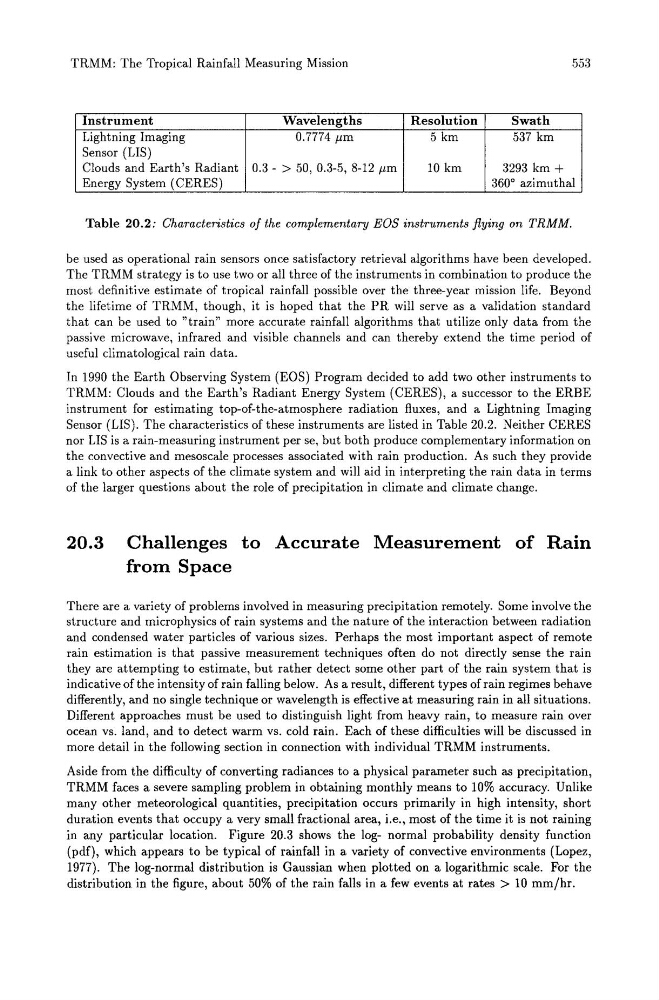
Table 20.2: Characteristics of the complementary EOS instruments flying on TRMM.
be used as operational rain sensors once satisfactory retrieval algorithms have been developed.
The TRMM strategy is to use two or all three of the instruments in combination to produce the
most definitive estimate of tropical rainfall possible over the three-year mission life. Beyond
the lifetime of TRMM, though, it is hoped that the PR will serve as a validation standard
that can be used to "train" more accurate rainfall algorithms that utilize only data from the
passive microwave, infrared and visible channels and can thereby extend the time period of
useful climatological rain data.
In 1990 the Earth Observing System (EOS) Program decided to add two other instruments to
TRMM: Clouds and the Earth's Radiant Energy System (CERES), a successor to the ERBE
instrument for estimating top-of-the-atmosphere radiation fluxes, and a Lightning Imaging
Sensor (LIS). The characteristics of these instruments are listed in Table 20.2. Neither CERES
nor LIS is a rain-measuring instrument per se, but both produce complementary information on
the convective and mesoscale processes associated with rain production. As such they provide
a link to other aspects of the climate system and will aid in interpreting the rain data in terms
of the larger questions about the role of precipitation in climate and climate change.
20.3 Challenges to Accurate Measurement of Rain
from Space
There are a variety of problems involved in measuring precipitation remotely. Some involve the
structure and microphysics of rain systems and the nature of the interaction between radiation
and condensed water particles of various sizes. Perhaps the most important aspect of remote
rain estimation is that passive measurement techniques often do not directly sense the rain
they are attempting to estimate, but rather detect some other part of the rain system that is
indicative of the intensity of rain falling below. As a result, different types of rain regimes behave
differently, and no single technique or wavelength is effective at measuring rain in all situations.
Different approaches must be used to distinguish light from heavy rain, to measure rain over
ocean vs. land, and to detect warm vs. cold rain. Each of these difficulties will be discussed in
more detail in the following section in connection with individual TRMM instruments.
Aside from the difficulty of converting radiances to a physical parameter such as precipitation,
TRMM faces a severe sampling problem in obtaining monthly means to 10% accuracy. Unlike
many other meteorological quantities, precipitation occurs primarily in high intensity, short
duration events that occupy a very small fractional area, i.e., most of the time it is not raining
in any particular location. Figure 20.3 shows the log- normal probability density function
(pdf), which appears to be typical of rainfall in a variety of convective environments (Lopez,
1977). The log-normal distribution is Gaussian when plotted on a logarithmic scale. For the
distribution in the figure, about 50% of the rain falls in a few events at rates> 10 mm/hr.