

Retrieval of Sea Ice and Snow Parameters ...
(a) Arctic
0.1 r-----,---r--,----.--,-----,
.g
~ 0.0 t--,...-f'--",' c1r-----,,~--+--+_---l
C
.~
'0
~
(:J
~.1L--~--~---L--~--L--~
0.00
0.05
0.10
0.15
0.20
0.25
Polarization ratio (PRl
(bl Antarctic
a:
~
o
-.;::;
'"
0.1
~
0.0
.... c:
.~
'0
~
(:J ~.1
0.00
-:;?'
....
~
~ ~ V
~. , WV
~/
V"
0.05
0.10
0.15
0.20
0.25
Polarization ratio (PRl
0.30
0.30
531
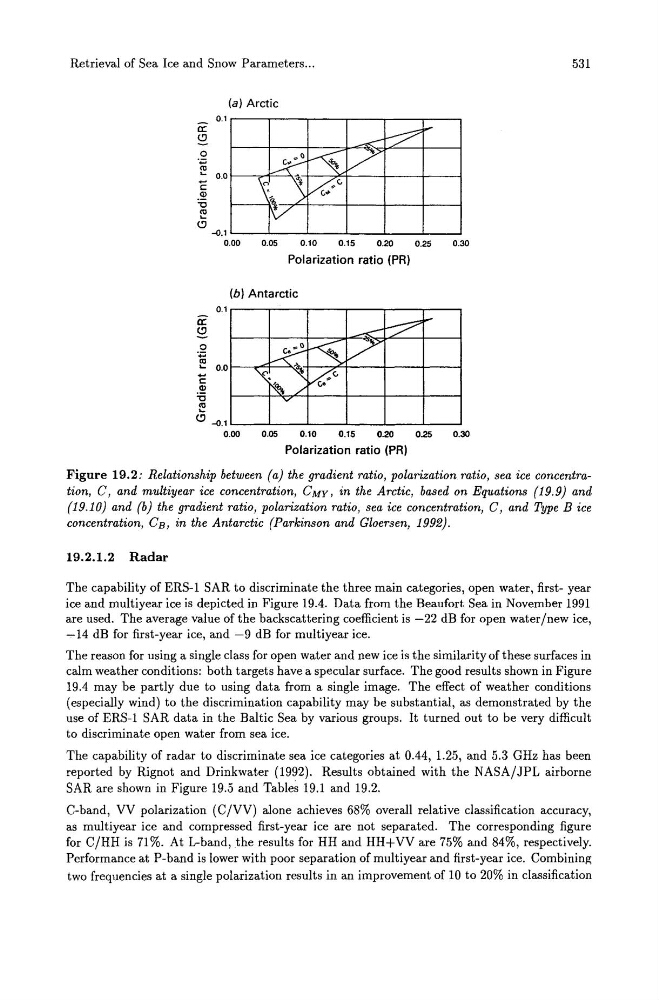
Figure 19.2: Relationship between (a) the gradient ratio, polarization ratio, sea ice concentration, G, and multiyear ice concentration, GMy , in the Arctic, based on Equations (19.9) and
(19.10) and (b) the gradient ratio, polarization ratio, sea ice concentration, G, and Type B ice
concentration, GB , in the Antarctic (Parkinson and Gloersen, 1992).
19.2.1.2 Radar
The capability of ERS-1 SAR to discriminate the three main categories, open water, first- year
ice and multiyear ice is depicted in Figure 19.4. Data from the Beaufort Sea in November 1991
are used. The average value of the backscattering coefficient is -22 dB for open water/new ice,
~14 dB for first-year ice, and -9 dB for multiyear ice.
The reason for using a single class for open water and new ice is the similarity of these surfaces in
calm weather conditions: both targets have a specular surface. The good results shown in Figure
19.4 may be partly due to using data from a single image. The effect of weather conditions
(especially wind) to the discrimination capability may be substantial, as demonstrated by the
use of ERS-1 SAR data in the Baltic Sea by various groups. It turned out to be very difficult
to discriminate open water from sea ice.
The capability of radar to discriminate sea ice categories at 0.44, 1.25, and 5.3 GHz has been
reported by Rignot and Drinkwater (1992). Results obtained with the NASAl JPL airborne
SAR are shown in Figure 19.5 and Tables 19.1 and 19.2.
C-band, VV polarization (C IVV) alone achieves 68% overall relative classification accuracy,
as multiyear ice and compressed first-year ice are not separated. The corresponding figure
for C/HH is 71%. At L-band, the results for HH and HH+VV are 75% and 84%, respectively.
Performance at P-band is lower with poor separation of multiyear and first-year ice. Combining
two frequencies at a single polarization results in an improvement of 10 to 20% in classification