

Physical Basis for Microwave Remote Sensing ...
497
{ 8<1%0
I
p", .7..v"""
601
8:2 - •• /00
}
CONGElATION ICE p= .s _ .• gm/ .....
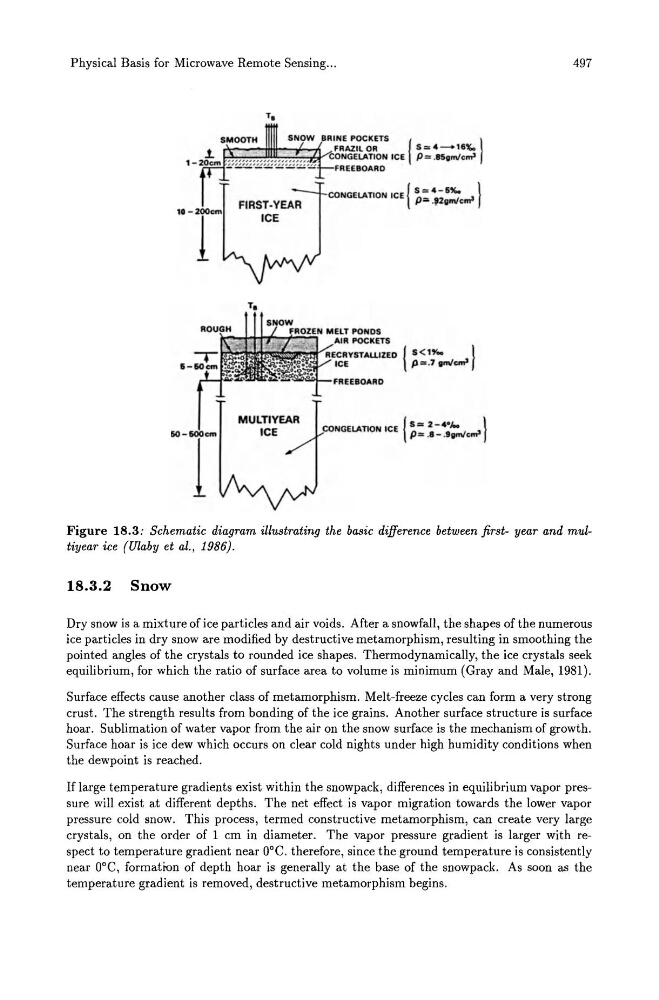
Figure 18.3: Schematic diagram illustrating the basic difference between first- year and multiyear ice (Ulaby et al., 1986).
18.3.2 Snow
Dry snow is a mixture of ice particles and air voids. After a snowfall, the shapes of the numerous
ice particles in dry snow are modified by destructive metamorphism, resulting in smoothing the
pointed angles of the crystals to rounded ice shapes. Thermodynamically, the ice crystals seek
equilibrium, for which the ratio of surface area to volume is minimum (Gray and Male, 1981).
Surface effects cause another class of metamorphism. Melt-freeze cycles can form a very strong
crust. The strength results from bonding of the ice grains. Another surface structure is surface
hoar. Sublimation of water vapor from the air on the snow surface is the mechanism of growth.
Surface hoar is ice dew which occurs on clear cold nights under high humidity conditions when
the dewpoint is reached.
If large temperature gradients exist within the snowpack, differences in equilibrium vapor pressure will exist at different depths. The net effect is vapor migration towards the lower vapor
pressure cold snow. This process, termed constructive metamorphism, can create very large
crystals, on the order of 1 cm in diameter. The vapor pressure gradient is larger with respect to temperature gradient near O°C . therefore, since the ground temperature is consistently
near O°C, formati-on of depth hoar is generally at the base of the snowpack. As soon as the
temperature gradient is removed, destructive metamorphism begins.
497
{ 8<1%0
I
p", .7..v"""
601
8:2 - •• /00
}
CONGElATION ICE p= .s _ .• gm/ .....
Figure 18.3: Schematic diagram illustrating the basic difference between first- year and multiyear ice (Ulaby et al., 1986).
18.3.2 Snow
Dry snow is a mixture of ice particles and air voids. After a snowfall, the shapes of the numerous
ice particles in dry snow are modified by destructive metamorphism, resulting in smoothing the
pointed angles of the crystals to rounded ice shapes. Thermodynamically, the ice crystals seek
equilibrium, for which the ratio of surface area to volume is minimum (Gray and Male, 1981).
Surface effects cause another class of metamorphism. Melt-freeze cycles can form a very strong
crust. The strength results from bonding of the ice grains. Another surface structure is surface
hoar. Sublimation of water vapor from the air on the snow surface is the mechanism of growth.
Surface hoar is ice dew which occurs on clear cold nights under high humidity conditions when
the dewpoint is reached.
If large temperature gradients exist within the snowpack, differences in equilibrium vapor pressure will exist at different depths. The net effect is vapor migration towards the lower vapor
pressure cold snow. This process, termed constructive metamorphism, can create very large
crystals, on the order of 1 cm in diameter. The vapor pressure gradient is larger with respect to temperature gradient near O°C . therefore, since the ground temperature is consistently
near O°C, formati-on of depth hoar is generally at the base of the snowpack. As soon as the
temperature gradient is removed, destructive metamorphism begins.