

496
M. Hallikainen
Ziee
Ice Conditions
Om
OPEN WATER
r
·
[Calm _[Cooling]
• [Snow]
conditions]
I
I [Agitated ~aterlWind]
Q-Smm
FRAZIL
FRAZIL ICE
SLUSH
ICE
+
j
NEW
J GREASE ICE SHUGA
ICE
I · .1
l' -~
Q-O.OSm
DARK NILAS/}--rnd ant [W.tes]
ICE RIND
wave
+
O.O~.tlT
u,~u doo l~
O.l-O.3m
YOU~G ICE_ [Refreezing]
f-------[Heavy snow]
FLOOt!EDICE
[RetrJ;,Zing]
t
SNOW ICE
[Refreezing]
O.3-2m
[Further ice growth~
FIRST}EAR ICE
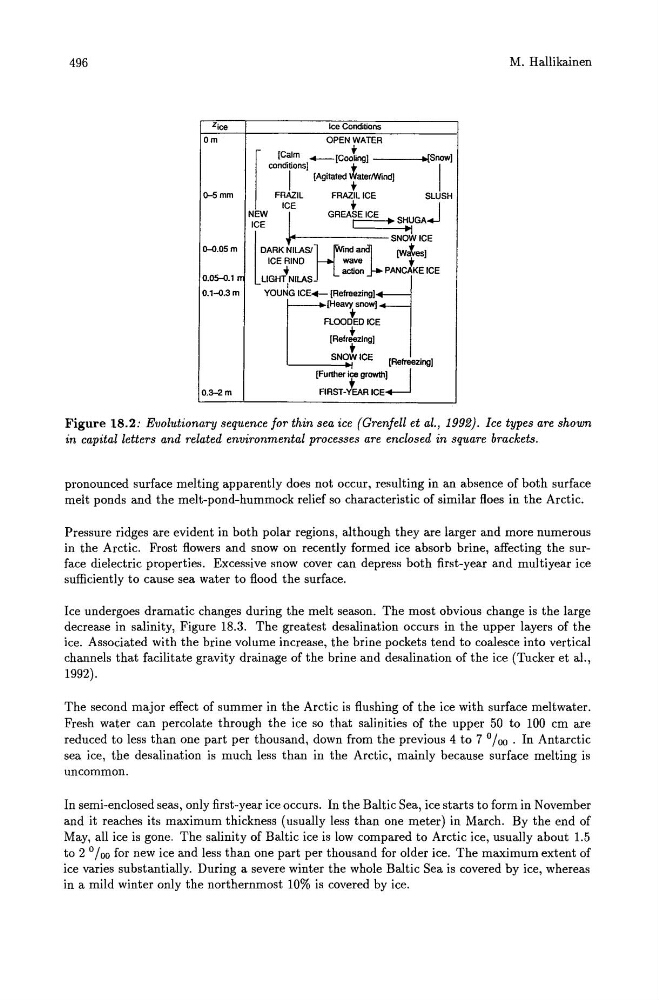
Figure 18.2: Evolutionary sequence for thin sea ice (Grenfell et al. J 1992). Ice types are shown
in capital letters and related environmental processes are enclosed in square brackets.
pronounced surface melting apparently does not occur, resulting in an absence of both surface
melt ponds and the melt-pond-hummock relief so characteristic of similar floes in the Arctic.
Pressure ridges are evident in both polar regions, although they are larger and more numerous
in the Arctic. Frost flowers and snow on recently formed ice absorb brine, affecting the surface dielectric properties. Excessive snow cover can depress both first-year and multiyear ice
sufficiently to cause sea water to flood the surface.
Ice undergoes dramatic changes during the melt season. The most obvious change is the large
decrease in salinity, Figure 18.3. The greatest desalination occurs in the upper layers of the
ice. Associated with the brine volume increase, the brine pockets tend to coalesce into vertical
channels that facilitate gravity drainage of the brine and desalination of the ice (Tucker et al.,
1992).
The second major effect of summer in the Arctic is flushing of the ice with surface meltwater.
Fresh water can percolate through the ice so that salinities of the upper 50 to 100 cm are
reduced to less than one part per thousand, down from the previous 4 to 7 0/00 . In Antarctic
sea ice, the desalination is much less than in the Arctic, mainly because surface melting is
uncommon.
In semi-enclosed seas, only first-year ice occurs. In the Baltic Sea, ice starts to form in November
and it reaches its maximum thickness (usually less than one meter) in March. By the end of
May, all ice is gone. The salinity of Baltic ice is low compared to Arctic ice, usually about 1.5
to 2 0/00 for new ice and less than one part per thousand for older ice. The maximum extent of
ice varies substantially. During a severe winter the whole Baltic Sea is covered by ice, whereas
in a mild winter only the northernmost 10% is covered by ice.
M. Hallikainen
Ziee
Ice Conditions
Om
OPEN WATER
r
·
[Calm _[Cooling]
• [Snow]
conditions]
I
I [Agitated ~aterlWind]
Q-Smm
FRAZIL
FRAZIL ICE
SLUSH
ICE
+
j
NEW
J GREASE ICE SHUGA
ICE
I · .1
l' -~
Q-O.OSm
DARK NILAS/}--rnd ant [W.tes]
ICE RIND
wave
+
O.O~.tlT
u,~u doo l~
O.l-O.3m
YOU~G ICE_ [Refreezing]
f-------[Heavy snow]
FLOOt!EDICE
[RetrJ;,Zing]
t
SNOW ICE
[Refreezing]
O.3-2m
[Further ice growth~
FIRST}EAR ICE
Figure 18.2: Evolutionary sequence for thin sea ice (Grenfell et al. J 1992). Ice types are shown
in capital letters and related environmental processes are enclosed in square brackets.
pronounced surface melting apparently does not occur, resulting in an absence of both surface
melt ponds and the melt-pond-hummock relief so characteristic of similar floes in the Arctic.
Pressure ridges are evident in both polar regions, although they are larger and more numerous
in the Arctic. Frost flowers and snow on recently formed ice absorb brine, affecting the surface dielectric properties. Excessive snow cover can depress both first-year and multiyear ice
sufficiently to cause sea water to flood the surface.
Ice undergoes dramatic changes during the melt season. The most obvious change is the large
decrease in salinity, Figure 18.3. The greatest desalination occurs in the upper layers of the
ice. Associated with the brine volume increase, the brine pockets tend to coalesce into vertical
channels that facilitate gravity drainage of the brine and desalination of the ice (Tucker et al.,
1992).
The second major effect of summer in the Arctic is flushing of the ice with surface meltwater.
Fresh water can percolate through the ice so that salinities of the upper 50 to 100 cm are
reduced to less than one part per thousand, down from the previous 4 to 7 0/00 . In Antarctic
sea ice, the desalination is much less than in the Arctic, mainly because surface melting is
uncommon.
In semi-enclosed seas, only first-year ice occurs. In the Baltic Sea, ice starts to form in November
and it reaches its maximum thickness (usually less than one meter) in March. By the end of
May, all ice is gone. The salinity of Baltic ice is low compared to Arctic ice, usually about 1.5
to 2 0/00 for new ice and less than one part per thousand for older ice. The maximum extent of
ice varies substantially. During a severe winter the whole Baltic Sea is covered by ice, whereas
in a mild winter only the northernmost 10% is covered by ice.