

Applications of Passive and Active Microwave Sensors ...
lb)
,
,
!
I
,
I
475
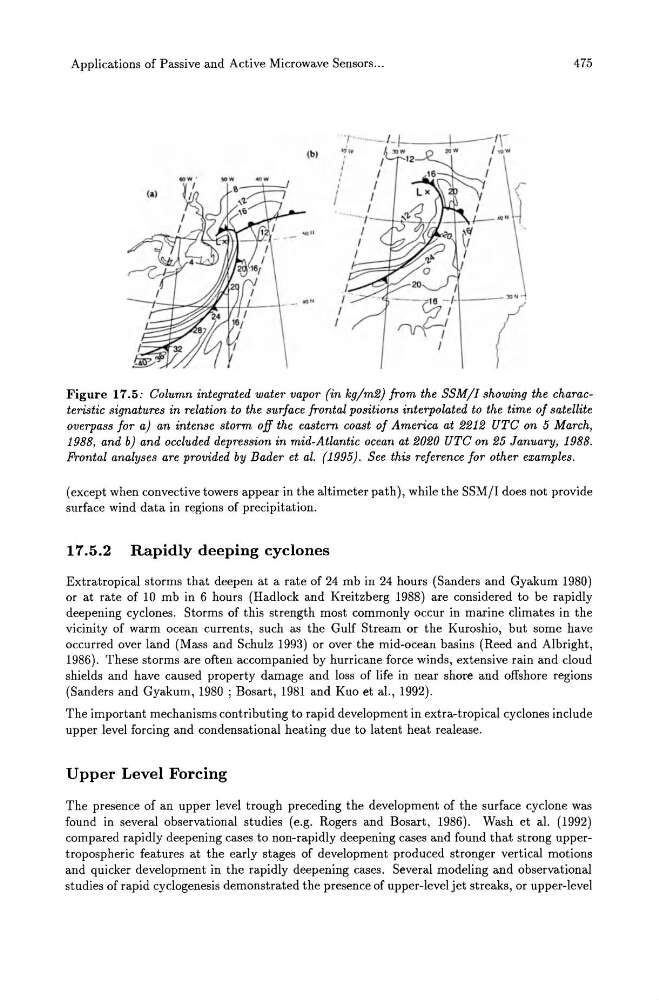
Figure 17.5: Column integrated water vapor (in kg/m2) from the SSM/I showing the characteristic signatures in relation to the surface frontal positions interpolated to the time of satellite
overpass for a) an intense storm off the eastern coast of America at 2212 UTC on 5 March,
1988, and b) and occluded depression in mid-Atlantic ocean at 2020 UTC on 25 January, 1988.
Frontal analyses are provided by Bader et al. (1995). See this reference for other examples.
(except when convective towers appear in the altimeter path), while the SSM!I does not provide
surface wind data in regions of precipitation.
17.5.2 Rapidly deeping cyclones
Extratropical storms that deepen at a rate of 24 mb in 24 hours (Sanders and Gyakum 1980)
or at rate of 10 mb in 6 hours (Hadlock and Kreitzberg 1988) are considered to be rapidly
deepening cyclones. Storms of this strength most commonly occur in marine climates in the
vicinity of warm ocean currents, such as the Gulf Stream or the Kuroshio, but some have
occurred over land (Mass and Schulz 1993) or over the mid-ocean basins (Reed and Albright,
1986). These storms are often accompanied by hurricane force winds, extensive rain and cloud
shields and have caused property damage and loss of life in near shore and offshore regions
(Sanders and Gyakum, 1980 ; Bosart, 1981 and Kuo et al., 1992).
The important mechanisms contributing to rapid development in extra-tropical cyclones include
upper level forcing and condensational heating due to latent heat realease.
Upper Level Forcing
The presence of an upper level trough preceding the development of the surface cyclone was
found in several observational studies (e.g. Rogers and Bosart, 1986). Wash et al. (1992)
compared rapidly deepening cases to non-rapidly deepening cases and found that strong uppertropospheric features at the early stages of development produced stronger vertical motions
and quicker development in the rapidly deepening cases. Several modeling and observational
studies of rapid cyclogenesis demonstrated the presence of upper-level jet streaks, or upper-level
lb)
,
,
!
I
,
I
475
Figure 17.5: Column integrated water vapor (in kg/m2) from the SSM/I showing the characteristic signatures in relation to the surface frontal positions interpolated to the time of satellite
overpass for a) an intense storm off the eastern coast of America at 2212 UTC on 5 March,
1988, and b) and occluded depression in mid-Atlantic ocean at 2020 UTC on 25 January, 1988.
Frontal analyses are provided by Bader et al. (1995). See this reference for other examples.
(except when convective towers appear in the altimeter path), while the SSM!I does not provide
surface wind data in regions of precipitation.
17.5.2 Rapidly deeping cyclones
Extratropical storms that deepen at a rate of 24 mb in 24 hours (Sanders and Gyakum 1980)
or at rate of 10 mb in 6 hours (Hadlock and Kreitzberg 1988) are considered to be rapidly
deepening cyclones. Storms of this strength most commonly occur in marine climates in the
vicinity of warm ocean currents, such as the Gulf Stream or the Kuroshio, but some have
occurred over land (Mass and Schulz 1993) or over the mid-ocean basins (Reed and Albright,
1986). These storms are often accompanied by hurricane force winds, extensive rain and cloud
shields and have caused property damage and loss of life in near shore and offshore regions
(Sanders and Gyakum, 1980 ; Bosart, 1981 and Kuo et al., 1992).
The important mechanisms contributing to rapid development in extra-tropical cyclones include
upper level forcing and condensational heating due to latent heat realease.
Upper Level Forcing
The presence of an upper level trough preceding the development of the surface cyclone was
found in several observational studies (e.g. Rogers and Bosart, 1986). Wash et al. (1992)
compared rapidly deepening cases to non-rapidly deepening cases and found that strong uppertropospheric features at the early stages of development produced stronger vertical motions
and quicker development in the rapidly deepening cases. Several modeling and observational
studies of rapid cyclogenesis demonstrated the presence of upper-level jet streaks, or upper-level