

Observational Requirements for Modeling of Global...
37
DISTRIBUTIO~ or ClOUD PROPERTIES
DISTRIBUTION or CLOUD PROPERTIES
cc • • 12as JUtlAl'Y
OCUli
o - 16 •
I.
' .
.,
.,
'"
'"
w
. .
..
'"
:0
:0
"
.,
::.l
::.l
'"
..
0.
..
0.
..
0
•••
0
..
. .
"
"
:0
..
"
"
...
...
"
"
•••
CLOUD OPTICAL THICKNESS
ClOUD OPTICAL THICKNESS
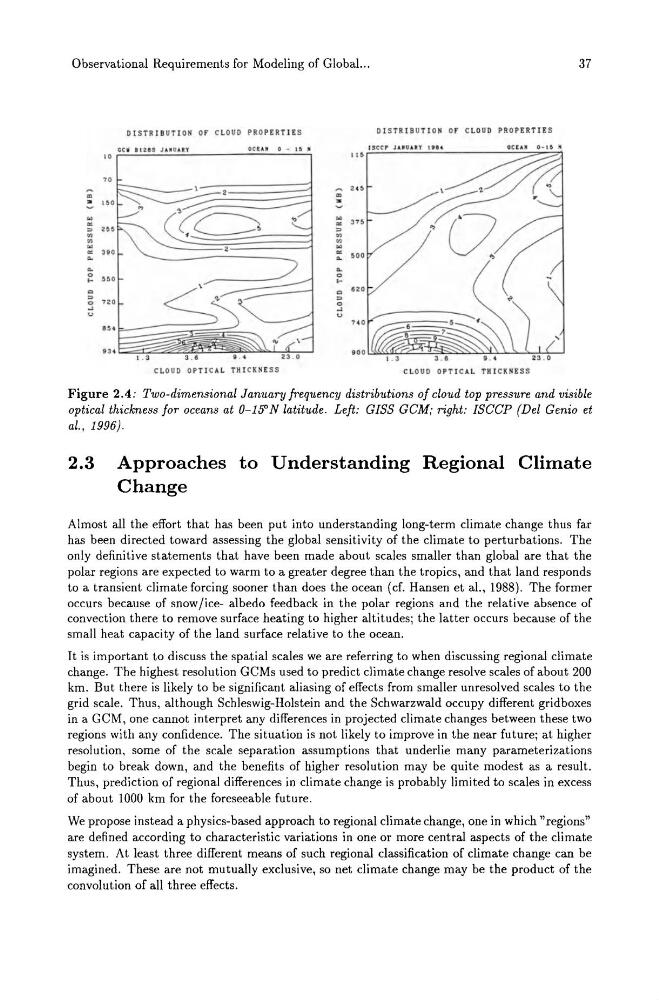
Figure 2.4: Two-dimensional January frequency distributions of cloud top pressure and visible
optical thickness for oceans at 0-15" N latitude. Left: GISS GCM; right: ISCCP (Del Genio et
al., 1996).
2.3 Approaches to Understanding Regional Climate
Change
Almost all the effort that has been put into understanding long-term climate change thus far
has been directed toward assessing the global sensitivity of the climate to perturbations. The
only definitive statements that have been made about scales smaller than global are that the
polar regions are expected to warm to a greater degree than the tropics, and that land responds
to a transient climate forcing sooner than does the ocean (cf. Hansen et aI., 1988). The former
occurs because of snow jice- albedo feedback in the polar regions and the relative absence of
convection there to remove surface heating to higher altitudes; the latter occurs because of the
small heat capacity of the land surface relative to the ocean.
It is important to discuss the spatial scales we are referring to when discussing regional climate
change. The highest resolution GCMs used to predict climate change resolve scales of about 200
km. But there is likely to be significant aliasing of effects from smaller unresolved scales to the
grid scale. Thus, although Schleswig-Holstein and the Schwarzwald occupy different gridboxes
in a GCM, one cannot interpret any differences in projected climate changes between these two
regions with any confidence. The situation is not likely to improve in the near future; at higher
resolution, some of the scale separation assumptions that underlie many parameterizations
begin to break down, and the benefits of higher resolution may be quite modest as a result.
Thus, prediction of regional differences in climate change is probably limited to scales in excess
of about 1000 km for the foreseeable future.
We propose instead a physics-based approach to regional climate change, one in which "regions"
are defined according to characteristic variations in one or more central aspects of the climate
system. At least three different means of such regional classification of climate change can be
imagined. These are not mutually exclusive, so net climate change may be the product of the
convolution of all three effects.
37
DISTRIBUTIO~ or ClOUD PROPERTIES
DISTRIBUTION or CLOUD PROPERTIES
cc • • 12as JUtlAl'Y
OCUli
o - 16 •
I.
' .
.,
.,
'"
'"
w
. .
..
'"
:0
:0
"
.,
::.l
::.l
'"
..
0.
..
0.
..
0
•••
0
..
. .
"
"
:0
..
"
"
...
...
"
"
•••
CLOUD OPTICAL THICKNESS
ClOUD OPTICAL THICKNESS
Figure 2.4: Two-dimensional January frequency distributions of cloud top pressure and visible
optical thickness for oceans at 0-15" N latitude. Left: GISS GCM; right: ISCCP (Del Genio et
al., 1996).
2.3 Approaches to Understanding Regional Climate
Change
Almost all the effort that has been put into understanding long-term climate change thus far
has been directed toward assessing the global sensitivity of the climate to perturbations. The
only definitive statements that have been made about scales smaller than global are that the
polar regions are expected to warm to a greater degree than the tropics, and that land responds
to a transient climate forcing sooner than does the ocean (cf. Hansen et aI., 1988). The former
occurs because of snow jice- albedo feedback in the polar regions and the relative absence of
convection there to remove surface heating to higher altitudes; the latter occurs because of the
small heat capacity of the land surface relative to the ocean.
It is important to discuss the spatial scales we are referring to when discussing regional climate
change. The highest resolution GCMs used to predict climate change resolve scales of about 200
km. But there is likely to be significant aliasing of effects from smaller unresolved scales to the
grid scale. Thus, although Schleswig-Holstein and the Schwarzwald occupy different gridboxes
in a GCM, one cannot interpret any differences in projected climate changes between these two
regions with any confidence. The situation is not likely to improve in the near future; at higher
resolution, some of the scale separation assumptions that underlie many parameterizations
begin to break down, and the benefits of higher resolution may be quite modest as a result.
Thus, prediction of regional differences in climate change is probably limited to scales in excess
of about 1000 km for the foreseeable future.
We propose instead a physics-based approach to regional climate change, one in which "regions"
are defined according to characteristic variations in one or more central aspects of the climate
system. At least three different means of such regional classification of climate change can be
imagined. These are not mutually exclusive, so net climate change may be the product of the
convolution of all three effects.