

36
A.D. Del Genio
TROPICAL PACIFIC
100
+
Z
+
+
U
SO r
0:
~+ +
0
lL..
++ ~++
W
+~"'"++)..+
>
-«:
(~,
:3
! ~ ~+
IOr
~
+
0:
++:.t
\ .
0
:c
+ ~..".
Ul
+~ +
-«:
"'t\ +.. 11,.
0
I+ ++.t., + !
+
+ + +
-«: -SOr
+ :
I+
...J
+
W
0
+
+
-100
I
I
I
-100
-SO
a
SO
100
DELTA TOA LONG YAVE FORCING
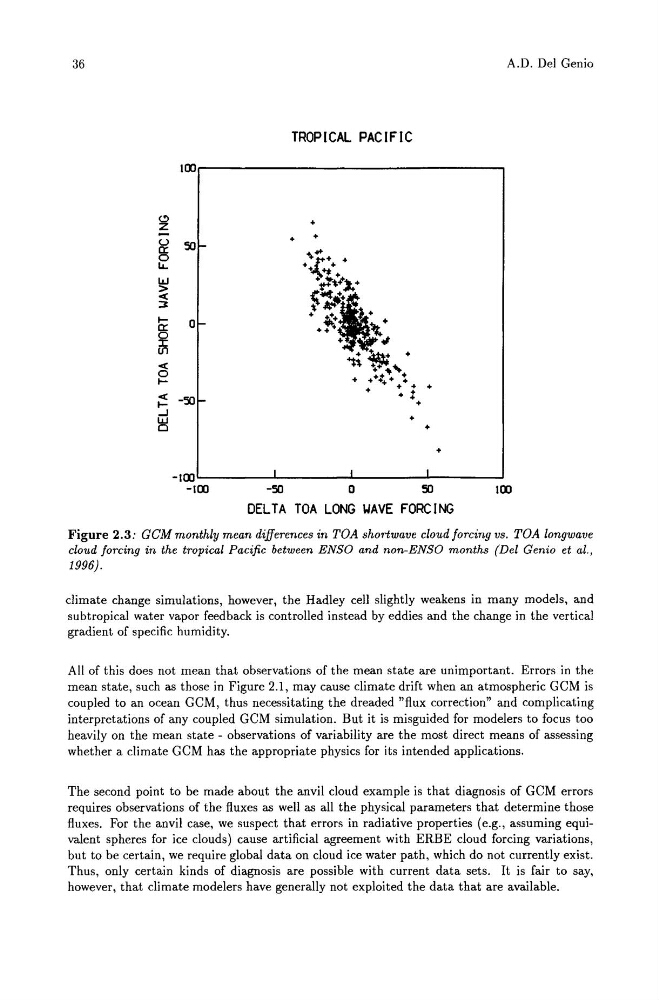
Figure 2.3: GeM monthly mean differences in TOA shortwave cloud forcing vs. TOA longwave
cloud forcing in the tropical Pacific between ENSO and non-ENSO months (Del Genio et al.,
1996).
climate change simulations, however, the Hadley cell slightly weakens in many models, and
subtropical water vapor feedback is controlled instead by eddies and the change in the vertical
gradient of specific humidity.
All of this does not mean that observations of the mean state are unimportant. Errors in the
mean state, such as those in Figure 2.1, may cause climate drift when an atmospheric GeM is
coupled to an ocean GeM, thus necessitating the dreaded "flux correction" and complicating
interpretations of any coupled GeM simulation. But it is misguided for modelers to focus too
heavily on the mean state - observations of variability are the most direct means of assessing
whether a climate GeM has the appropriate physics for its intended applications.
The second point to be made about the anvil cloud example is that diagnosis of GeM errors
requires observations of the fluxes as well as all the physical parameters that determine those
fluxes. For the anvil case, we suspect that errors in radiative properties (e.g., assuming equivalent spheres for ice clouds) cause artificial agreement with ERBE cloud forcing variations,
but to be certain, we require global data on cloud ice water path, which do not currently exist.
Thus, only certain kinds of diagnosis are possible with current data sets. It is fair to say,
however, that climate modelers have generally not exploited the data that are available.
A.D. Del Genio
TROPICAL PACIFIC
100
+
Z
+
+
U
SO r
0:
~+ +
0
lL..
++ ~++
W
+~"'"++)..+
>
-«:
(~,
:3
! ~ ~+
IOr
~
+
0:
++:.t
\ .
0
:c
+ ~..".
Ul
+~ +
-«:
"'t\ +.. 11,.
0
I+ ++.t., + !
+
+ + +
-«: -SOr
+ :
I+
...J
+
W
0
+
+
-100
I
I
I
-100
-SO
a
SO
100
DELTA TOA LONG YAVE FORCING
Figure 2.3: GeM monthly mean differences in TOA shortwave cloud forcing vs. TOA longwave
cloud forcing in the tropical Pacific between ENSO and non-ENSO months (Del Genio et al.,
1996).
climate change simulations, however, the Hadley cell slightly weakens in many models, and
subtropical water vapor feedback is controlled instead by eddies and the change in the vertical
gradient of specific humidity.
All of this does not mean that observations of the mean state are unimportant. Errors in the
mean state, such as those in Figure 2.1, may cause climate drift when an atmospheric GeM is
coupled to an ocean GeM, thus necessitating the dreaded "flux correction" and complicating
interpretations of any coupled GeM simulation. But it is misguided for modelers to focus too
heavily on the mean state - observations of variability are the most direct means of assessing
whether a climate GeM has the appropriate physics for its intended applications.
The second point to be made about the anvil cloud example is that diagnosis of GeM errors
requires observations of the fluxes as well as all the physical parameters that determine those
fluxes. For the anvil case, we suspect that errors in radiative properties (e.g., assuming equivalent spheres for ice clouds) cause artificial agreement with ERBE cloud forcing variations,
but to be certain, we require global data on cloud ice water path, which do not currently exist.
Thus, only certain kinds of diagnosis are possible with current data sets. It is fair to say,
however, that climate modelers have generally not exploited the data that are available.