

Satellite Remote Sensing of Evaporation over Sea
3+---~~--~----~--~----~----~---+
2
-1
-2+---~r---~----~--~-----r----~---+
-60
-40
-20
o
20
Latitude (0]
40
60
80
455
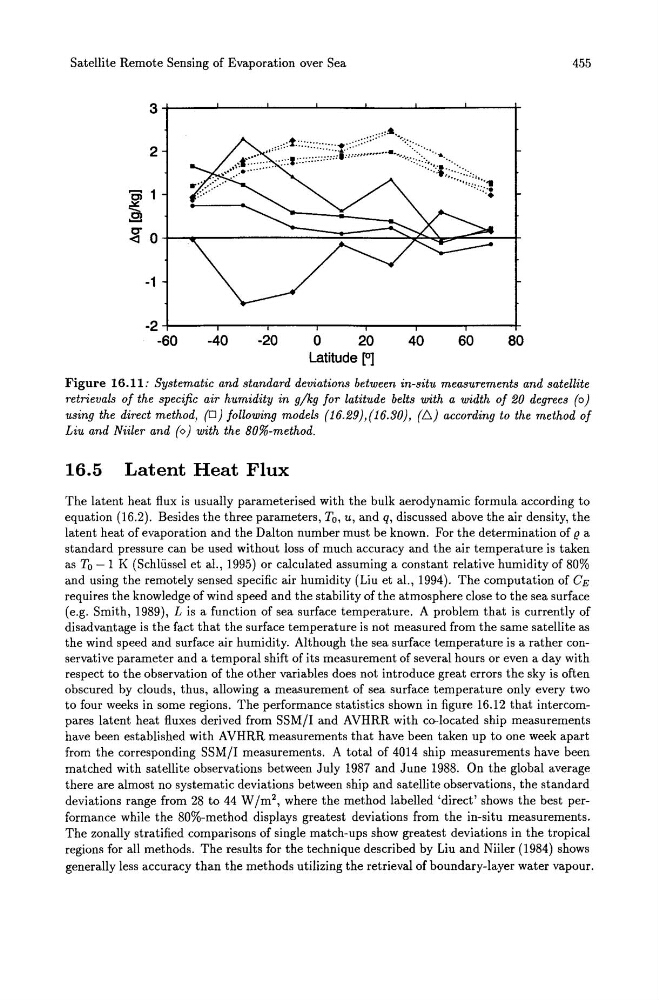
Figure 16.11: Systematic and standard deviations between in-situ measurements and satellite
retrievals of the specific air humidity in g/kg for latitude belts with a width of 20 degrees (0)
using the direct method, (D) following models (16.29),(16.30), (L) according to the method of
Liu and Niiler and (0) with the 80%-method.
16.5 Latent Heat Flux
The latent heat flux is usually parameterised with the bulk aerodynamic formula according to
equation (16.2). Besides the three parameters, To, u, and q, discussed above the air density, the
latent heat of evaporation and the Dalton number must be known. For the determination of (! a
standard pressure can be used without loss of much accuracy and the air temperature is taken
as To - 1 K (Schliissel et al., 1995) or calculated assuming a constant relative humidity of 80%
and using the remotely sensed specific air humidity (Liu et al., 1994). The computation of CE
requires the knowledge of wind speed and the stability of the atmosphere close to the sea surface
(e.g. Smith, 1989), L is a function of sea surface temperature. A problem that is currently of
disadvantage is the fact that the surface temperature is not measured from the same satellite as
the wind speed and surface air humidity. Although the sea surface temperature is a rather conservative parameter and a temporal shift of its measurement of several hours or even a day with
respect to the observation of the other variables does not introduce great errors the sky is often
obscured by clouds, thus, allowing a measurement of sea surface temperature only every two
to four weeks in some regions. The performance statistics shown in figure 16.12 that intercompares latent heat fluxes derived from SSM/I and AVHRR with co-located ship measurements
have been established with AVHRR measurements that have been taken up to one week apart
from the corresponding SSM/I measurements. A total of 4014 ship measurements have been
matched with satellite observations between July 1987 and June 1988. On the global average
there are almost no systematic deviations between ship and satellite observations, the standard
deviations range from 28 to 44 W / m 2 , where the method labelled 'direct' shows the best performance while the 80%-method displays greatest deviations from the in-situ measurements.
The zonally stratified comparisons of single match-ups show greatest deviations in the tropical
regions for all methods. The results for the technique described by Liu and Niiler (1984) shows
generally less accuracy than the methods utilizing the retrieval of boundary-layer water vapour.
3+---~~--~----~--~----~----~---+
2
-1
-2+---~r---~----~--~-----r----~---+
-60
-40
-20
o
20
Latitude (0]
40
60
80
455
Figure 16.11: Systematic and standard deviations between in-situ measurements and satellite
retrievals of the specific air humidity in g/kg for latitude belts with a width of 20 degrees (0)
using the direct method, (D) following models (16.29),(16.30), (L) according to the method of
Liu and Niiler and (0) with the 80%-method.
16.5 Latent Heat Flux
The latent heat flux is usually parameterised with the bulk aerodynamic formula according to
equation (16.2). Besides the three parameters, To, u, and q, discussed above the air density, the
latent heat of evaporation and the Dalton number must be known. For the determination of (! a
standard pressure can be used without loss of much accuracy and the air temperature is taken
as To - 1 K (Schliissel et al., 1995) or calculated assuming a constant relative humidity of 80%
and using the remotely sensed specific air humidity (Liu et al., 1994). The computation of CE
requires the knowledge of wind speed and the stability of the atmosphere close to the sea surface
(e.g. Smith, 1989), L is a function of sea surface temperature. A problem that is currently of
disadvantage is the fact that the surface temperature is not measured from the same satellite as
the wind speed and surface air humidity. Although the sea surface temperature is a rather conservative parameter and a temporal shift of its measurement of several hours or even a day with
respect to the observation of the other variables does not introduce great errors the sky is often
obscured by clouds, thus, allowing a measurement of sea surface temperature only every two
to four weeks in some regions. The performance statistics shown in figure 16.12 that intercompares latent heat fluxes derived from SSM/I and AVHRR with co-located ship measurements
have been established with AVHRR measurements that have been taken up to one week apart
from the corresponding SSM/I measurements. A total of 4014 ship measurements have been
matched with satellite observations between July 1987 and June 1988. On the global average
there are almost no systematic deviations between ship and satellite observations, the standard
deviations range from 28 to 44 W / m 2 , where the method labelled 'direct' shows the best performance while the 80%-method displays greatest deviations from the in-situ measurements.
The zonally stratified comparisons of single match-ups show greatest deviations in the tropical
regions for all methods. The results for the technique described by Liu and Niiler (1984) shows
generally less accuracy than the methods utilizing the retrieval of boundary-layer water vapour.