

440
P. Schliissel
ATSR
/} [0] Noise
ao
al
a2
E
0-21 w/o
-1.72 1.0060 2.5663 0.34
0-21 with -2.15 1.0077 2.5369 0.36
AVHRR
/} [0] Noise
ao
al
a2
E
0
w/o
-3.48 1.0134 2.3999 0.28
0
with -6.17 1.0235 2.1767 0.57
10
w/o
-3.50 1.0135 2.4163 0.28
10
with -6.14 1.0234 2.1976 0.57
20
w/o
-3.69 1.0142 2.4667 0.31
20
with -6.23 1.0238 2.2580 0.60
30
w/o
-4.53 1.0173 2.5676 0.37
30
with -6.84 1.0260 2.3745 0.64
40
w/o
-8.12 1.0301 2.7470 0.49
40
with -9.95 1.0372 2.5721 0.74
50
w/o -22.71 1.0837 3.0201 0.78
50
with -23.28 1.0863 2.8654 0.99
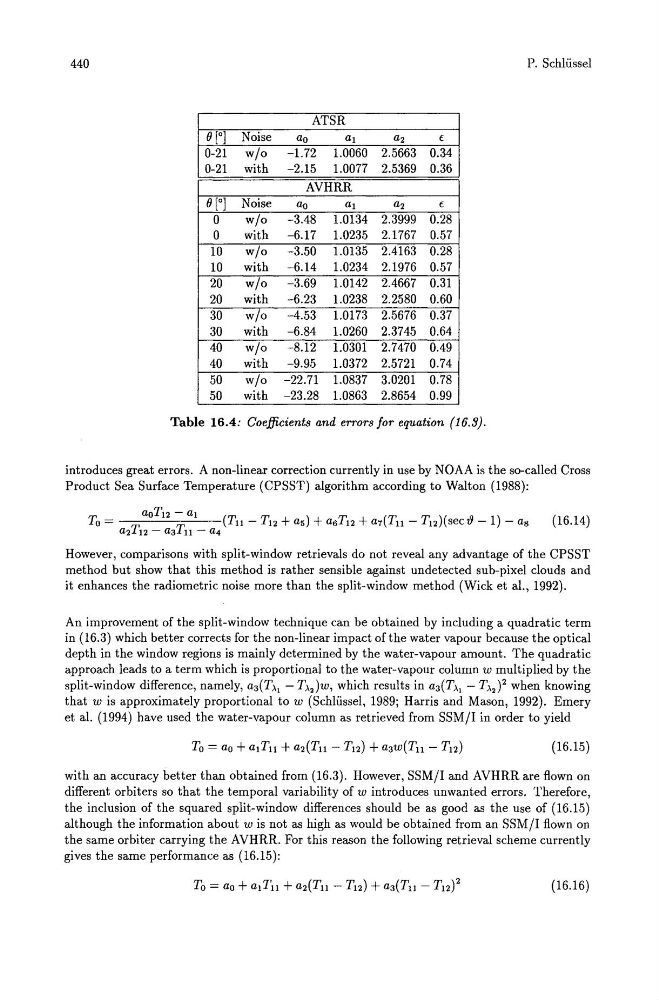
Table 16.4: Coefficients and errors for equation (16.3).
introduces great errors. A non-linear correction currently in use by NOAA is the so-called Cross
Product Sea Surface Temperature (CPSST) algorithm according to Walton (1988):
(16.14)
However, comparisons with split-window retrievals do not reveal any advantage of the CPSST
method but show that this method is rather sensible against undetected sub-pixel clouds and
it enhances the radiometric noise more than the split-window method (Wick et al., 1992).
An improvement of the split-window technique can be obtained by including a quadratic term
in (16.3) which better corrects for the non-linear impact of the water vapour because the optical
depth in the window regions is mainly determined by the water-vapour amount. The quadratic
approach leads to a term which is proportional to the water-vapour column w multiplied by the
split-window difference, namely, a3(T>., - T>'2)W, which results in a3(T>., - T>'2)2 when knowing
that w is approximately proportional to w (Schliissel, 1989; Harris and Mason, 1992). Emery
et al. (1994) have used the water-vapour column as retrieved from SSM/I in order to yield
(16.15)
with an accuracy better than obtained from (16.3). However, SSM/I and AVHRR are flown on
different orbiters so that the temporal variability of w introduces unwanted errors. Therefore,
the inclusion of the squared split-window differences should be as good as the use of (16.15)
although the information about w is not as high as would be obtained from an SSM/I flown on
the same orbiter carrying the AVHRR. For this reason the following retrieval scheme currently
gives the same performance as (16.15):
(16.16)
P. Schliissel
ATSR
/} [0] Noise
ao
al
a2
E
0-21 w/o
-1.72 1.0060 2.5663 0.34
0-21 with -2.15 1.0077 2.5369 0.36
AVHRR
/} [0] Noise
ao
al
a2
E
0
w/o
-3.48 1.0134 2.3999 0.28
0
with -6.17 1.0235 2.1767 0.57
10
w/o
-3.50 1.0135 2.4163 0.28
10
with -6.14 1.0234 2.1976 0.57
20
w/o
-3.69 1.0142 2.4667 0.31
20
with -6.23 1.0238 2.2580 0.60
30
w/o
-4.53 1.0173 2.5676 0.37
30
with -6.84 1.0260 2.3745 0.64
40
w/o
-8.12 1.0301 2.7470 0.49
40
with -9.95 1.0372 2.5721 0.74
50
w/o -22.71 1.0837 3.0201 0.78
50
with -23.28 1.0863 2.8654 0.99
Table 16.4: Coefficients and errors for equation (16.3).
introduces great errors. A non-linear correction currently in use by NOAA is the so-called Cross
Product Sea Surface Temperature (CPSST) algorithm according to Walton (1988):
(16.14)
However, comparisons with split-window retrievals do not reveal any advantage of the CPSST
method but show that this method is rather sensible against undetected sub-pixel clouds and
it enhances the radiometric noise more than the split-window method (Wick et al., 1992).
An improvement of the split-window technique can be obtained by including a quadratic term
in (16.3) which better corrects for the non-linear impact of the water vapour because the optical
depth in the window regions is mainly determined by the water-vapour amount. The quadratic
approach leads to a term which is proportional to the water-vapour column w multiplied by the
split-window difference, namely, a3(T>., - T>'2)W, which results in a3(T>., - T>'2)2 when knowing
that w is approximately proportional to w (Schliissel, 1989; Harris and Mason, 1992). Emery
et al. (1994) have used the water-vapour column as retrieved from SSM/I in order to yield
(16.15)
with an accuracy better than obtained from (16.3). However, SSM/I and AVHRR are flown on
different orbiters so that the temporal variability of w introduces unwanted errors. Therefore,
the inclusion of the squared split-window differences should be as good as the use of (16.15)
although the information about w is not as high as would be obtained from an SSM/I flown on
the same orbiter carrying the AVHRR. For this reason the following retrieval scheme currently
gives the same performance as (16.15):
(16.16)