

438
P. Schliissel
at forward view of the radiometer. Similar but weaker relationships are found in the channels
at 3.7 and 11 /-Lm.
Different retrieval models have been formulated for the use with split-, dual- and triple-window
techniques. The first one has been introduced above which was derived from the truncated
radiative transfer equation:
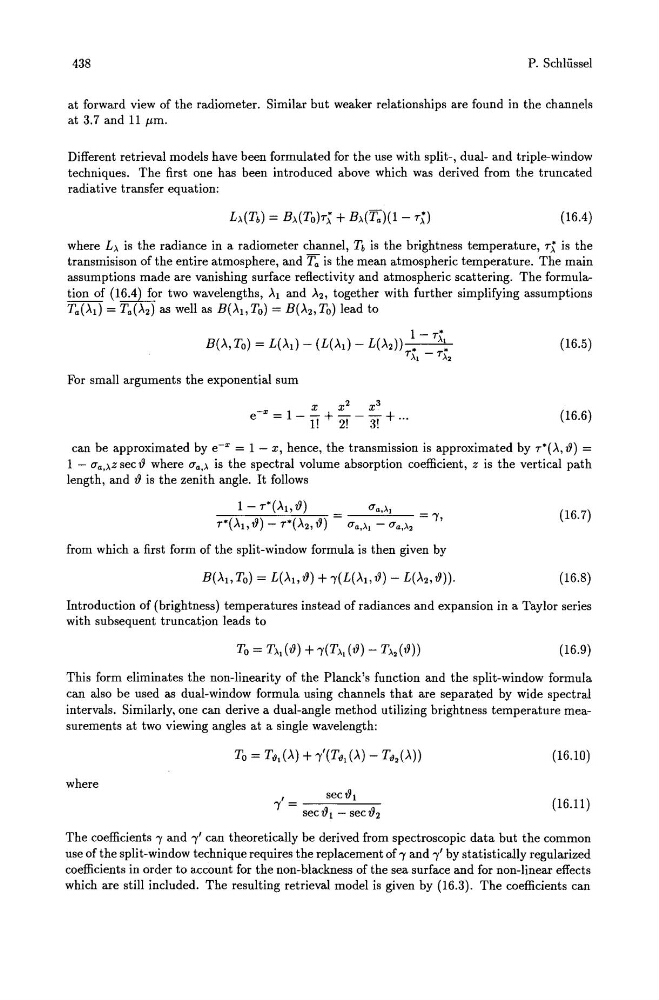
(16.4)
where L>. is the radiance in a radiometer channel, n is the brightness temperature, r~ is the
transmisison of the entire atmosphere, and Ta is the mean atmospheric temperature. The main
assumptions made are vanishing surface reflectivity and atmospheric scattering. The formulation of (16.4) for two wavelengths, >' 1 and A2, together with further simplifying assumptions
Ta(Ad = Ta(A2) as well as B(AI, To) = B(A2, To) lead to
(16.5)
For small arguments the exponential sum
(16.6)
can be approximated by e- X = 1 - x, hence, the transmission is approximated by r*(>', '!9) =
1 - ITa,>.Z sec'!9 where ITa,>. is the spectral volume absorption coefficient, Z is the vertical path
length, and ' !9 is the zenith angle. It follows
(16.7)
from which a first form of the split-window formula is then given by
(16.8)
Introduction of (brightness) temperatures instead of radiances and expansion in a Taylor series
with subsequent truncation leads to
(16.9)
This form eliminates the non-linearity of the Planck's function and the split-window formula
can also be used as dual-window formula using channels that are separated by wide spectral
intervals. Similarly, one can derive a dual-angle method utilizing brightness temperature measurements at two viewing angles at a single wavelength:
(16.10)
where
,
sec'!9 1
, = sec'!9 1 - sec'!9 2
(16.11)
The coefficients, and " can theoretically be derived from spectroscopic data but the common
use of the split-window technique requires the replacement of , and " by statistically regularized
coefficients in order to account for the non-blackness of the sea surface and for non-linear effects
which are still included. The resulting retrieval model is given by (16.3). The coefficients can
P. Schliissel
at forward view of the radiometer. Similar but weaker relationships are found in the channels
at 3.7 and 11 /-Lm.
Different retrieval models have been formulated for the use with split-, dual- and triple-window
techniques. The first one has been introduced above which was derived from the truncated
radiative transfer equation:
(16.4)
where L>. is the radiance in a radiometer channel, n is the brightness temperature, r~ is the
transmisison of the entire atmosphere, and Ta is the mean atmospheric temperature. The main
assumptions made are vanishing surface reflectivity and atmospheric scattering. The formulation of (16.4) for two wavelengths, >' 1 and A2, together with further simplifying assumptions
Ta(Ad = Ta(A2) as well as B(AI, To) = B(A2, To) lead to
(16.5)
For small arguments the exponential sum
(16.6)
can be approximated by e- X = 1 - x, hence, the transmission is approximated by r*(>', '!9) =
1 - ITa,>.Z sec'!9 where ITa,>. is the spectral volume absorption coefficient, Z is the vertical path
length, and ' !9 is the zenith angle. It follows
(16.7)
from which a first form of the split-window formula is then given by
(16.8)
Introduction of (brightness) temperatures instead of radiances and expansion in a Taylor series
with subsequent truncation leads to
(16.9)
This form eliminates the non-linearity of the Planck's function and the split-window formula
can also be used as dual-window formula using channels that are separated by wide spectral
intervals. Similarly, one can derive a dual-angle method utilizing brightness temperature measurements at two viewing angles at a single wavelength:
(16.10)
where
,
sec'!9 1
, = sec'!9 1 - sec'!9 2
(16.11)
The coefficients, and " can theoretically be derived from spectroscopic data but the common
use of the split-window technique requires the replacement of , and " by statistically regularized
coefficients in order to account for the non-blackness of the sea surface and for non-linear effects
which are still included. The resulting retrieval model is given by (16.3). The coefficients can