

Observational Requirements for Modeling of Global...
33
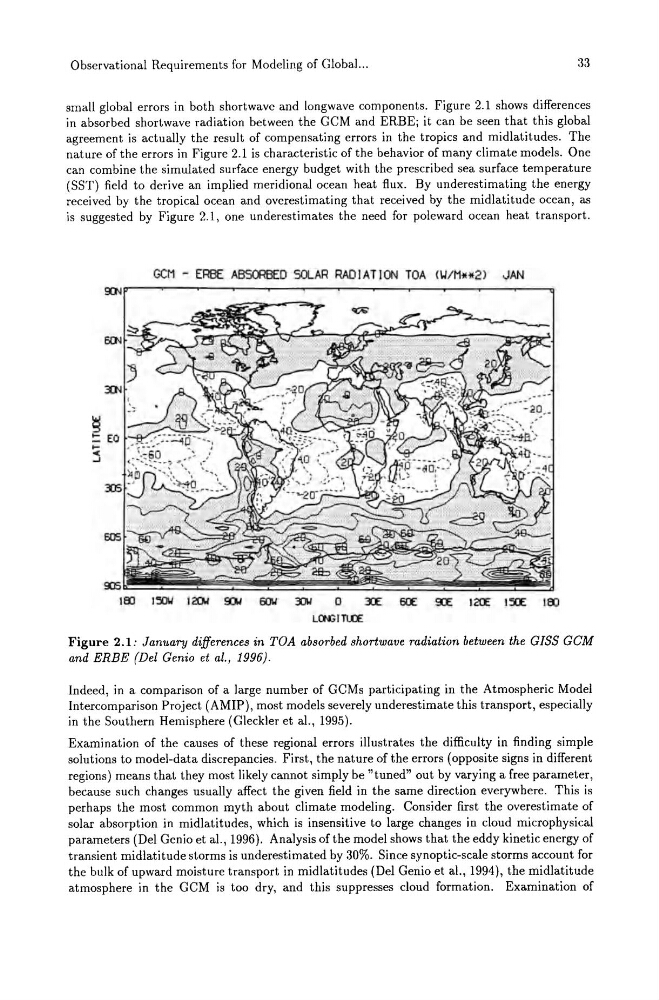
small global errors in both shortwave and longwave components. Figure 2.1 shows differences
in absorbed shortwave radiation between the GCM and ERBEj it can be seen that this global
agreement is actually the result of compensating errors in the tropics and midlatitudes. The
nature of the errors in Figure 2.1 is characteristic of the behavior of many climate models. One
can combine the simulated surface energy budget with the prescribed sea surface temperature
(SST) field to derive an implied meridional ocean heat flux. By underestimating the energy
received by the tropical ocean and overestimating that received by the midlatitude ocean, as
is suggested by Figure 2.1, one underestimates the need for poleward ocean heat transport.
GeM - ERBE ABSORBED SQ.AR RAO I A Ti CN TOA (\.J/M**2) JAN
1 eo 1:5001 12Bl 9lI 6011 DI a :n: 6CE sa: 12CE 1 ~ 1 eo
LCN>ITt..a:
Figure 2.1: January differences in TOA absorbed shortwave radiation between the GISS GeM
and ERBE (Del Genio et al., 1996).
Indeed, in a comparison of a large number of GCMs participating in the Atmospheric Model
intercomparison Project (AMIP), most models severely underestimate this transport, especially
in the Southern Hemisphere (Gleckler et al., 1995).
Examination of the causes of these regional errors illustrates the difficulty in finding simple
solutions to model-data discrepancies. First, the nature of the errors (opposite signs in different
regions) means that they most likely cannot simply be "tuned" out by varying a free parameter,
because such changes usually affect the given field in the same direction everywhere. This is
perhaps the most common myth about climate modeling. Consider first the overestimate of
solar absorption in midlatitudes, which is insensitive to large changes in cloud microphysical
parameters (Del Genio et al., 1996). Analysis of the model shows that the eddy kinetic energy of
transient midlatitude storms is underestimated by 30%. Since synoptic-scale storms account for
the bulk of upward moisture transport in midlatitudes (Del Genio et aI., 1994), the midlatitude
atmosphere in the GCM is too dry, and this suppresses cloud formation. Examination of
33
small global errors in both shortwave and longwave components. Figure 2.1 shows differences
in absorbed shortwave radiation between the GCM and ERBEj it can be seen that this global
agreement is actually the result of compensating errors in the tropics and midlatitudes. The
nature of the errors in Figure 2.1 is characteristic of the behavior of many climate models. One
can combine the simulated surface energy budget with the prescribed sea surface temperature
(SST) field to derive an implied meridional ocean heat flux. By underestimating the energy
received by the tropical ocean and overestimating that received by the midlatitude ocean, as
is suggested by Figure 2.1, one underestimates the need for poleward ocean heat transport.
GeM - ERBE ABSORBED SQ.AR RAO I A Ti CN TOA (\.J/M**2) JAN
1 eo 1:5001 12Bl 9lI 6011 DI a :n: 6CE sa: 12CE 1 ~ 1 eo
LCN>ITt..a:
Figure 2.1: January differences in TOA absorbed shortwave radiation between the GISS GeM
and ERBE (Del Genio et al., 1996).
Indeed, in a comparison of a large number of GCMs participating in the Atmospheric Model
intercomparison Project (AMIP), most models severely underestimate this transport, especially
in the Southern Hemisphere (Gleckler et al., 1995).
Examination of the causes of these regional errors illustrates the difficulty in finding simple
solutions to model-data discrepancies. First, the nature of the errors (opposite signs in different
regions) means that they most likely cannot simply be "tuned" out by varying a free parameter,
because such changes usually affect the given field in the same direction everywhere. This is
perhaps the most common myth about climate modeling. Consider first the overestimate of
solar absorption in midlatitudes, which is insensitive to large changes in cloud microphysical
parameters (Del Genio et al., 1996). Analysis of the model shows that the eddy kinetic energy of
transient midlatitude storms is underestimated by 30%. Since synoptic-scale storms account for
the bulk of upward moisture transport in midlatitudes (Del Genio et aI., 1994), the midlatitude
atmosphere in the GCM is too dry, and this suppresses cloud formation. Examination of