

404
W.G.M. Bastiaanssen
scale, >. (J kg-I) is the latent heat of vaporization, qa (-) is the air specific humidity and q.
(-) is the humidity scale. A full explanation of the symbols is presented in Appendix 1. It
is useful to express the u., T. and q. scales into profiles of horizontal windspeed u, potential
temperature Tp and air specific humidity qa respectively:
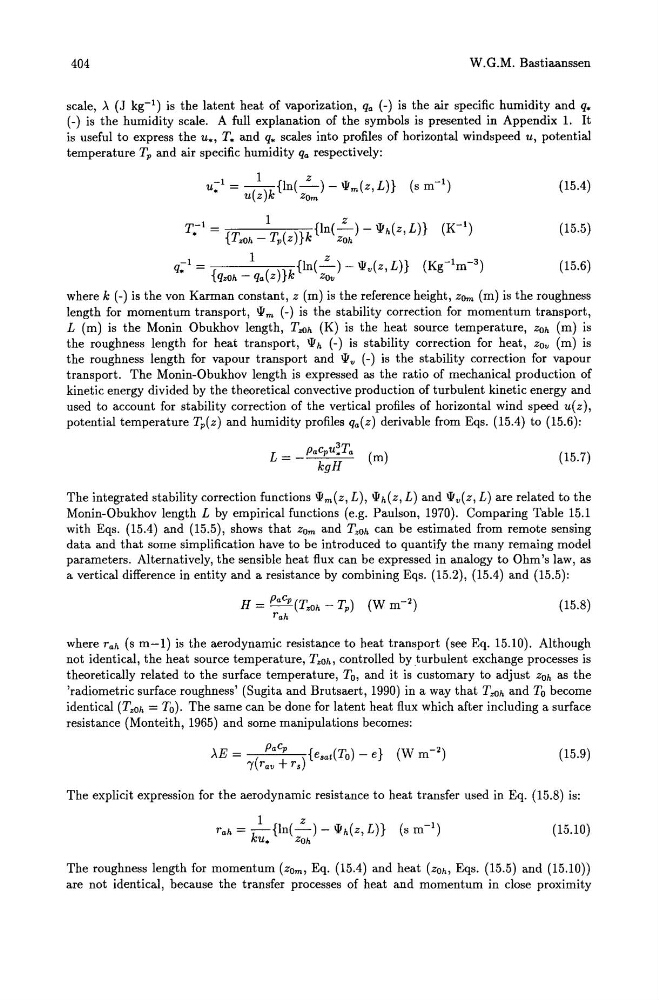
(15.4)
(15.5)
(15.6)
where k (-) is the von Karman constant, Z (m) is the reference height, ZOm (m) is the roughness
length for momentum transport, i[lm (-) is the stability correction for momentum transport,
L (m) is the Monin Obukhov length, TzOh (K) is the heat source temperature, ZOh (m) is
the roughness length for heat transport, i[lh (-) is stability correction for heat, ZOv (m) is
the roughness length for vapour transport and i[lv (-) is the stability correction for vapour
transport. The Monin-Obukhov length is expressed as the ratio of mechanical production of
kinetic energy divided by the theoretical convective production of turbulent kinetic energy and
used to account for stability correction of the vertical profiles of horizontal wind speed u(z),
potential temperature Tp(z) and humidity profiles qa(z) derivable from Eqs. (15.4) to (15.6):
L = _PaCpu~Ta (m)
kgH
(15.7)
The integrated stability correction functions i[lm(z, L), i[lh(Z, L) and i[lv(z, L) are related to the
Monin-Obukhov length L by empirical functions (e.g. Paulson, 1970). Comparing Table 15.1
with Eqs. (15.4) and (15.5), shows that ZOrn and TzOh can be estimated from remote sensing
data and that some simplification have to be introduced to quantify the many remaing model
parameters. Alternatively, the sensible heat flux can be expressed in analogy to Ohm's law, as
a vertical difference in entity and a resistance by combining Eqs. (15.2), (15.4) and (15.5):
(15.8)
where rah (s m-l) is the aerodynamic resistance to heat transport (see Eq. 15.10). Although
not identical, the heat source temperature, TzOh , controlled by turbulent exchange processes is
theoretically related to the surface temperature, To, and it is customary to adjust ZOh as the
'radiometric surface roughness' (Sugita and Brutsaert, 1990) in a way that TzOh and To become
identical (TzOh = To). The same can be done for latent heat flux which after including a surface
resistance (Monteith, 1965) and some manipulations becomes:
(15.9)
The explicit expression for the aerodynamic resistance to heat transfer used in Eq. (15.8) is:
1
Z
rah = -k {In(-) - i[lh(z,L)} (s m- I )
u.
ZOh
(15.10)
The roughness length for momentum (ZOm, Eq. (15.4) and heat (ZOh' Eqs. (15.5) and (15.10))
are not identical, because the transfer processes of heat and momentum in close proximity
W.G.M. Bastiaanssen
scale, >. (J kg-I) is the latent heat of vaporization, qa (-) is the air specific humidity and q.
(-) is the humidity scale. A full explanation of the symbols is presented in Appendix 1. It
is useful to express the u., T. and q. scales into profiles of horizontal windspeed u, potential
temperature Tp and air specific humidity qa respectively:
(15.4)
(15.5)
(15.6)
where k (-) is the von Karman constant, Z (m) is the reference height, ZOm (m) is the roughness
length for momentum transport, i[lm (-) is the stability correction for momentum transport,
L (m) is the Monin Obukhov length, TzOh (K) is the heat source temperature, ZOh (m) is
the roughness length for heat transport, i[lh (-) is stability correction for heat, ZOv (m) is
the roughness length for vapour transport and i[lv (-) is the stability correction for vapour
transport. The Monin-Obukhov length is expressed as the ratio of mechanical production of
kinetic energy divided by the theoretical convective production of turbulent kinetic energy and
used to account for stability correction of the vertical profiles of horizontal wind speed u(z),
potential temperature Tp(z) and humidity profiles qa(z) derivable from Eqs. (15.4) to (15.6):
L = _PaCpu~Ta (m)
kgH
(15.7)
The integrated stability correction functions i[lm(z, L), i[lh(Z, L) and i[lv(z, L) are related to the
Monin-Obukhov length L by empirical functions (e.g. Paulson, 1970). Comparing Table 15.1
with Eqs. (15.4) and (15.5), shows that ZOrn and TzOh can be estimated from remote sensing
data and that some simplification have to be introduced to quantify the many remaing model
parameters. Alternatively, the sensible heat flux can be expressed in analogy to Ohm's law, as
a vertical difference in entity and a resistance by combining Eqs. (15.2), (15.4) and (15.5):
(15.8)
where rah (s m-l) is the aerodynamic resistance to heat transport (see Eq. 15.10). Although
not identical, the heat source temperature, TzOh , controlled by turbulent exchange processes is
theoretically related to the surface temperature, To, and it is customary to adjust ZOh as the
'radiometric surface roughness' (Sugita and Brutsaert, 1990) in a way that TzOh and To become
identical (TzOh = To). The same can be done for latent heat flux which after including a surface
resistance (Monteith, 1965) and some manipulations becomes:
(15.9)
The explicit expression for the aerodynamic resistance to heat transfer used in Eq. (15.8) is:
1
Z
rah = -k {In(-) - i[lh(z,L)} (s m- I )
u.
ZOh
(15.10)
The roughness length for momentum (ZOm, Eq. (15.4) and heat (ZOh' Eqs. (15.5) and (15.10))
are not identical, because the transfer processes of heat and momentum in close proximity