

Remote Sensing of Soil Moisture
393
backscattering. Three corner reflectors are well recognizable as bright points on the right side
of Cerbaia, south of the Pesa. Forests are also evident as bright areas and agricultural fields are
clearly distinguishable: different levels of colour refer to different crops (Baronti et al., 1995) .
.... c:
Q)
u
:.;::
....
Q)
o
U
01 10 -1
c:
°C
Q)
.... .... o u
CfJ
.:::t:.
U
MA1988
MA1991
MA1995
Nadir Angle 30"
o
CD 1 0 -' 2 -I-_.___-r--T""""1r--T----r~--.--_.___...-f
2 4 6 8 10 12
Frequency (GHz)
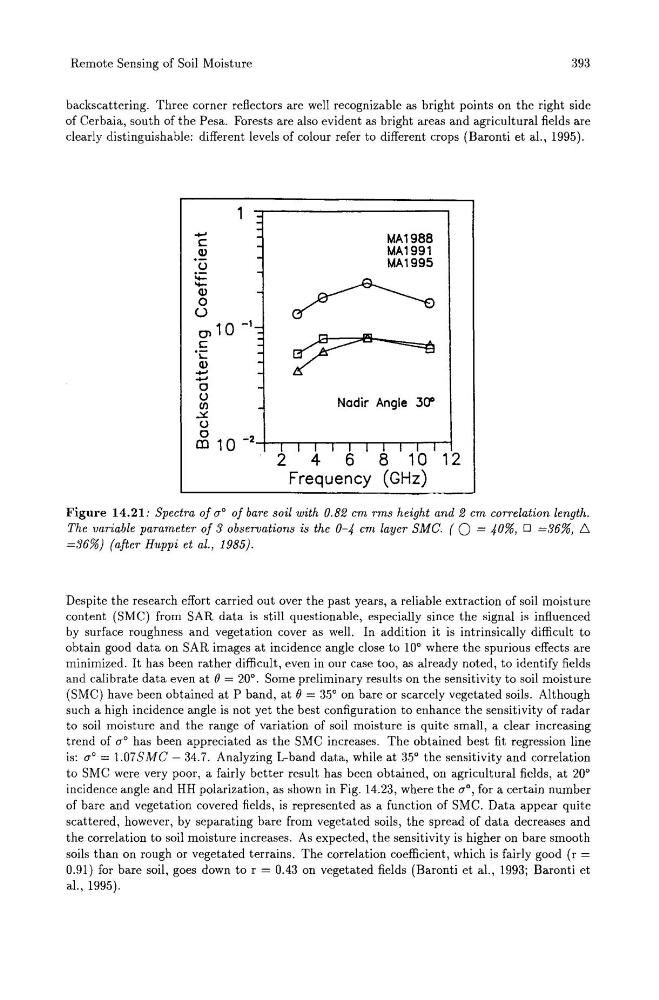
Figure 14.21: Spectra of (TO of bare soil with 0.82 cm rms height and 2 cm correlation length.
The variable parameter of 3 observations is the 0-4 cm layer SMC. (0 = 40%, 0 =36%, L,
=36%) (after Huppi et al., 1985).
Despite the research effort carried out over the past years, a reliable extraction of soil moisture
content (SMC) from SAR data is still questionable, especially since the signal is influenced
by surface roughness and vegetation cover as well. In addition it is intrinsically difficult to
obtain good data on SAR images at incidence angle close to 10° where the spurious effects are
minimized. It has been rather difficult, even in our case too, as already noted, to identify fields
and calibrate data even at e = 20°. Some preliminary results on the sensitivity to soil moisture
(SMC) have been obtained at P band, at e = 35° on bare or scarcely vegetated soils. Although
such a high incidence angle is not yet the best configuration to enhance the sensitivity of radar
to soil moisture and the range of variation of soil moisture is quite small, a clear increasing
trend of (TO has been appreciated as the SMC increases. The obtained best fit regression line
is: (TO = 1.07SMC - 34.7. Analyzing L-band data, while at 35° the sensitivity and correlation
to SMC were very poor, a fairly better result has been obtained, on agricultural fields, at 20°
incidence angle and HH polarization, as shown in Fig. 14.23, where the (To, for a certain number
of bare and vegetation covered fields, is represented as a function of SMC. Data appear quite
scattered, however, by separating bare from vegetated soils, the spread of data decreases and
the correlation to soil moisture increases. As expected, the sensitivity is higher on bare smooth
soils than on rough or vegetated terrains. The correlation coefficient, which is fairly good (r =
0.91) for bare soil, goes down to r = 0.43 on vegetated fields (Baronti et al., 1993; Baronti et
al., 1995).
393
backscattering. Three corner reflectors are well recognizable as bright points on the right side
of Cerbaia, south of the Pesa. Forests are also evident as bright areas and agricultural fields are
clearly distinguishable: different levels of colour refer to different crops (Baronti et al., 1995) .
.... c:
Q)
u
:.;::
....
Q)
o
U
01 10 -1
c:
°C
Q)
.... .... o u
CfJ
.:::t:.
U
MA1988
MA1991
MA1995
Nadir Angle 30"
o
CD 1 0 -' 2 -I-_.___-r--T""""1r--T----r~--.--_.___...-f
2 4 6 8 10 12
Frequency (GHz)
Figure 14.21: Spectra of (TO of bare soil with 0.82 cm rms height and 2 cm correlation length.
The variable parameter of 3 observations is the 0-4 cm layer SMC. (0 = 40%, 0 =36%, L,
=36%) (after Huppi et al., 1985).
Despite the research effort carried out over the past years, a reliable extraction of soil moisture
content (SMC) from SAR data is still questionable, especially since the signal is influenced
by surface roughness and vegetation cover as well. In addition it is intrinsically difficult to
obtain good data on SAR images at incidence angle close to 10° where the spurious effects are
minimized. It has been rather difficult, even in our case too, as already noted, to identify fields
and calibrate data even at e = 20°. Some preliminary results on the sensitivity to soil moisture
(SMC) have been obtained at P band, at e = 35° on bare or scarcely vegetated soils. Although
such a high incidence angle is not yet the best configuration to enhance the sensitivity of radar
to soil moisture and the range of variation of soil moisture is quite small, a clear increasing
trend of (TO has been appreciated as the SMC increases. The obtained best fit regression line
is: (TO = 1.07SMC - 34.7. Analyzing L-band data, while at 35° the sensitivity and correlation
to SMC were very poor, a fairly better result has been obtained, on agricultural fields, at 20°
incidence angle and HH polarization, as shown in Fig. 14.23, where the (To, for a certain number
of bare and vegetation covered fields, is represented as a function of SMC. Data appear quite
scattered, however, by separating bare from vegetated soils, the spread of data decreases and
the correlation to soil moisture increases. As expected, the sensitivity is higher on bare smooth
soils than on rough or vegetated terrains. The correlation coefficient, which is fairly good (r =
0.91) for bare soil, goes down to r = 0.43 on vegetated fields (Baronti et al., 1993; Baronti et
al., 1995).