

378
S. Paloscia
1·0 K
o·g
0·8
+ (a l }2
+(bl
0·7
0·6
3
(b)
o
0'1
0·2
0·3
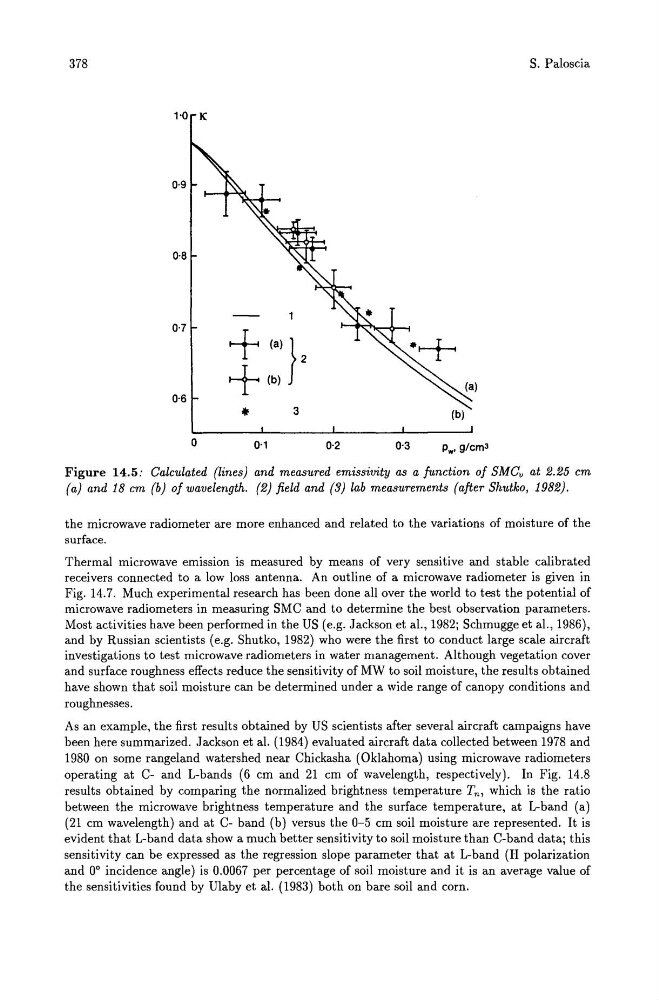
Figure 14.5: Calculated (lines) and measured emissivity as a function of SMC. at 2.25 cm
(a) and 18 cm (b) of wavelength. (2) field and (3) lab measurements (after Shutko, 1982).
the microwave radiometer are more enhanced and related to the variations of moisture of the
surface.
Thermal microwave emission is measured by means of very sensitive and stable calibrated
receivers connected to a low loss antenna. An outline of a microwave radiometer is given in
Fig. 14.7. Much experimental research has been done all over the world to test the potential of
microwave radiometers in measuring SMC and to determine the best observation parameters.
Most activities have been performed in the US (e.g. Jackson et aI., 1982; Schmugge et aI., 1986),
and by Russian scientists (e.g. Shutko, 1982) who were the first to conduct large scale aircraft
investigations to test microwave radiometers in water management. Although vegetation cover
and surface roughness effects reduce the sensitivity of MW to soil moisture, the results obtained
have shown that soil moisture can be determined under a wide range of canopy conditions and
roughnesses.
As an example, the first results obtained by US scientists after several aircraft campaigns have
been here summarized. Jackson et al. (1984) evaluated aircraft data collected between 1978 and
1980 on some rangeland watershed near Chickasha (Oklahoma) using microwave radiometers
operating at C- and L-bands (6 cm and 21 cm of wavelength, respectively). In Fig. 14.8
results obtained by comparing the normalized brightness temperature Tn, which is the ratio
between the microwave brightness temperature and the surface temperature, at L-band (a)
(21 cm wavelength) and at C- band (b) versus the 0-5 cm soil moisture are represented. It is
evident that L-band data show a much better sensitivity to soil moisture than C-band data; this
sensitivity can be expressed as the regression slope parameter that at L-band (H polarization
and 0° incidence angle) is 0.0067 per percentage of soil moisture and it is an average value of
the sensitivities found by Ulabyet al. (1983) both on bare soil and corn.
S. Paloscia
1·0 K
o·g
0·8
+ (a l }2
+(bl
0·7
0·6
3
(b)
o
0'1
0·2
0·3
Figure 14.5: Calculated (lines) and measured emissivity as a function of SMC. at 2.25 cm
(a) and 18 cm (b) of wavelength. (2) field and (3) lab measurements (after Shutko, 1982).
the microwave radiometer are more enhanced and related to the variations of moisture of the
surface.
Thermal microwave emission is measured by means of very sensitive and stable calibrated
receivers connected to a low loss antenna. An outline of a microwave radiometer is given in
Fig. 14.7. Much experimental research has been done all over the world to test the potential of
microwave radiometers in measuring SMC and to determine the best observation parameters.
Most activities have been performed in the US (e.g. Jackson et aI., 1982; Schmugge et aI., 1986),
and by Russian scientists (e.g. Shutko, 1982) who were the first to conduct large scale aircraft
investigations to test microwave radiometers in water management. Although vegetation cover
and surface roughness effects reduce the sensitivity of MW to soil moisture, the results obtained
have shown that soil moisture can be determined under a wide range of canopy conditions and
roughnesses.
As an example, the first results obtained by US scientists after several aircraft campaigns have
been here summarized. Jackson et al. (1984) evaluated aircraft data collected between 1978 and
1980 on some rangeland watershed near Chickasha (Oklahoma) using microwave radiometers
operating at C- and L-bands (6 cm and 21 cm of wavelength, respectively). In Fig. 14.8
results obtained by comparing the normalized brightness temperature Tn, which is the ratio
between the microwave brightness temperature and the surface temperature, at L-band (a)
(21 cm wavelength) and at C- band (b) versus the 0-5 cm soil moisture are represented. It is
evident that L-band data show a much better sensitivity to soil moisture than C-band data; this
sensitivity can be expressed as the regression slope parameter that at L-band (H polarization
and 0° incidence angle) is 0.0067 per percentage of soil moisture and it is an average value of
the sensitivities found by Ulabyet al. (1983) both on bare soil and corn.