

Precipitation at the Ground: Radar Techniques
319
of the equivalent reflectance factor Ze and the differential reflectance ZDR suggests the target
may be separated as being hail, rain, drizzle or snow.
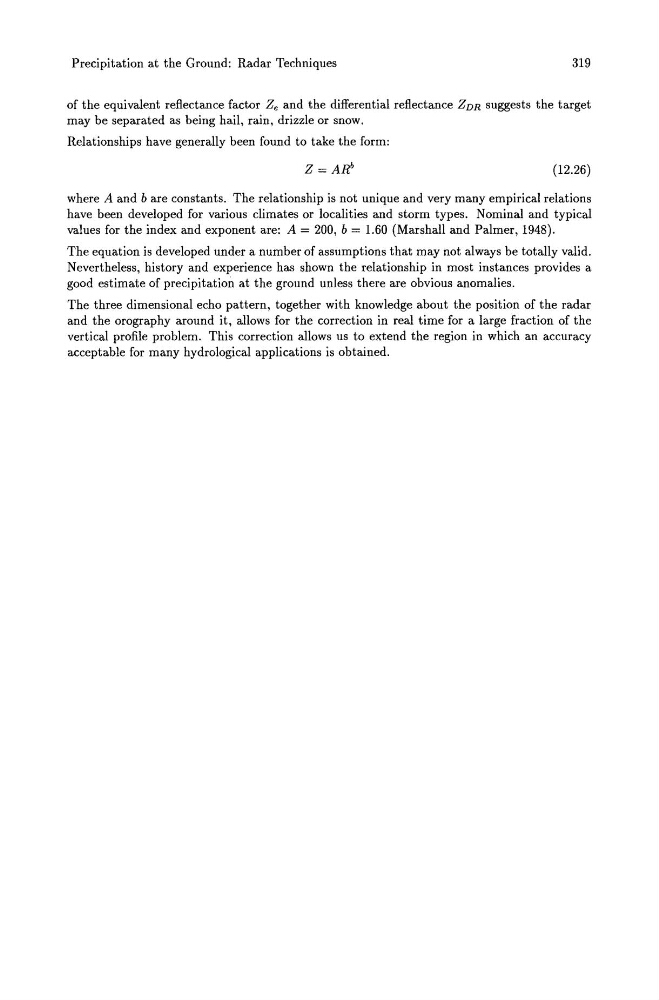
Relationships have generally been found to take the form:
(12.26)
where A and b are constants. The relationship is not unique and very many empirical relations
have been developed for various climates or localities and storm types. Nominal and typical
values for the index and exponent are: A = 200, b = 1.60 (Marshall and Palmer, 1948).
The equation is developed under a number of assumptions that may not always be totally valid.
Nevertheless, history and experience has shown the relationship in most instances provides a
good estimate of precipitation at the ground unless there are obvious anomalies.
The three dimensional echo pattern, together with knowledge about the position of the radar
and the orography around it, allows for the correction in real time for a large fraction of the
vertical profile problem. This correction allows us to extend the region in which an accuracy
acceptable for many hydrological applications is obtained.
319
of the equivalent reflectance factor Ze and the differential reflectance ZDR suggests the target
may be separated as being hail, rain, drizzle or snow.
Relationships have generally been found to take the form:
(12.26)
where A and b are constants. The relationship is not unique and very many empirical relations
have been developed for various climates or localities and storm types. Nominal and typical
values for the index and exponent are: A = 200, b = 1.60 (Marshall and Palmer, 1948).
The equation is developed under a number of assumptions that may not always be totally valid.
Nevertheless, history and experience has shown the relationship in most instances provides a
good estimate of precipitation at the ground unless there are obvious anomalies.
The three dimensional echo pattern, together with knowledge about the position of the radar
and the orography around it, allows for the correction in real time for a large fraction of the
vertical profile problem. This correction allows us to extend the region in which an accuracy
acceptable for many hydrological applications is obtained.