

264
C. Simmer
The elements of the matrix D are then determined by minimizing the quadratic difference
between the estimated parameters and the exact ones for the data set leading to the equation
(e.g. Houghton et al., 1984)
(11.7)
where Sr,x, is the covariance matrix of the radiances with the parameters and Sr,r the covariance
matrix of the radiances. Instead of using the radiances and the sought parameters itself in (11.6)
transformations of both can be used to linearize the relation between both. This is especially
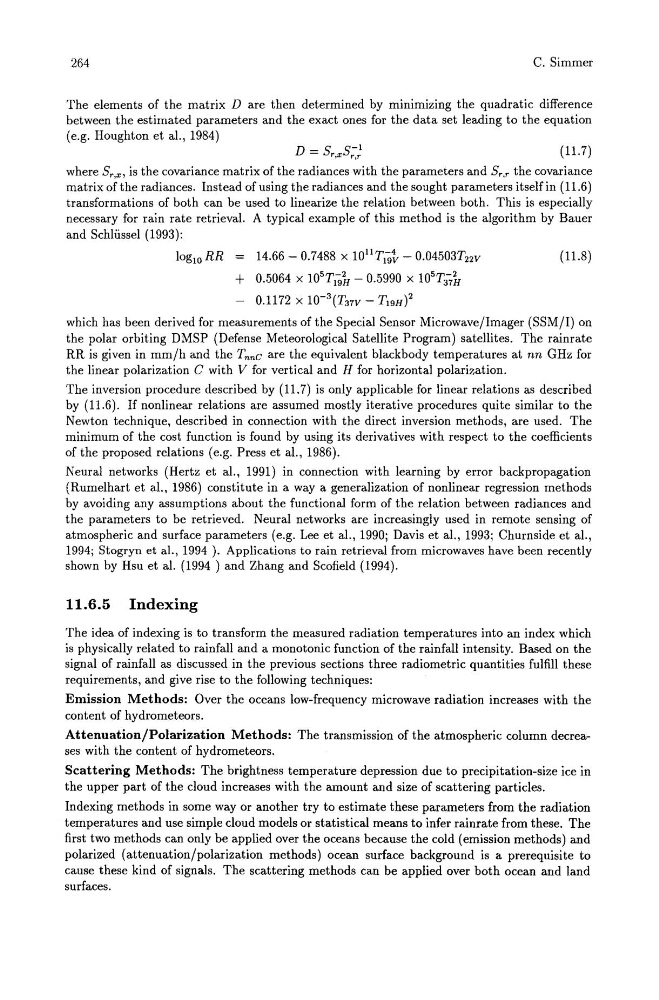
necessary for rain rate retrieval. A typical example of this method is the algorithm by Bauer
and Schliissel (1993):
14.66 - 0.7488 x lOll Ti;t - 0.04503T22V
+ 0.5064 x 10 5 Ti;k - 0.5990 x 10 5 T37k
O.ll72 x 1O-3(T37v - T19H )2
(11.8)
which has been derived for measurements of the Special Sensor Microwave/Imager (SSM/I) on
the polar orbiting DMSP (Defense Meteorological Satellite Program) satellites. The rainrate
RR is given in mm/h and the Tnnc are the equivalent blackbody temperatures at nn GHz for
the linear polarization C with V for vertical and H for horizontal polarization.
The inversion procedure described by (11. 7) is only applicable for linear relations as described
by (11.6). If nonlinear relations are assumed mostly iterative procedures quite similar to the
Newton technique, described in connection with the direct inversion methods, are used. The
minimum of the cost function is found by using its derivatives with respect to the coefficients
of the proposed relations (e.g. Press et al., 1986).
Neural networks (Hertz et al., 1991) in connection with learning by error backpropagation
(Rumelhart et aI., 1986) constitute in a way a generalization of nonlinear regression methods
by avoiding any assumptions about the functional form of the relation between radiances and
the parameters to be retrieved. Neural networks are increasingly used in remote sensing of
atmospheric and surface parameters (e.g. Lee et al., 1990; Davis et al., 1993; Churnside et al.,
1994; Stogryn et al., 1994 ). Applications to rain retrieval from microwaves have been recently
shown by Hsu et al. (1994 ) and Zhang and Scofield (1994).
11.6.5 Indexing
The idea of indexing is to transform the measured radiation temperatures into an index which
is physically related to rainfall and a monotonic function of the rainfall intensity. Based on the
signal of rainfall as discussed in the previous sections three radiometric quantities fulfill these
requirements, and give rise to the following techniques:
Emission Methods: Over the oceans low-frequency microwave radiation increases with the
content of hydrometeors.
Attenuation/Polarization Methods: The transmission of the atmospheric column decreases with the content of hydrometeors.
Scattering Methods: The brightness temperature depression due to precipitation-size ice in
the upper part of the cloud increases with the amount and size of scattering particles.
Indexing methods in some way or another try to estimate these parameters from the radiation
temperatures and use simple cloud models or statistical means to infer rainrate from these. The
first two methods can only be applied over the oceans because the cold (emission methods) and
polarized (attenuation/polarization methods) ocean surface background is a prerequisite to
cause these kind of signals. The scattering methods can be applied over both ocean and land
surfaces.
C. Simmer
The elements of the matrix D are then determined by minimizing the quadratic difference
between the estimated parameters and the exact ones for the data set leading to the equation
(e.g. Houghton et al., 1984)
(11.7)
where Sr,x, is the covariance matrix of the radiances with the parameters and Sr,r the covariance
matrix of the radiances. Instead of using the radiances and the sought parameters itself in (11.6)
transformations of both can be used to linearize the relation between both. This is especially
necessary for rain rate retrieval. A typical example of this method is the algorithm by Bauer
and Schliissel (1993):
14.66 - 0.7488 x lOll Ti;t - 0.04503T22V
+ 0.5064 x 10 5 Ti;k - 0.5990 x 10 5 T37k
O.ll72 x 1O-3(T37v - T19H )2
(11.8)
which has been derived for measurements of the Special Sensor Microwave/Imager (SSM/I) on
the polar orbiting DMSP (Defense Meteorological Satellite Program) satellites. The rainrate
RR is given in mm/h and the Tnnc are the equivalent blackbody temperatures at nn GHz for
the linear polarization C with V for vertical and H for horizontal polarization.
The inversion procedure described by (11. 7) is only applicable for linear relations as described
by (11.6). If nonlinear relations are assumed mostly iterative procedures quite similar to the
Newton technique, described in connection with the direct inversion methods, are used. The
minimum of the cost function is found by using its derivatives with respect to the coefficients
of the proposed relations (e.g. Press et al., 1986).
Neural networks (Hertz et al., 1991) in connection with learning by error backpropagation
(Rumelhart et aI., 1986) constitute in a way a generalization of nonlinear regression methods
by avoiding any assumptions about the functional form of the relation between radiances and
the parameters to be retrieved. Neural networks are increasingly used in remote sensing of
atmospheric and surface parameters (e.g. Lee et al., 1990; Davis et al., 1993; Churnside et al.,
1994; Stogryn et al., 1994 ). Applications to rain retrieval from microwaves have been recently
shown by Hsu et al. (1994 ) and Zhang and Scofield (1994).
11.6.5 Indexing
The idea of indexing is to transform the measured radiation temperatures into an index which
is physically related to rainfall and a monotonic function of the rainfall intensity. Based on the
signal of rainfall as discussed in the previous sections three radiometric quantities fulfill these
requirements, and give rise to the following techniques:
Emission Methods: Over the oceans low-frequency microwave radiation increases with the
content of hydrometeors.
Attenuation/Polarization Methods: The transmission of the atmospheric column decreases with the content of hydrometeors.
Scattering Methods: The brightness temperature depression due to precipitation-size ice in
the upper part of the cloud increases with the amount and size of scattering particles.
Indexing methods in some way or another try to estimate these parameters from the radiation
temperatures and use simple cloud models or statistical means to infer rainrate from these. The
first two methods can only be applied over the oceans because the cold (emission methods) and
polarized (attenuation/polarization methods) ocean surface background is a prerequisite to
cause these kind of signals. The scattering methods can be applied over both ocean and land
surfaces.