

Retrieval of Precipitation from Satellites
263
• Library search
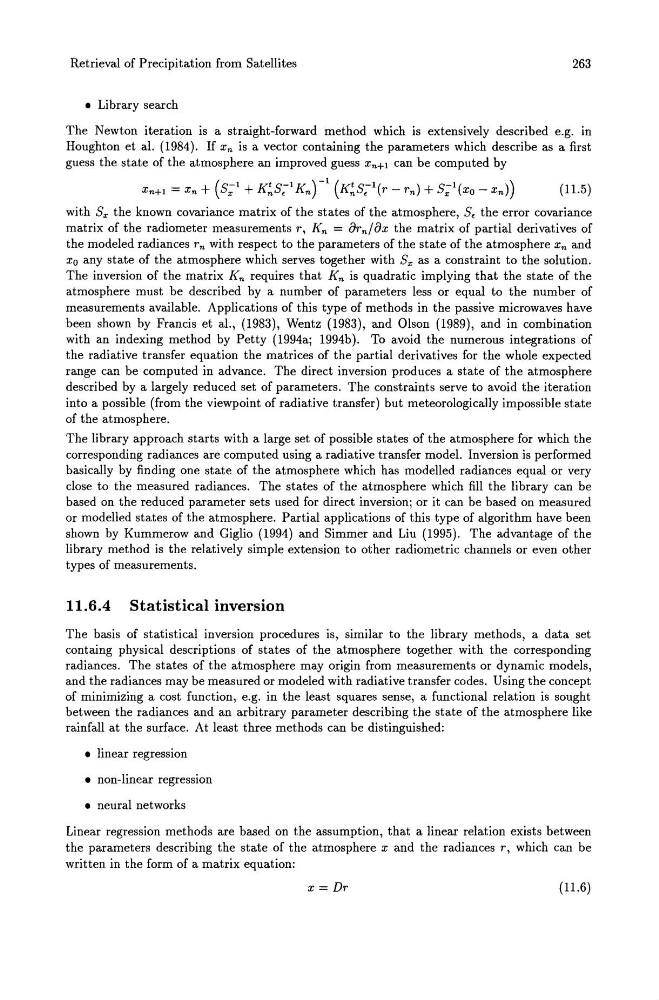
The Newton iteration is a straight-forward method which is extensively described e.g. in
Houghton et al. (1984). If Xn is a vector containing the parameters which describe as a first
guess the state of the atmosphere an improved guess X n +1 can be computed by
(11.5 )
with Sx the known covariance matrix of the states of the atmosphere, S, the error covariance
matrix of the radiometer measurements r, Kn = 8rn/8x the matrix of partial derivatives of
the modeled radiances rn with respect to the parameters of the state of the atmosphere Xn and
Xo any state of the atmosphere which serves together with Sx as a constraint to the solution.
The inversion of the matrix Kn requires that Kn is quadratic implying that the state of the
atmosphere must be described by a number of parameters less or equal to the number of
measurements available. Applications of this type of methods in the passive microwaves have
been shown by Francis et al., (1983), Wentz (1983), and Olson (1989), and in combination
with an indexing method by Petty (1994a; 1994b). To avoid the numerous integrations of
the radiative transfer equation the matrices of the partial derivatives for the whole expected
range can be computed in advance. The direct inversion produces a state of the atmosphere
described by a largely reduced set of parameters. The constraints serve to avoid the iteration
into a possible (from the viewpoint of radiative transfer) but meteorologically impossible state
of the atmosphere.
The library approach starts with a large set of possible states of the atmosphere for which the
corresponding radiances are computed using a radiative transfer model. Inversion is performed
basically by finding one state of the atmosphere which has modelled radiances equal or very
close to the measured radiances. The states of the atmosphere which fill the library can be
based on the reduced parameter sets used for direct inversion; or it can be based on measured
or modelled states of the atmosphere. Partial applications of this type of algorithm have been
shown by Kummerow and Giglio (1994) and Simmer and Liu (1995). The advantage of the
library method is the relatively simple extension to other radiometric channels or even other
types of measurements.
11.6.4 Statistical inversion
The basis of statistical inversion procedures is, similar to the library methods, a data set
containg physical descriptions of states of the atmosphere together with the corresponding
radiances. The states of the atmosphere may origin from measurements or dynamic models,
and the radiances may be measured or modeled with radiative transfer codes. Using the concept
of minimizing a cost function, e.g. in the least squares sense, a functional relation is sought
between the radiances and an arbitrary parameter describing the state of the atmosphere like
rainfall at the surface. At least three methods can be distinguished:
• linear regression
• non-linear regression
• neural networks
Linear regression methods are based on the assumption, that a linear relation exists between
the parameters describing the state of the atmosphere x and the radiances r, which can be
written in the form of a matrix equation:
x = Dr
(11.6)
263
• Library search
The Newton iteration is a straight-forward method which is extensively described e.g. in
Houghton et al. (1984). If Xn is a vector containing the parameters which describe as a first
guess the state of the atmosphere an improved guess X n +1 can be computed by
(11.5 )
with Sx the known covariance matrix of the states of the atmosphere, S, the error covariance
matrix of the radiometer measurements r, Kn = 8rn/8x the matrix of partial derivatives of
the modeled radiances rn with respect to the parameters of the state of the atmosphere Xn and
Xo any state of the atmosphere which serves together with Sx as a constraint to the solution.
The inversion of the matrix Kn requires that Kn is quadratic implying that the state of the
atmosphere must be described by a number of parameters less or equal to the number of
measurements available. Applications of this type of methods in the passive microwaves have
been shown by Francis et al., (1983), Wentz (1983), and Olson (1989), and in combination
with an indexing method by Petty (1994a; 1994b). To avoid the numerous integrations of
the radiative transfer equation the matrices of the partial derivatives for the whole expected
range can be computed in advance. The direct inversion produces a state of the atmosphere
described by a largely reduced set of parameters. The constraints serve to avoid the iteration
into a possible (from the viewpoint of radiative transfer) but meteorologically impossible state
of the atmosphere.
The library approach starts with a large set of possible states of the atmosphere for which the
corresponding radiances are computed using a radiative transfer model. Inversion is performed
basically by finding one state of the atmosphere which has modelled radiances equal or very
close to the measured radiances. The states of the atmosphere which fill the library can be
based on the reduced parameter sets used for direct inversion; or it can be based on measured
or modelled states of the atmosphere. Partial applications of this type of algorithm have been
shown by Kummerow and Giglio (1994) and Simmer and Liu (1995). The advantage of the
library method is the relatively simple extension to other radiometric channels or even other
types of measurements.
11.6.4 Statistical inversion
The basis of statistical inversion procedures is, similar to the library methods, a data set
containg physical descriptions of states of the atmosphere together with the corresponding
radiances. The states of the atmosphere may origin from measurements or dynamic models,
and the radiances may be measured or modeled with radiative transfer codes. Using the concept
of minimizing a cost function, e.g. in the least squares sense, a functional relation is sought
between the radiances and an arbitrary parameter describing the state of the atmosphere like
rainfall at the surface. At least three methods can be distinguished:
• linear regression
• non-linear regression
• neural networks
Linear regression methods are based on the assumption, that a linear relation exists between
the parameters describing the state of the atmosphere x and the radiances r, which can be
written in the form of a matrix equation:
x = Dr
(11.6)