

238
30
20
E
-'"
.S
~ 10
'0
:t:
C. Weitkamp
••••••
3
12
40
Zeit in Kalendermonaten
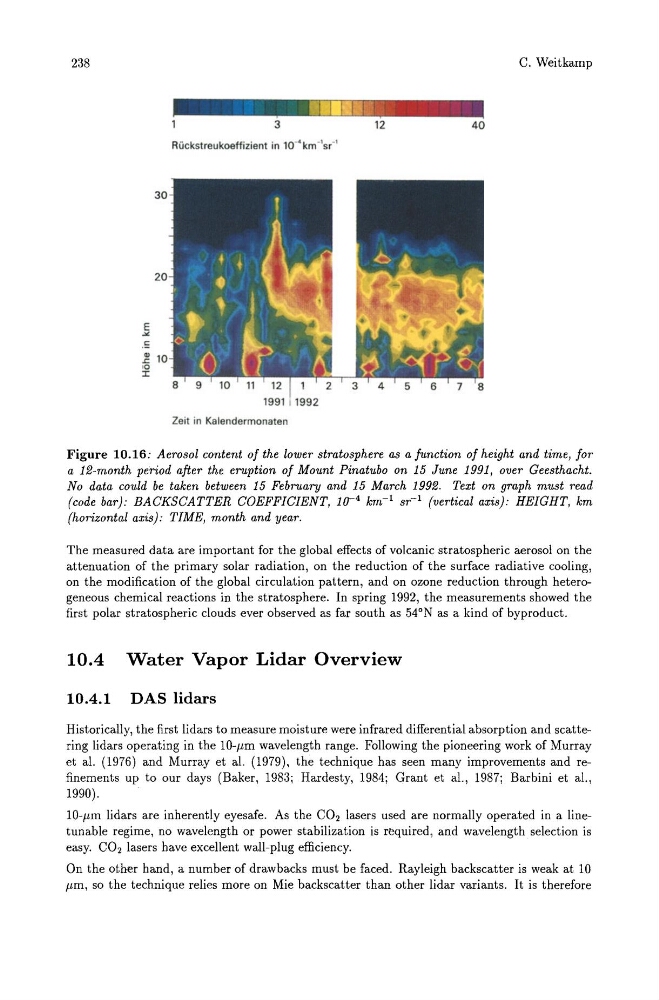
Figure 10.16: Aerosol content of the lower stratosphere as a function of height and time, for
a 12-month period after the eruption of Mount Pinatubo on 15 June 1991, over Geesthacht.
No data could be taken between 15 February and 15 March 1992. Text on graph must read
(code bar): BACKSCATTER COEFFICIENT, l(J4 km- l sr- l (vertical axis): HEIGHT, km
(horizontal axis): TIME, month and year.
The measured data are important for the global effects of volcanic stratospheric aerosol on the
attenuation of the primary solar radiation, on the reduction of the surface radiative cooling,
on the modification of the global circulation pattern, and on ozone reduction through heterogeneous chemical reactions in the stratosphere. In spring 1992, the measurements showed the
first polar stratospheric clouds ever observed as far south as 54°N as a kind of byproduct.
10.4 Water Vapor Lidar Overview
10.4.1 DAS lidars
Historically, the first lidars to measure moisture were infrared differential absorption and scattering lidars operating in the 10-j.lm wavelength range. Following the pioneering work of Murray
et al. (1976) and Murray et al. (1979), the technique has seen many improvements and refinements up to our days (Baker, 1983; Hardesty, 1984; Grant et al., 1987; Barbini et al.,
1990).
lO-j.lm lidars are inherently eyesafe. As the CO2 lasers used are normally operated in a linetunable regime, no wavelength or power stabilization is required, and wavelength selection is
easy. CO2 lasers have excellent wall-plug efficiency.
On the other hand, a number of drawbacks must be faced. Rayleigh backscatter is weak at 10
j.lm, so the technique relies more on Mie backscatter than other lidar variants. It is therefore
30
20
E
-'"
.S
~ 10
'0
:t:
C. Weitkamp
••••••
3
12
40
Zeit in Kalendermonaten
Figure 10.16: Aerosol content of the lower stratosphere as a function of height and time, for
a 12-month period after the eruption of Mount Pinatubo on 15 June 1991, over Geesthacht.
No data could be taken between 15 February and 15 March 1992. Text on graph must read
(code bar): BACKSCATTER COEFFICIENT, l(J4 km- l sr- l (vertical axis): HEIGHT, km
(horizontal axis): TIME, month and year.
The measured data are important for the global effects of volcanic stratospheric aerosol on the
attenuation of the primary solar radiation, on the reduction of the surface radiative cooling,
on the modification of the global circulation pattern, and on ozone reduction through heterogeneous chemical reactions in the stratosphere. In spring 1992, the measurements showed the
first polar stratospheric clouds ever observed as far south as 54°N as a kind of byproduct.
10.4 Water Vapor Lidar Overview
10.4.1 DAS lidars
Historically, the first lidars to measure moisture were infrared differential absorption and scattering lidars operating in the 10-j.lm wavelength range. Following the pioneering work of Murray
et al. (1976) and Murray et al. (1979), the technique has seen many improvements and refinements up to our days (Baker, 1983; Hardesty, 1984; Grant et al., 1987; Barbini et al.,
1990).
lO-j.lm lidars are inherently eyesafe. As the CO2 lasers used are normally operated in a linetunable regime, no wavelength or power stabilization is required, and wavelength selection is
easy. CO2 lasers have excellent wall-plug efficiency.
On the other hand, a number of drawbacks must be faced. Rayleigh backscatter is weak at 10
j.lm, so the technique relies more on Mie backscatter than other lidar variants. It is therefore