

12
E. Raschke
schemes for the description of clouds and their impacts in larger-scale circulation models. These
experiments are known under the names FIRE (First ISCCP Regional Experiment; Randall et
al. 1996), EUCREX (European Cloud and Radiation Experiment; Raschke et al., 1989) and
JACCS (Japanese Cloud and Climate Studies; Asano et al., 1992). They provided much new
information on microphysical properties of clouds, in particular of the high cirrus. There were
also other related investigations. Another initiative will start over the Arctics sea ice fields
within the ACSYS (Arctic Climate Systems Study; WCRP 1994).
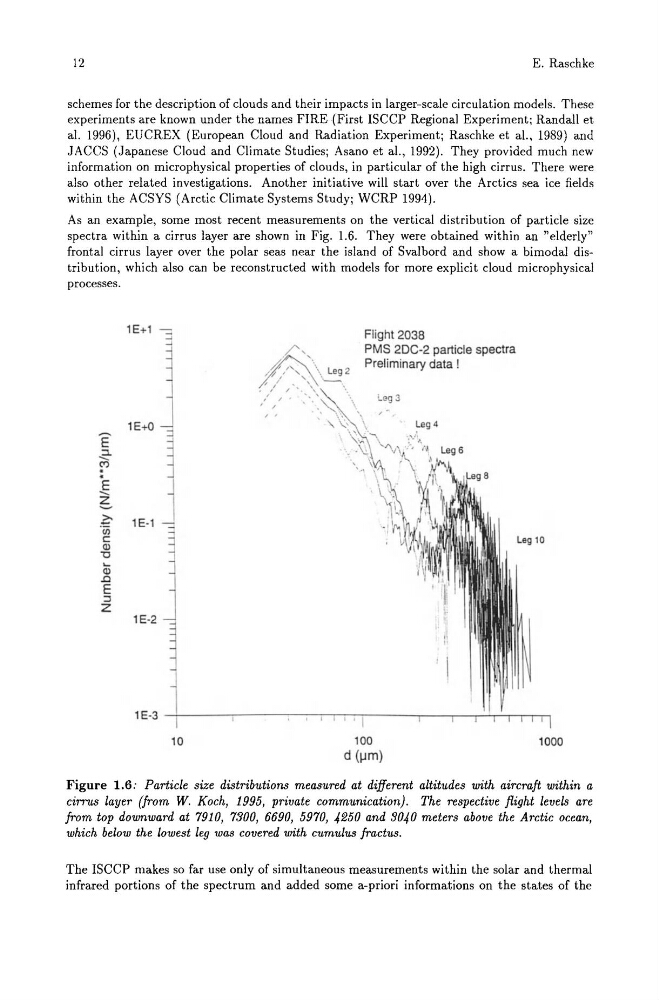
As an example, some most recent measurements on the vertical distribution of particle size
spectra within a cirrus layer are shown in Fig. 1.6. They were obtained within an "elderly"
frontal cirrus layer over the polar seas near the island of Svalbord and show a bimodal distribution, which also can be reconstructed with models for more explicit cloud microphysical
processes.
E :::J..
...... (')
. • E
......
~
.?;'(ij
c:
Q)
'0
...
Q)
.D
E
:::l
Z
1E+1
J
1E+O ::J
",]
1E·2
/',
. '.
4"
\ L
g ' ,,, \, eg 2
.>< / . . ~\ ' ~\'.
, ,
"
Flight 2038
PMS 2DC-2 particle spectra
Preliminary data!
Leg 3
I I
1E·3 -+-------.------~~'-.I-r~I_, ' ' I ------.----r--~~.-"I,I~I
10
100
1000
d (IJm)
Figure 1.6: Particle size distributions measured at different altitudes with aircraft within a
cirrus layer (from W. Koch, 1995, private communication). The respective flight levels are
from top downward at 7910, 7300, 6690, 5970, ,{250 and 3040 meters above the Arctic ocean,
which below the lowest leg was covered with cumulus fractus.
The ISCCP makes so far use only of simultaneous measurements within the solar and thermal
infrared portions of the spectrum and added some a-priori informations on the states of the
E. Raschke
schemes for the description of clouds and their impacts in larger-scale circulation models. These
experiments are known under the names FIRE (First ISCCP Regional Experiment; Randall et
al. 1996), EUCREX (European Cloud and Radiation Experiment; Raschke et al., 1989) and
JACCS (Japanese Cloud and Climate Studies; Asano et al., 1992). They provided much new
information on microphysical properties of clouds, in particular of the high cirrus. There were
also other related investigations. Another initiative will start over the Arctics sea ice fields
within the ACSYS (Arctic Climate Systems Study; WCRP 1994).
As an example, some most recent measurements on the vertical distribution of particle size
spectra within a cirrus layer are shown in Fig. 1.6. They were obtained within an "elderly"
frontal cirrus layer over the polar seas near the island of Svalbord and show a bimodal distribution, which also can be reconstructed with models for more explicit cloud microphysical
processes.
E :::J..
...... (')
. • E
......
~
.?;'(ij
c:
Q)
'0
...
Q)
.D
E
:::l
Z
1E+1
J
1E+O ::J
",]
1E·2
/',
. '.
4"
\ L
g ' ,,, \, eg 2
.>< / . . ~\ ' ~\'.
, ,
"
Flight 2038
PMS 2DC-2 particle spectra
Preliminary data!
Leg 3
I I
1E·3 -+-------.------~~'-.I-r~I_, ' ' I ------.----r--~~.-"I,I~I
10
100
1000
d (IJm)
Figure 1.6: Particle size distributions measured at different altitudes with aircraft within a
cirrus layer (from W. Koch, 1995, private communication). The respective flight levels are
from top downward at 7910, 7300, 6690, 5970, ,{250 and 3040 meters above the Arctic ocean,
which below the lowest leg was covered with cumulus fractus.
The ISCCP makes so far use only of simultaneous measurements within the solar and thermal
infrared portions of the spectrum and added some a-priori informations on the states of the