

Properties of Clouds and Cloud Systems
(a)
' " c~ ","''''~'.''''dl
m
no
'" m
'" ,,,
1_ SlrUlorm Cloud MYiI !
(b)
~
.--- .. .... ~ ...... ~. _ .
.a a,1i
~
i
~.," / -
1_ Stsa\dOrmCIoljaAnll~1
""'~--:::=~~~
1- CIoudCIuste O,50.L _ _ "'=====-~ __ J
211
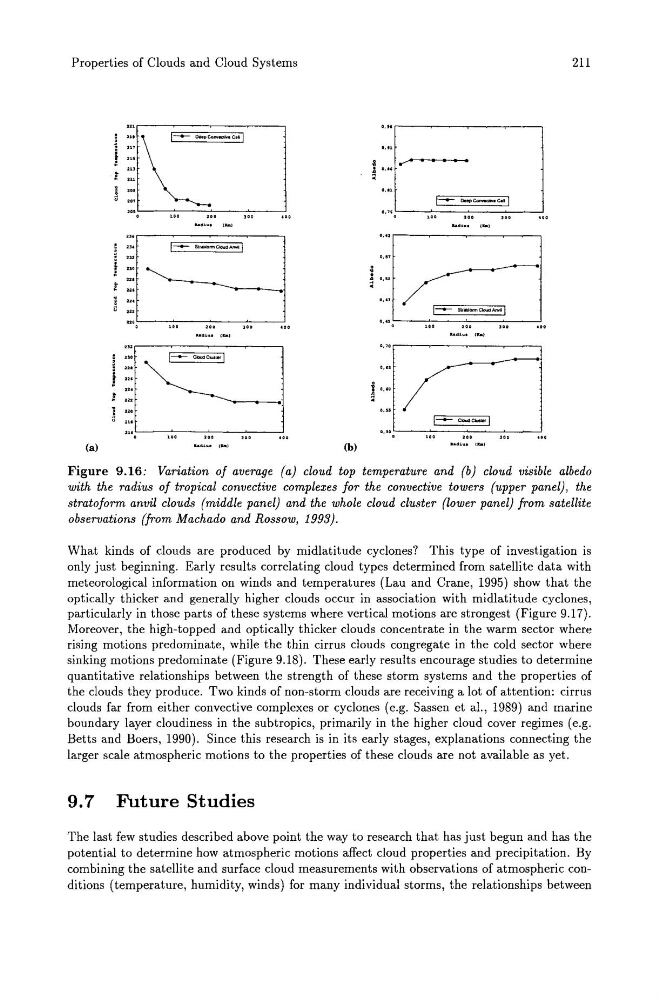
Figure 9.16: Variation of average (a) cloud top temperature and (b) cloud visible albedo
with the radius of tropical convective complexes for the convective towers (upper panel), the
stratoform anvil clouds (middle panel) and the whole cloud cluster (lower panel) from satellite
observations (from Machado and Rossow, 1993).
What kinds of clouds are produced by midlatitude cyclones? This type of investigation is
only just beginning. Early results correlating cloud types determined from satellite data with
meteorological information on winds and temperatures (Lau and Crane, 1995) show that the
optically thicker and generally higher clouds occur in association with midlatitude cyclones,
particularly in those parts of these systems where vertical motions are strongest (Figure 9.17).
Moreover, the high-topped and optically thicker clouds concentrate in the warm sector where
rising motions predominate, while the thin cirrus clouds congregate in the cold sector where
sinking motions predominate (Figure 9.18). These early results encourage studies to determine
quantitative relationships between the strength of these storm systems and the properties of
the clouds they produce. Two kinds of non-storm clouds are receiving a lot of attention: cirrus
clouds far from either convective complexes or cyclones (e.g. Sassen et al., 1989) and marine
boundary layer cloudiness in the subtropics, primarily in the higher cloud cover regimes (e.g.
Betts and Boers, 1990). Since this research is in its early stages, explanations connecting the
larger scale atmospheric motions to the properties of these clouds are not available as yet.
9.7 Future Studies
The last few studies described above point the way to research that has just begun and has the
potential to determine how atmospheric motions affect cloud properties and precipitation. By
combining the satellite and surface cloud measurements with observations of atmospheric conditions (temperature, humidity, winds) for many individual storms, the relationships between
(a)
' " c~ ","''''~'.''''dl
m
no
'" m
'" ,,,
1_ SlrUlorm Cloud MYiI !
(b)
~
.--- .. .... ~ ...... ~. _ .
.a a,1i
~
i
~.," / -
1_ Stsa\dOrmCIoljaAnll~1
""'~--:::=~~~
1- CIoudCIuste O,50.L _ _ "'=====-~ __ J
211
Figure 9.16: Variation of average (a) cloud top temperature and (b) cloud visible albedo
with the radius of tropical convective complexes for the convective towers (upper panel), the
stratoform anvil clouds (middle panel) and the whole cloud cluster (lower panel) from satellite
observations (from Machado and Rossow, 1993).
What kinds of clouds are produced by midlatitude cyclones? This type of investigation is
only just beginning. Early results correlating cloud types determined from satellite data with
meteorological information on winds and temperatures (Lau and Crane, 1995) show that the
optically thicker and generally higher clouds occur in association with midlatitude cyclones,
particularly in those parts of these systems where vertical motions are strongest (Figure 9.17).
Moreover, the high-topped and optically thicker clouds concentrate in the warm sector where
rising motions predominate, while the thin cirrus clouds congregate in the cold sector where
sinking motions predominate (Figure 9.18). These early results encourage studies to determine
quantitative relationships between the strength of these storm systems and the properties of
the clouds they produce. Two kinds of non-storm clouds are receiving a lot of attention: cirrus
clouds far from either convective complexes or cyclones (e.g. Sassen et al., 1989) and marine
boundary layer cloudiness in the subtropics, primarily in the higher cloud cover regimes (e.g.
Betts and Boers, 1990). Since this research is in its early stages, explanations connecting the
larger scale atmospheric motions to the properties of these clouds are not available as yet.
9.7 Future Studies
The last few studies described above point the way to research that has just begun and has the
potential to determine how atmospheric motions affect cloud properties and precipitation. By
combining the satellite and surface cloud measurements with observations of atmospheric conditions (temperature, humidity, winds) for many individual storms, the relationships between