

208
W.B. Rossow
striking resemblance to the distribution determined by surface observers. The similarity of
the distributions observed from surface and satellite of cirrus and cumulus cloud amounts and
cumulonimbus and nimbostratus suggests a primary link between the weather producing clouds
and their observed radiative properties.
2.r------------------------,~
2.
solid Iseep
broken SSM/.
10 "
I ~
f
~.~0~-4~0--~37.--~20~-~IO~.~~,.~2~.~3~O~.~.~ •• ·
Latitude
~.~.~-.~.--~3~.--~2.~-~,.~.~~,.--2~.--3~.~.~.~ ••
Latitude
2.r--------------------------,
2.
I.
I.
solid (Seep
broken SSt.l/l
U8?
/
--,
~.~.~-.~O--~3~.--~20~-~IO~O~~,.~~2.~~3.~4~.~.O·
La.lil\lde
2.r--------------------------,
I.
f '
\
\ r
solid Iseep
0588
broken SSM/I
1/
_I
,-I
I'",
'-"~~ •• ~-.~.--~37.--~2.~-~IO~.~~,.~~2.~3~.~.~.~.·O
t..tltude
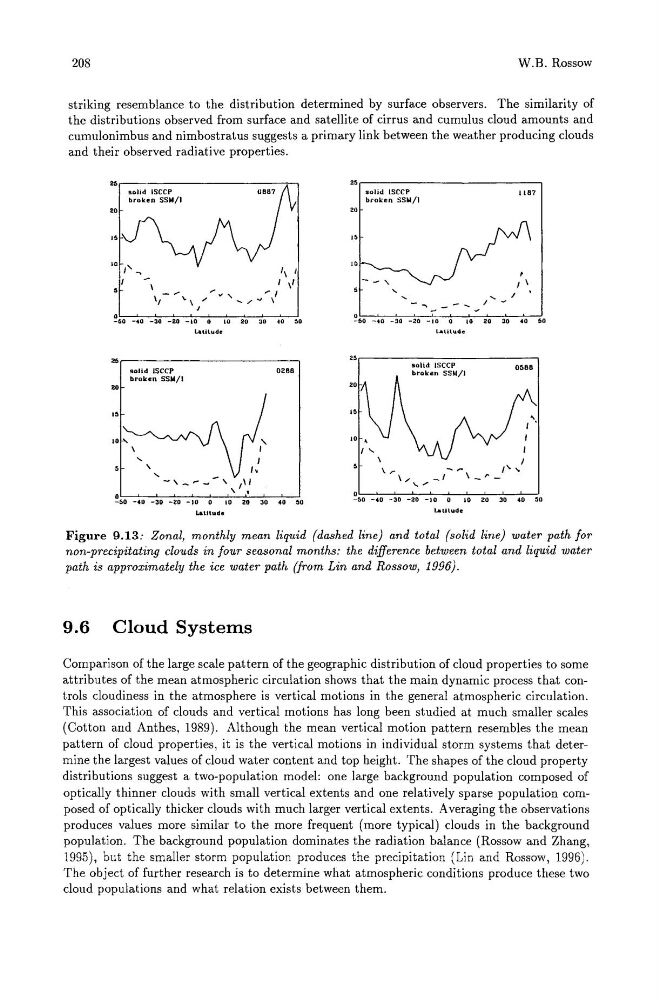
Figure 9.13: Zonal, monthly mean liquid (dashed line) and total (solid line) water path for
non-precipitating clouds in four seasonal months: the difference between total and liquid water
path is approximately the ice water path (from Lin and Rossow, 1996).
9.6 Cloud Systems
Comparison of the large scale pattern of the geographic distribution of cloud properties to some
attributes of the mean atmospheric circulation shows that the main dynamic process that controls cloudiness in the atmosphere is vertical motions in the general atmospheric circulation.
This association of clouds and vertical motions has long been studied at much smaller scales
(Cotton and Anthes, 1989). Although the mean vertical motion pattern resembles the mean
pattern of cloud properties, it is the vertical motions in individual storm systems that determine the largest values of cloud water content and top height. The shapes of the cloud property
distributions suggest a two-population model: one large background population composed of
optically thinner clouds with small vertical extents and one relatively sparse population composed of optically thicker clouds with much larger vertical extents. Averaging the observations
produces values more similar to the more frequent (more typical) clouds in the background
population. The background population dominates the radiation balance (Rossow and Zhang,
1995), but the smaller storm population produces the precipitation (Lin and Rossow, 1996).
The object of further research is to determine what atmospheric conditions produce these two
cloud populations and what relation exists between them.
W.B. Rossow
striking resemblance to the distribution determined by surface observers. The similarity of
the distributions observed from surface and satellite of cirrus and cumulus cloud amounts and
cumulonimbus and nimbostratus suggests a primary link between the weather producing clouds
and their observed radiative properties.
2.r------------------------,~
2.
solid Iseep
broken SSM/.
10 "
I ~
f
~.~0~-4~0--~37.--~20~-~IO~.~~,.~2~.~3~O~.~.~ •• ·
Latitude
~.~.~-.~.--~3~.--~2.~-~,.~.~~,.--2~.--3~.~.~.~ ••
Latitude
2.r--------------------------,
2.
I.
I.
solid (Seep
broken SSt.l/l
U8?
/
--,
~.~.~-.~O--~3~.--~20~-~IO~O~~,.~~2.~~3.~4~.~.O·
La.lil\lde
2.r--------------------------,
I.
f '
\
\ r
solid Iseep
0588
broken SSM/I
1/
_I
,-I
I'",
'-"~~ •• ~-.~.--~37.--~2.~-~IO~.~~,.~~2.~3~.~.~.~.·O
t..tltude
Figure 9.13: Zonal, monthly mean liquid (dashed line) and total (solid line) water path for
non-precipitating clouds in four seasonal months: the difference between total and liquid water
path is approximately the ice water path (from Lin and Rossow, 1996).
9.6 Cloud Systems
Comparison of the large scale pattern of the geographic distribution of cloud properties to some
attributes of the mean atmospheric circulation shows that the main dynamic process that controls cloudiness in the atmosphere is vertical motions in the general atmospheric circulation.
This association of clouds and vertical motions has long been studied at much smaller scales
(Cotton and Anthes, 1989). Although the mean vertical motion pattern resembles the mean
pattern of cloud properties, it is the vertical motions in individual storm systems that determine the largest values of cloud water content and top height. The shapes of the cloud property
distributions suggest a two-population model: one large background population composed of
optically thinner clouds with small vertical extents and one relatively sparse population composed of optically thicker clouds with much larger vertical extents. Averaging the observations
produces values more similar to the more frequent (more typical) clouds in the background
population. The background population dominates the radiation balance (Rossow and Zhang,
1995), but the smaller storm population produces the precipitation (Lin and Rossow, 1996).
The object of further research is to determine what atmospheric conditions produce these two
cloud populations and what relation exists between them.