

Remote Sensing of Atmospheric Water Vapor
5
4
3
2
1.2
1.0
O.S
0.6
0.4
,~
O.S
0.6
0.4
0.2
\
\
\
\
\
\
_ _ ANNUAL
__ DJF
--- JJA
a
b
c
185
SON
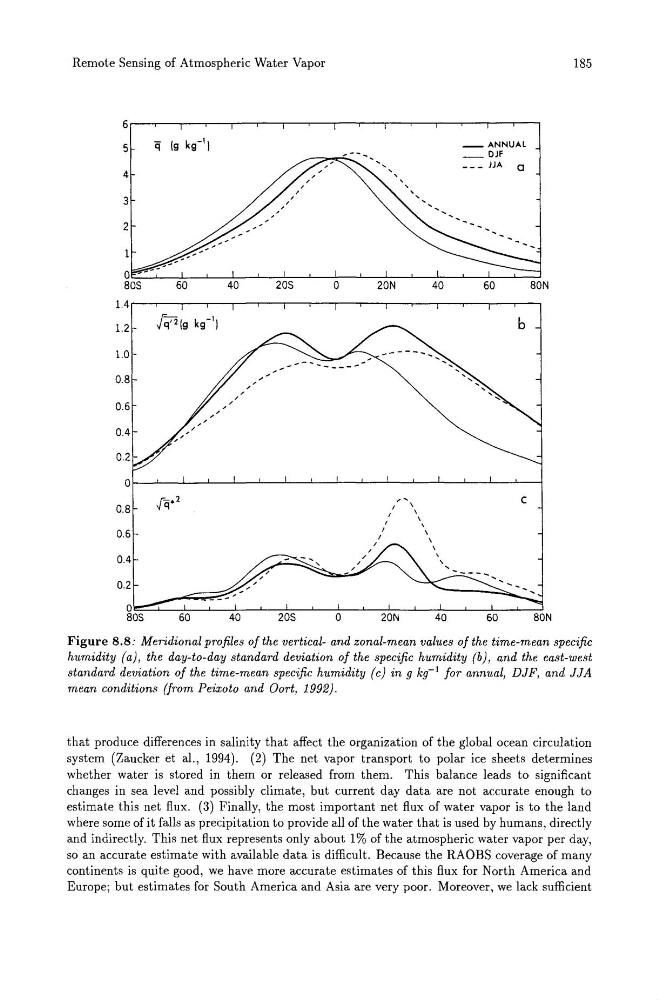
Figure 8.8: Meridional profiles of the vertical- and zonal-mean values of the time-mean specific
humidity (a), the day-to-day standard deviation of the specific humidity (b), and the east-west
standard deviation of the time-mean specific humidity (c) in g kg- 1 for annual, DJF, and JJA
mean conditions (from Peixoto and Gort, 1992).
that produce differences in salinity that affect the organization of the global ocean circulation
system (Zaucker et al., 1994). (2) The net vapor transport to polar ice sheets determines
whether water is stored in them or released from them. This balance leads to significant
changes in sea level and possibly climate, but current day data are not accurate enough to
estimate this net flux. (3) Finally, the most important net flux of water vapor is to the land
where some of it falls as precipitation to provide all of the water that is used by humans, directly
and indirectly. This net flux represents only about 1% of the atmospheric water vapor per day,
so an accurate estimate with available data is difficult. Because the RAOBS coverage of many
continents is quite good, we have more accurate estimates of this flux for North America and
Europe; but estimates for South America and Asia are very poor. Moreover, we lack sufficient
5
4
3
2
1.2
1.0
O.S
0.6
0.4
,~
O.S
0.6
0.4
0.2
\
\
\
\
\
\
_ _ ANNUAL
__ DJF
--- JJA
a
b
c
185
SON
Figure 8.8: Meridional profiles of the vertical- and zonal-mean values of the time-mean specific
humidity (a), the day-to-day standard deviation of the specific humidity (b), and the east-west
standard deviation of the time-mean specific humidity (c) in g kg- 1 for annual, DJF, and JJA
mean conditions (from Peixoto and Gort, 1992).
that produce differences in salinity that affect the organization of the global ocean circulation
system (Zaucker et al., 1994). (2) The net vapor transport to polar ice sheets determines
whether water is stored in them or released from them. This balance leads to significant
changes in sea level and possibly climate, but current day data are not accurate enough to
estimate this net flux. (3) Finally, the most important net flux of water vapor is to the land
where some of it falls as precipitation to provide all of the water that is used by humans, directly
and indirectly. This net flux represents only about 1% of the atmospheric water vapor per day,
so an accurate estimate with available data is difficult. Because the RAOBS coverage of many
continents is quite good, we have more accurate estimates of this flux for North America and
Europe; but estimates for South America and Asia are very poor. Moreover, we lack sufficient