

178
W.B. Rossow
Fourth, the deceptively simple water molecule produces one of the most complex interactions
with radiation such that water vapor and clouds also dramatically alter the exchanges of radiation that control the energy budget. Water vapor is the major "greenhouse gas" in Earth's
atmosphere producing a major negative feedback on the radiative cooling of the surface. The
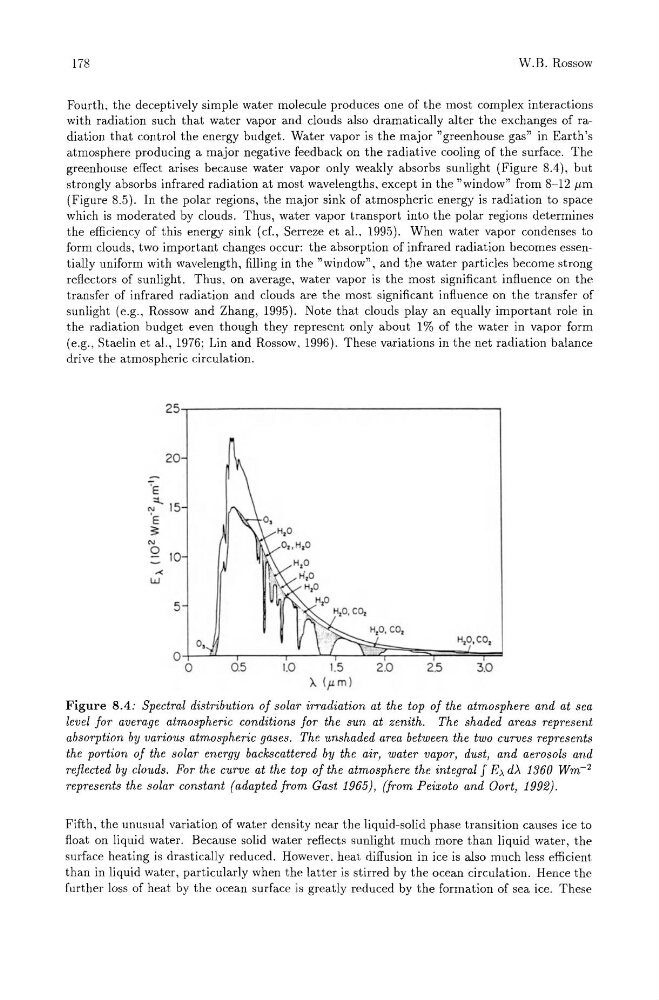
greenhouse effect arises because water vapor only weakly absorbs sunlight (Figure 8.4), but
strongly absorbs infrared radiation at most wavelengths, except in the "window" from 8-12 fLm
(Figure 8.5). In the polar regions, the major sink of atmospheric energy is radiation to space
which is moderated by clouds. Thus, water vapor transport into the polar regions determines
the efficiency of this energy sink (cf., Serreze et al., 1995). When water vapor condenses to
form clouds, two important changes occur: the absorption of infrared radiation becomes essentially uniform with wavelength, filling in the "window", and the water particles become strong
reflectors of sunlight. Thus, on average, water vapor is the most significant influence on the
transfer of infrared radiation and clouds are the most significant influence on the transfer of
sunlight (e.g., Rossow and Zhang, 1995). Note that clouds play an equally important role in
the radiation budget even though they represent only about 1% of the water in vapor form
(e.g., Staelin et al., 1976; Lin and Rossow, 1996). These variations in the net radiation balance
drive the atmospheric circulation.
25~----------------------------------~
20
"7
E
";'~ 15
E
:::
N
0 10
-<
w
5
0, ,
H,O, CO,
0 0
0.5
1.0
1. 5
2.0
2.5
3.0
A (Ilm)
Figure 8.4: Spectral distribution of solar irradiation at the top of the atmosphere and at sea
level for average atmospheric conditions for the sun at zenith. The shaded areas represent
absorption by various atmospheric gases. The unshaded area between the two curves represents
the portion of the solar energy backscattered by the air, water vapor, dust, and aerosols and
reflected by clo1Lds. For the C1Lrve at the top of the atmosphere the integral f E>. d)" 1360 Wm- 2
represents the solar constant (adapted from Cast 1965), (from Peixoto and Gort, 1992).
Fifth, the unusual variation of water density near the liquid-solid phase transition causes ice to
float on liquid water. Because solid water reflects sunlight much more than liquid water, the
surface heating is drastically reduced. However. heat diffusion in ice is also much less efficient
than in liquid water, particularly when the latter is stirred by the ocean circulation. Hence the
further loss of heat by the ocean surface is greatly reduced by the formation of sea ice. These
W.B. Rossow
Fourth, the deceptively simple water molecule produces one of the most complex interactions
with radiation such that water vapor and clouds also dramatically alter the exchanges of radiation that control the energy budget. Water vapor is the major "greenhouse gas" in Earth's
atmosphere producing a major negative feedback on the radiative cooling of the surface. The
greenhouse effect arises because water vapor only weakly absorbs sunlight (Figure 8.4), but
strongly absorbs infrared radiation at most wavelengths, except in the "window" from 8-12 fLm
(Figure 8.5). In the polar regions, the major sink of atmospheric energy is radiation to space
which is moderated by clouds. Thus, water vapor transport into the polar regions determines
the efficiency of this energy sink (cf., Serreze et al., 1995). When water vapor condenses to
form clouds, two important changes occur: the absorption of infrared radiation becomes essentially uniform with wavelength, filling in the "window", and the water particles become strong
reflectors of sunlight. Thus, on average, water vapor is the most significant influence on the
transfer of infrared radiation and clouds are the most significant influence on the transfer of
sunlight (e.g., Rossow and Zhang, 1995). Note that clouds play an equally important role in
the radiation budget even though they represent only about 1% of the water in vapor form
(e.g., Staelin et al., 1976; Lin and Rossow, 1996). These variations in the net radiation balance
drive the atmospheric circulation.
25~----------------------------------~
20
"7
E
";'~ 15
E
:::
N
0 10
-<
w
5
0, ,
H,O, CO,
0 0
0.5
1.0
1. 5
2.0
2.5
3.0
A (Ilm)
Figure 8.4: Spectral distribution of solar irradiation at the top of the atmosphere and at sea
level for average atmospheric conditions for the sun at zenith. The shaded areas represent
absorption by various atmospheric gases. The unshaded area between the two curves represents
the portion of the solar energy backscattered by the air, water vapor, dust, and aerosols and
reflected by clo1Lds. For the C1Lrve at the top of the atmosphere the integral f E>. d)" 1360 Wm- 2
represents the solar constant (adapted from Cast 1965), (from Peixoto and Gort, 1992).
Fifth, the unusual variation of water density near the liquid-solid phase transition causes ice to
float on liquid water. Because solid water reflects sunlight much more than liquid water, the
surface heating is drastically reduced. However. heat diffusion in ice is also much less efficient
than in liquid water, particularly when the latter is stirred by the ocean circulation. Hence the
further loss of heat by the ocean surface is greatly reduced by the formation of sea ice. These