

Clouds and the Radiative Heating ...
165
JANUARY
JULY
90 CFIS).
90
60
60
30
30
0
0
·30
·30
·60
·60
·90
·90
-1SO -100 -50
0
50 100
·150 ·100 -50
0
50 100
90
90
.... 60
CF(,
60
CF{~
i -30
30
w
0
0
0
~
·30
~
·30
-60
-60
-90
-90
·150 -100 ·50
0
50 100
.150 ·100 -50
0
50 100
90
90 CF(S)
60
60
30
30
0
0
-30
-30
-60
·60
·90
·90
-150 ·100 ·50
0
50 100
·150 ·100 -50
0
50 100
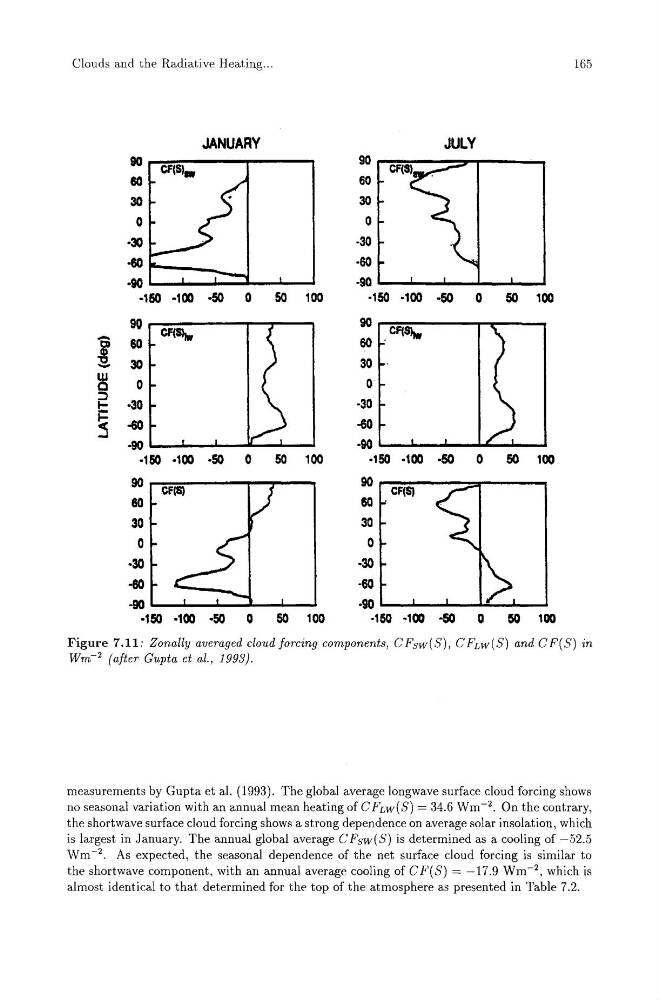
Figure 7.11: Zonally averaged cloud forcing components, CFsw(S), CFLw(S) and CF(S) in
Wm- 2 (after Gupta et al., 1993).
measurements by Gupta et al. (1993). The global average longwave surface cloud forcing shows
no seasonal variation with an annual mean heating of C FLW(S) = 34.6 Wm- 2 • On the contrary,
the shortwave surface cloud forcing shows a strong dependence on average solar insolation, which
is largest in January. The annual global average C Fsw(S) is determined as a cooling of -52.5
Wm- 2 • As expected, the seasonal dependence of the net surface cloud forcing is similar to
the shortwave component, with an annual average cooling of CF(S) = -17.9 Wm- 2 , which is
almost identical to that determined for the top of the atmosphere as presented in Table 7.2.
165
JANUARY
JULY
90 CFIS).
90
60
60
30
30
0
0
·30
·30
·60
·60
·90
·90
-1SO -100 -50
0
50 100
·150 ·100 -50
0
50 100
90
90
.... 60
CF(,
60
CF{~
i -30
30
w
0
0
0
~
·30
~
·30
-60
-60
-90
-90
·150 -100 ·50
0
50 100
.150 ·100 -50
0
50 100
90
90 CF(S)
60
60
30
30
0
0
-30
-30
-60
·60
·90
·90
-150 ·100 ·50
0
50 100
·150 ·100 -50
0
50 100
Figure 7.11: Zonally averaged cloud forcing components, CFsw(S), CFLw(S) and CF(S) in
Wm- 2 (after Gupta et al., 1993).
measurements by Gupta et al. (1993). The global average longwave surface cloud forcing shows
no seasonal variation with an annual mean heating of C FLW(S) = 34.6 Wm- 2 • On the contrary,
the shortwave surface cloud forcing shows a strong dependence on average solar insolation, which
is largest in January. The annual global average C Fsw(S) is determined as a cooling of -52.5
Wm- 2 • As expected, the seasonal dependence of the net surface cloud forcing is similar to
the shortwave component, with an annual average cooling of CF(S) = -17.9 Wm- 2 , which is
almost identical to that determined for the top of the atmosphere as presented in Table 7.2.