

Clouds and the Radiative Heating ...
155
Reflected Short-Wave Radiation W/m2
20
60
80
100
120
140
160
180
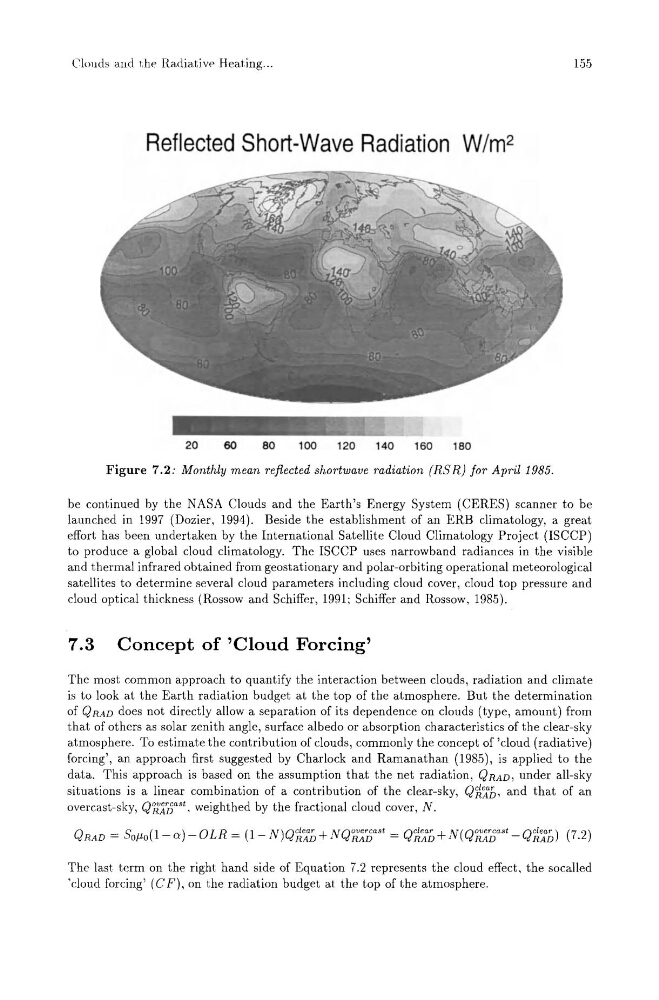
Figure 7.2: Monthly mean reflected shortwave radiation (RSR) for April 1985.
be continued by the NASA Clouds and the Earth's Energy System (CERES) scanner to be
launched in 1997 (Dozier, 1994). Beside the establishment of an ERB climatology, a great
effort has been undertaken by the International Satellite Cloud Climatology Project (ISCCP)
to produce a global cloud climatology. The ISCCP uses narrowband radiances in the visible
and thermal infrared obtained from geostationary and polar-orbiting operational meteorological
satellites to determine several cloud parameters including cloud cover, cloud top pressure and
cloud optical thickness (Rossow and Schiffer, 1991; Schiffer and Rossow, 1985).
7.3 Concept of 'Cloud Forcing'
The most common approach to quantify the interaction between clouds, radiation and climate
is to look at the Earth radiation budget at the top of the atmosphere. But the determination
of Q RAD does not directly allow a separation of its dependence on clouds (type, amount) from
that of others as solar zenith angle, surface albedo or absorption characteristics of the clear-sky
atmosphere. To estimate the contribution of clouds, commonly the concept of 'cloud (radiative)
forcing', an approach first suggested by Charlock and Ramanathan (1985), is applied to the
data. This approach is based on the assumption that the net radiation, QRAD, under all-sky
situations is a linear combination of a contribution of the clear-sky, Q~AJj, and that of an
overcast-sky, QRAD"st, weighthed by the fractional cloud cover, N.
The last term on the right hand side of Equation 7.2 represents the cloud effect, the socalled
'cloud forcing' (C F), on the radiation budget at the top of the atmosphere.
155
Reflected Short-Wave Radiation W/m2
20
60
80
100
120
140
160
180
Figure 7.2: Monthly mean reflected shortwave radiation (RSR) for April 1985.
be continued by the NASA Clouds and the Earth's Energy System (CERES) scanner to be
launched in 1997 (Dozier, 1994). Beside the establishment of an ERB climatology, a great
effort has been undertaken by the International Satellite Cloud Climatology Project (ISCCP)
to produce a global cloud climatology. The ISCCP uses narrowband radiances in the visible
and thermal infrared obtained from geostationary and polar-orbiting operational meteorological
satellites to determine several cloud parameters including cloud cover, cloud top pressure and
cloud optical thickness (Rossow and Schiffer, 1991; Schiffer and Rossow, 1985).
7.3 Concept of 'Cloud Forcing'
The most common approach to quantify the interaction between clouds, radiation and climate
is to look at the Earth radiation budget at the top of the atmosphere. But the determination
of Q RAD does not directly allow a separation of its dependence on clouds (type, amount) from
that of others as solar zenith angle, surface albedo or absorption characteristics of the clear-sky
atmosphere. To estimate the contribution of clouds, commonly the concept of 'cloud (radiative)
forcing', an approach first suggested by Charlock and Ramanathan (1985), is applied to the
data. This approach is based on the assumption that the net radiation, QRAD, under all-sky
situations is a linear combination of a contribution of the clear-sky, Q~AJj, and that of an
overcast-sky, QRAD"st, weighthed by the fractional cloud cover, N.
The last term on the right hand side of Equation 7.2 represents the cloud effect, the socalled
'cloud forcing' (C F), on the radiation budget at the top of the atmosphere.