

144
Ronald E. Stewart
this is the enhanced relative role of sublimation in the drier situations. For the same initial
relative humidity, precipitation efficiency decreased as temperature increased. There was more
moisture available to the cloud system in the warmer cases, but the cloud base was higher, and
consequently there was greater loss of the precipitation below cloud. The highest precipitation
efficiency occurred under the coldest conditions. These situations have the lowest bases and
so there is less opportunity for the precipitation to be lost. The low cloud bases were largely
the result of the efficient manner in which sublimation led to the saturation of initially dry
sub-cloud conditions.
Regardless of the actual situation, it is clear that the degree of sub-saturation below cloud
makes a major impact on the results. As an indication of the sensitivity of the environment
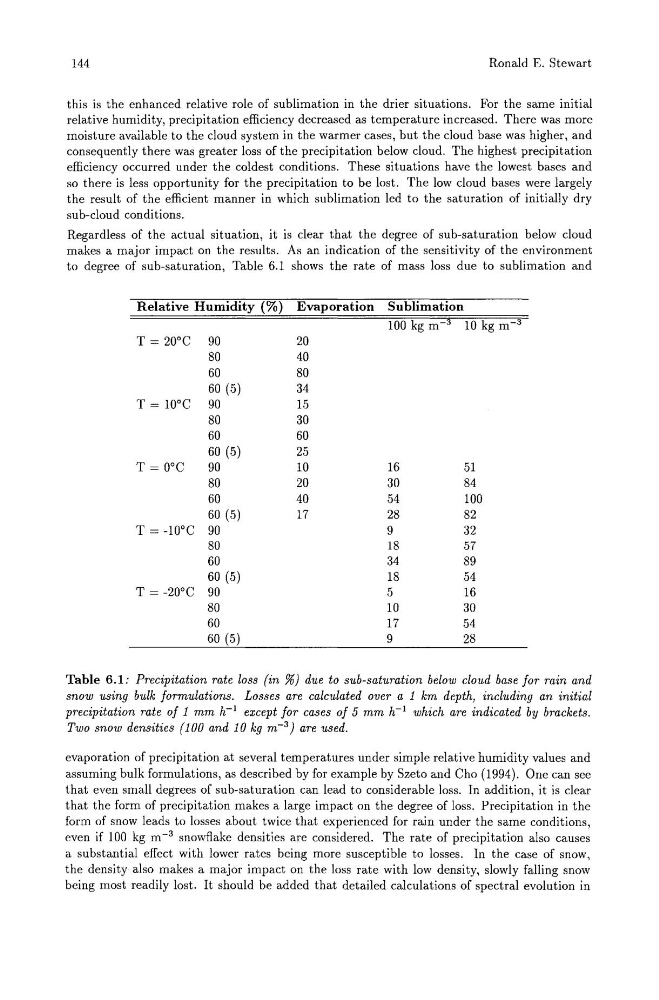
to degree of sub-saturation, Table 6.1 shows the rate of mass loss due to sublimation and
Relative Humidity (%) Evaporation Sublimation
100 kg m 3 10 kg m 3
T = 20°C 90
20
80
40
60
80
60 (5)
34
T = 10°C 90
15
80
30
60
60
60 (5)
25
T = ooe 90
10
16
51
80
20
30
84
60
40
54
100
60 (5)
17
28
82
T = -10°C 90
9
32
80
18
57
60
34
89
60 (5)
18
54
T = -20°C 90
5
16
80
10
30
60
17
54
60 (5)
9
28
Table 6.1: Precipitation rate loss (in %) due to sub-saturation below cloud base for rain and
snow using bulk formulations. Losses are calculated over a 1 km depth, including an initial
precipitation rate of 1 mm h- 1 except for cases of 5 mm h- 1 which are indicated by brackets.
Two snow densities (100 and 10 kg m- 3 ) are used.
evaporation of precipitation at several temperatures under simple relative humidity values and
assuming bulk formulations, as described by for example by Szeto and eho (1994). One can see
that even small degrees of sub-saturation can lead to considerable loss. In addition, it is clear
that the form of precipitation makes a large impact on the degree of loss. Precipitation in the
form of snow leads to losses about twice that experienced for rain under the same conditions,
even if 100 kg m- 3 snowflake densities are considered. The rate of precipitation also causes
a substantial effect with lower rates being more susceptible to losses. In the case of snow,
the density also makes a major impact on the loss rate with low density, slowly falling snow
being most readily lost. It should be added that detailed calculations of spectral evolution in
Ronald E. Stewart
this is the enhanced relative role of sublimation in the drier situations. For the same initial
relative humidity, precipitation efficiency decreased as temperature increased. There was more
moisture available to the cloud system in the warmer cases, but the cloud base was higher, and
consequently there was greater loss of the precipitation below cloud. The highest precipitation
efficiency occurred under the coldest conditions. These situations have the lowest bases and
so there is less opportunity for the precipitation to be lost. The low cloud bases were largely
the result of the efficient manner in which sublimation led to the saturation of initially dry
sub-cloud conditions.
Regardless of the actual situation, it is clear that the degree of sub-saturation below cloud
makes a major impact on the results. As an indication of the sensitivity of the environment
to degree of sub-saturation, Table 6.1 shows the rate of mass loss due to sublimation and
Relative Humidity (%) Evaporation Sublimation
100 kg m 3 10 kg m 3
T = 20°C 90
20
80
40
60
80
60 (5)
34
T = 10°C 90
15
80
30
60
60
60 (5)
25
T = ooe 90
10
16
51
80
20
30
84
60
40
54
100
60 (5)
17
28
82
T = -10°C 90
9
32
80
18
57
60
34
89
60 (5)
18
54
T = -20°C 90
5
16
80
10
30
60
17
54
60 (5)
9
28
Table 6.1: Precipitation rate loss (in %) due to sub-saturation below cloud base for rain and
snow using bulk formulations. Losses are calculated over a 1 km depth, including an initial
precipitation rate of 1 mm h- 1 except for cases of 5 mm h- 1 which are indicated by brackets.
Two snow densities (100 and 10 kg m- 3 ) are used.
evaporation of precipitation at several temperatures under simple relative humidity values and
assuming bulk formulations, as described by for example by Szeto and eho (1994). One can see
that even small degrees of sub-saturation can lead to considerable loss. In addition, it is clear
that the form of precipitation makes a large impact on the degree of loss. Precipitation in the
form of snow leads to losses about twice that experienced for rain under the same conditions,
even if 100 kg m- 3 snowflake densities are considered. The rate of precipitation also causes
a substantial effect with lower rates being more susceptible to losses. In the case of snow,
the density also makes a major impact on the loss rate with low density, slowly falling snow
being most readily lost. It should be added that detailed calculations of spectral evolution in