

134
Ronald E. Stewart
Recently, Marecal and Lemaitre (1995) and Szeto and Stewart (1995) found that small scale
precipitation and cloud processes can significantly modulate the local characteristics of the
conveyor belts. Condensational heating can enhance the strength of the low level jet associated
with the warm conveyor belt. In addition, they found that precipitation-induced diabatic
effects, including melting snow as first studied by Findeisen (1940), can alter the baroclinicity
near the surface front which in turn affects the structure and intensity of the (geostrophic)
along-front flow (the cold conveyor belt) provided the forcing exists for a sufficient time.
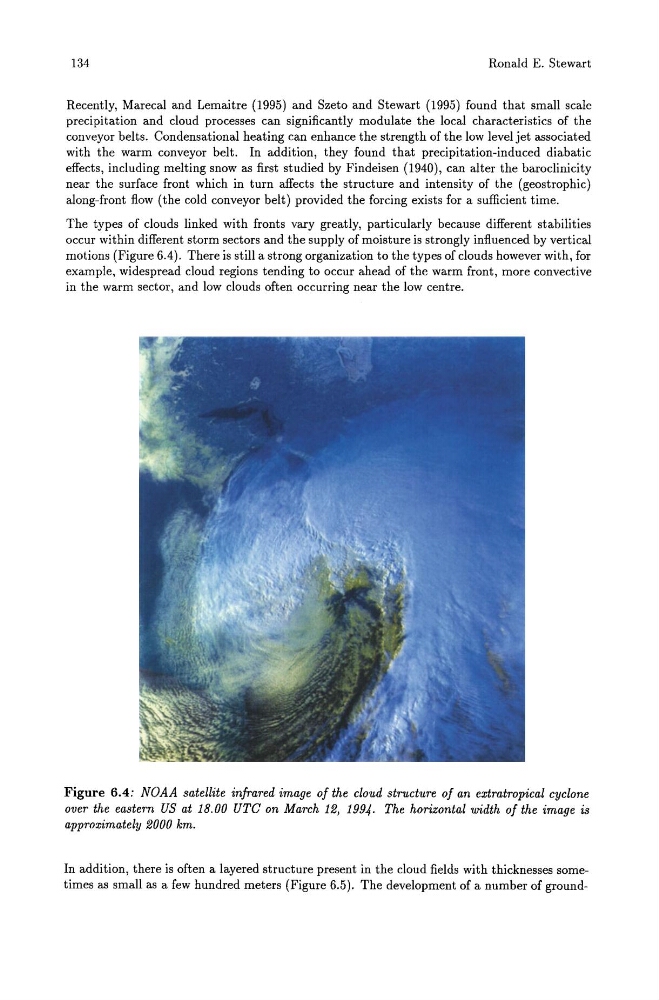
The types of clouds linked with fronts vary greatly, particularly because different stabilities
occur within different storm sectors and the supply of moisture is strongly influenced by vertical
motions (Figure 6.4). There is still a strong organization to the types of clouds however with, for
example, widespread cloud regions tending to occur ahead of the warm front, more convective
in the warm sector, and low clouds often occurring near the low centre.
Figure 6.4: NOAA satellite infrared image of the cloud structure of an extratropical cyclone
over the eastern US at 18.00 UTe on March 12, 1994. The horizontal width of the image is
approximately 2000 km.
In addition, there is often a layered structure present in the cloud fields with thicknesses sometimes as small as a few hundred meters (Figure 6.5). The development of a number of ground-
Ronald E. Stewart
Recently, Marecal and Lemaitre (1995) and Szeto and Stewart (1995) found that small scale
precipitation and cloud processes can significantly modulate the local characteristics of the
conveyor belts. Condensational heating can enhance the strength of the low level jet associated
with the warm conveyor belt. In addition, they found that precipitation-induced diabatic
effects, including melting snow as first studied by Findeisen (1940), can alter the baroclinicity
near the surface front which in turn affects the structure and intensity of the (geostrophic)
along-front flow (the cold conveyor belt) provided the forcing exists for a sufficient time.
The types of clouds linked with fronts vary greatly, particularly because different stabilities
occur within different storm sectors and the supply of moisture is strongly influenced by vertical
motions (Figure 6.4). There is still a strong organization to the types of clouds however with, for
example, widespread cloud regions tending to occur ahead of the warm front, more convective
in the warm sector, and low clouds often occurring near the low centre.
Figure 6.4: NOAA satellite infrared image of the cloud structure of an extratropical cyclone
over the eastern US at 18.00 UTe on March 12, 1994. The horizontal width of the image is
approximately 2000 km.
In addition, there is often a layered structure present in the cloud fields with thicknesses sometimes as small as a few hundred meters (Figure 6.5). The development of a number of ground-