

132
30
26
18
14
10
Ronald E. Stewart
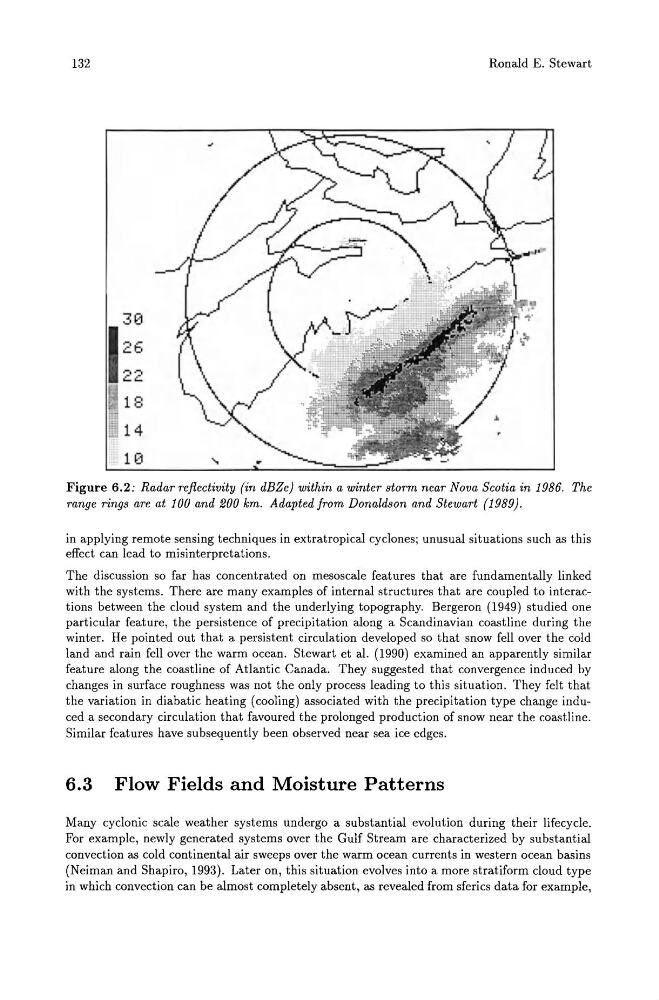
Figure 6.2: Radar reflectivity (in dBZe) within a winter storm near Nova Scotia in 1986. The
range rings are at 100 and 200 km. Adapted from Donaldson and Stewart (1989).
in applying remote sensing techniques in extratropical cyclones; unusual situations such as this
effect can lead to misinterpretations.
The discussion so far has concentrated on mesoscale features that are fundamentally linked
with the systems. There are many examples of internal structures that are coupled to interactions between the cloud system and the underlying topography. Bergeron (1949) studied one
particular feature, the persistence of precipitation along a Scandinavian coastline during the
winter. He pointed out that a persistent circulation developed so that snow fell over the cold
land and rain fell over the warm ocean. Stewart et al. (1990) examined an apparently similar
feature along the coastline of Atlantic Canada. They suggested that convergence induced by
changes in surface roughness was not the only process leading to this situation. They felt that
the variation in diabatic heating (cooling) associated with the precipitation type change induced a secondary circulation that favoured the prolonged production of snow near the coastline.
Similar features have subsequently been observed near sea ice edges.
6.3 Flow Fields and Moisture Patterns
Many cyclonic scale weather systems undergo a substantial evolution during their lifecycle.
For example, newly generated systems over the Gulf Stream are characterized by substantial
convection as cold continental air sweeps over the warm ocean currents in western ocean basins
(Neiman and Shapiro, 1993). Later on, this situation evolves into a more stratiform cloud type
in which convection can be almost completely absent, as revealed from sferics data for example,
30
26
18
14
10
Ronald E. Stewart
Figure 6.2: Radar reflectivity (in dBZe) within a winter storm near Nova Scotia in 1986. The
range rings are at 100 and 200 km. Adapted from Donaldson and Stewart (1989).
in applying remote sensing techniques in extratropical cyclones; unusual situations such as this
effect can lead to misinterpretations.
The discussion so far has concentrated on mesoscale features that are fundamentally linked
with the systems. There are many examples of internal structures that are coupled to interactions between the cloud system and the underlying topography. Bergeron (1949) studied one
particular feature, the persistence of precipitation along a Scandinavian coastline during the
winter. He pointed out that a persistent circulation developed so that snow fell over the cold
land and rain fell over the warm ocean. Stewart et al. (1990) examined an apparently similar
feature along the coastline of Atlantic Canada. They suggested that convergence induced by
changes in surface roughness was not the only process leading to this situation. They felt that
the variation in diabatic heating (cooling) associated with the precipitation type change induced a secondary circulation that favoured the prolonged production of snow near the coastline.
Similar features have subsequently been observed near sea ice edges.
6.3 Flow Fields and Moisture Patterns
Many cyclonic scale weather systems undergo a substantial evolution during their lifecycle.
For example, newly generated systems over the Gulf Stream are characterized by substantial
convection as cold continental air sweeps over the warm ocean currents in western ocean basins
(Neiman and Shapiro, 1993). Later on, this situation evolves into a more stratiform cloud type
in which convection can be almost completely absent, as revealed from sferics data for example,