

Priciples of Active and Passive Remote Measurements ...
123
The atmospheric source function, due to scattering only, becomes
Jv(l,O) = O"~C [11 p(8)Lv(l, s')dw']
41T
411"
In the shortwave, radiation at the boundary, Lv(lo, 0), is the incoming solar radiation at the top
of the atmosphere (TOA) in direction 0 defined by 00 and cpo, respectively nadir and azimuth
angles. This can be computed as Bv(Tsun) (cf. section 5.2.2) and will be hereafter referred to
as Ev.
Non-scattering atmosphere
Like for the longwave, the main difficulty is in estimating Jv(l, 0) because this involves very
expensive computation and requires a knowledge of the structure of scattering particles. (cf.
section 5.5.1). Retrieval of vertically integrated water vapour content from shortwave measurements is however possible in a non scattering atmosphere, by virtue of its total absorption
effect. The wavelength must be choosen long enough to avoid Rayleigh scattering.
In a non scattering atmosphere, the shortwave radiance transmitted downwards from TOA in
direction 00 , cpo at the surface level ° is
L~(O, 00 ) = Ev(Oo, CPo)Tv(ZT, 0, 00 )
A fraction is reflected by the surface depending on its reflectivity, Tv(Oo,O,cp-cpo)' and then
transmitted upwards
L!(ZT,O) = Ev(Oo, CPo)Tv(ZT' 0, Oo)Tv(Oo, 0, CP-CPo)Tv(O, ZT, 0)
The main uncertainty is on the surface reflectance Tv(Oo, 0, CP--
Remark: The same method can be used to infer the water vapour content above a cloud, the
latter being considered as a reflector. If the cloud top height Zc is known, the inferred quantity
is the integrated water vapour content between Zc and the TOA.
Differential absorption method
The differential absorption method (Frouin et al., 1990; Gao and Goetz, 1990) is based
on measuring radiances generated by the same source at two (or more) different wavelengths.
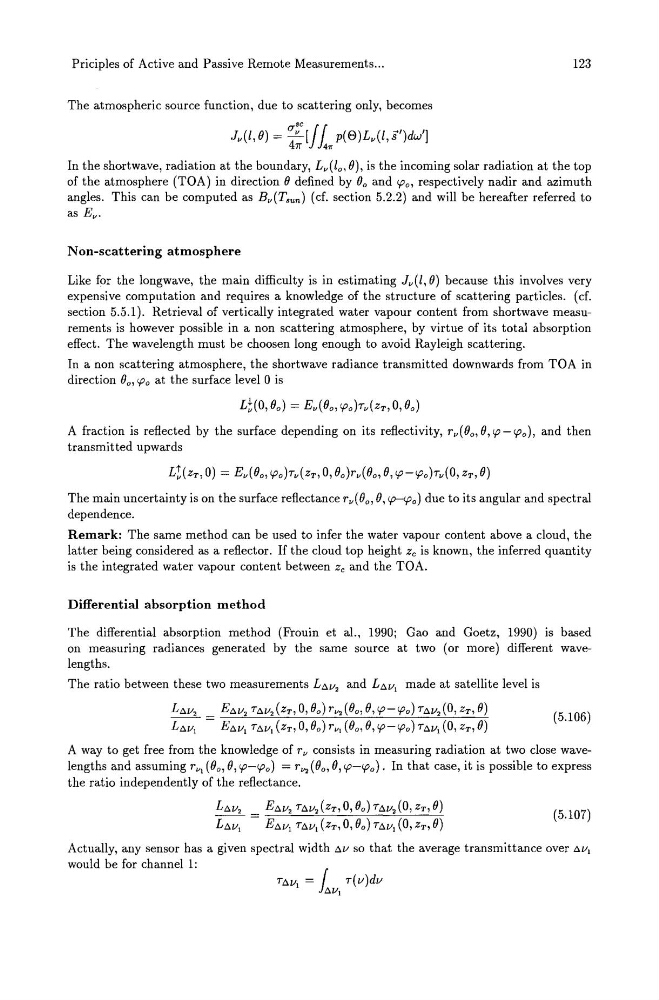
The ratio between these two measurements Ltlv, and Ltlv, made at satellite level is
Ltlv, = Etlv, TtlV,(ZT,O,OO) Tv, (00 , O,cp-cpo) TtlV,(O,ZT, 0)
Ltlv,
Etlv, Ttl v, (ZT' 0, 00 ) Tv, (00 , 0, CP-CPo) TtlV, (0, ZT, 0)
(5.106)
A way to get free from the knowledge of I'v consists in measuring radiation at two close wavelengths and assuming Tv, (00 , 0, CP-CPo) = Tv, (00 , 0, cP-CPo). In that case, it is possible to express
the ratio independently of the reflectance.
Ltlv,
Etlv, Ttl v, (ZT, 0, 00 ) Ttl v, (0, ZT,O)
Ltlv,
Etlv, Ttl v, (ZT, 0, 00 ) Ttl v, (0, ZT, 0)
(5.107)
Actually, any sensor has a given spectral width tlV so that the average transmittance over tlV,
would be for channel 1:
Ttl v, = r T(v)dv
JtlV,
123
The atmospheric source function, due to scattering only, becomes
Jv(l,O) = O"~C [11 p(8)Lv(l, s')dw']
41T
411"
In the shortwave, radiation at the boundary, Lv(lo, 0), is the incoming solar radiation at the top
of the atmosphere (TOA) in direction 0 defined by 00 and cpo, respectively nadir and azimuth
angles. This can be computed as Bv(Tsun) (cf. section 5.2.2) and will be hereafter referred to
as Ev.
Non-scattering atmosphere
Like for the longwave, the main difficulty is in estimating Jv(l, 0) because this involves very
expensive computation and requires a knowledge of the structure of scattering particles. (cf.
section 5.5.1). Retrieval of vertically integrated water vapour content from shortwave measurements is however possible in a non scattering atmosphere, by virtue of its total absorption
effect. The wavelength must be choosen long enough to avoid Rayleigh scattering.
In a non scattering atmosphere, the shortwave radiance transmitted downwards from TOA in
direction 00 , cpo at the surface level ° is
L~(O, 00 ) = Ev(Oo, CPo)Tv(ZT, 0, 00 )
A fraction is reflected by the surface depending on its reflectivity, Tv(Oo,O,cp-cpo)' and then
transmitted upwards
L!(ZT,O) = Ev(Oo, CPo)Tv(ZT' 0, Oo)Tv(Oo, 0, CP-CPo)Tv(O, ZT, 0)
The main uncertainty is on the surface reflectance Tv(Oo, 0, CP--
Remark: The same method can be used to infer the water vapour content above a cloud, the
latter being considered as a reflector. If the cloud top height Zc is known, the inferred quantity
is the integrated water vapour content between Zc and the TOA.
Differential absorption method
The differential absorption method (Frouin et al., 1990; Gao and Goetz, 1990) is based
on measuring radiances generated by the same source at two (or more) different wavelengths.
The ratio between these two measurements Ltlv, and Ltlv, made at satellite level is
Ltlv, = Etlv, TtlV,(ZT,O,OO) Tv, (00 , O,cp-cpo) TtlV,(O,ZT, 0)
Ltlv,
Etlv, Ttl v, (ZT' 0, 00 ) Tv, (00 , 0, CP-CPo) TtlV, (0, ZT, 0)
(5.106)
A way to get free from the knowledge of I'v consists in measuring radiation at two close wavelengths and assuming Tv, (00 , 0, CP-CPo) = Tv, (00 , 0, cP-CPo). In that case, it is possible to express
the ratio independently of the reflectance.
Ltlv,
Etlv, Ttl v, (ZT, 0, 00 ) Ttl v, (0, ZT,O)
Ltlv,
Etlv, Ttl v, (ZT, 0, 00 ) Ttl v, (0, ZT, 0)
(5.107)
Actually, any sensor has a given spectral width tlV so that the average transmittance over tlV,
would be for channel 1:
Ttl v, = r T(v)dv
JtlV,