

122
Y. Fouquart and M. Vesperini
• Bn(Tp) varies with wavelength. This problem can be cleared by defining a reference
function B(Tp), and correcting the radiance measurement accordingly;
• Since absorption lines are only weakly dependent on temperature, Wn,p(Tp) can be computed for a mean temperature profile so that an independent set of linear equations is
obtained;
• the surface term can be included in the summation;
• the computation of the solution is subject to the conditioning of the system of equations,
namely the number of independent radiance measurements (n) and of vertical layer (p),
making the problem over-constrained or under-constrained. More sophisticated methods
involve a-priori information (a guessed profile) together with its corresponding error and
uses the radiance measurements to correct (accordingly to their respective errors) this
profile. This approach is very close to the methods used in data analysis for numerical
weather prediction, and often inversion has become a part of the data assimilation process
(cf. Courtier, this volume, chapter 4).
c) Inversion of atmospheric constituents
Estimation of atmospheric constituents like water vapour or ozone is much more non linear since
it is not possible to express the RTE as a product of the constituent profile and an independent
"constituent weighting function" .
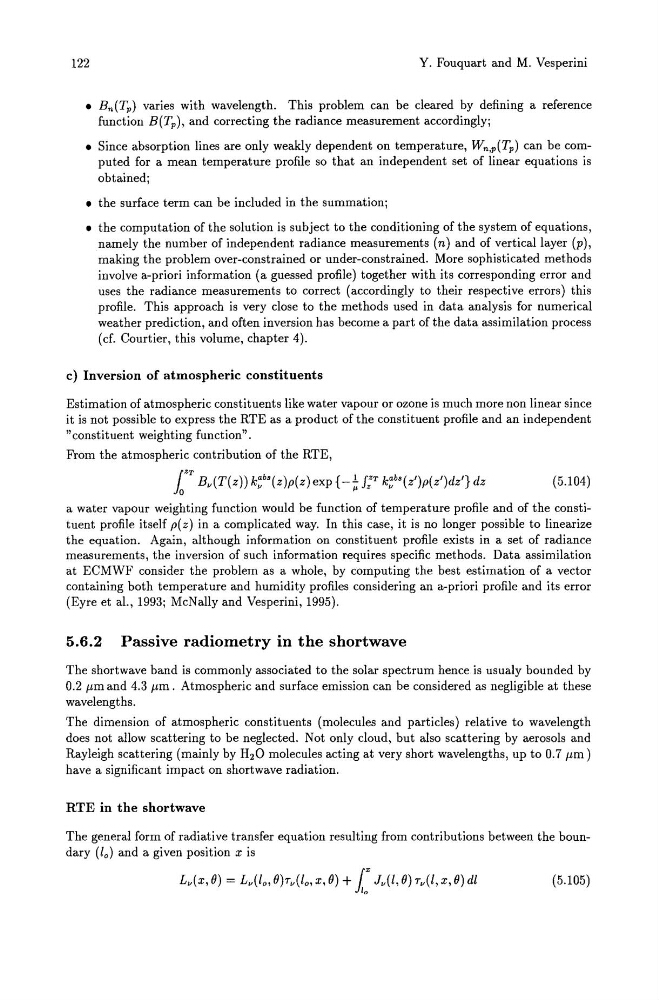
From the atmospheric contribution of the RTE,
f'T
Jo Bv(T(z» k~bs(Z)p(z) exp {-; J:T k~bs(ZI)p(ZI)dz/} dz
(5.104)
a water vapour weighting function would be function of temperature profile and of the constituent profile itself p(z) in a complicated way. In this case, it is no longer possible to linearize
the equation. Again, although information on constituent profile exists in a set of radiance
measurements, the inversion of such information requires specific methods. Data assimilation
at ECMWF consider the problem as a whole, by computing the best estimation of a vector
containing both temperature and humidity profiles considering an a-priori profile and its error
(Eyre et al., 1993; McNally and Vesperini, 1995).
5.6.2 Passive radiometry in the shortwave
The shortwave band is commonly associated to the solar spectrum hence is usualy bounded by
0.2 pm and 4.3 pm. Atmospheric and surface emission can be considered as negligible at these
wavelengths.
The dimension of atmospheric constituents (molecules and particles) relative to wavelength
does not allow scattering to be neglected. Not only cloud, but also scattering by aerosols and
Rayleigh scattering (mainly by H2 0 molecules acting at very short wavelengths, up to 0.7 pm)
have a significant impact on shortwave radiation.
RTE in the shortwave
The general form of radiative transfer equation resulting from contributions between the boundary (to) and a given position x is
(5.105)
Y. Fouquart and M. Vesperini
• Bn(Tp) varies with wavelength. This problem can be cleared by defining a reference
function B(Tp), and correcting the radiance measurement accordingly;
• Since absorption lines are only weakly dependent on temperature, Wn,p(Tp) can be computed for a mean temperature profile so that an independent set of linear equations is
obtained;
• the surface term can be included in the summation;
• the computation of the solution is subject to the conditioning of the system of equations,
namely the number of independent radiance measurements (n) and of vertical layer (p),
making the problem over-constrained or under-constrained. More sophisticated methods
involve a-priori information (a guessed profile) together with its corresponding error and
uses the radiance measurements to correct (accordingly to their respective errors) this
profile. This approach is very close to the methods used in data analysis for numerical
weather prediction, and often inversion has become a part of the data assimilation process
(cf. Courtier, this volume, chapter 4).
c) Inversion of atmospheric constituents
Estimation of atmospheric constituents like water vapour or ozone is much more non linear since
it is not possible to express the RTE as a product of the constituent profile and an independent
"constituent weighting function" .
From the atmospheric contribution of the RTE,
f'T
Jo Bv(T(z» k~bs(Z)p(z) exp {-; J:T k~bs(ZI)p(ZI)dz/} dz
(5.104)
a water vapour weighting function would be function of temperature profile and of the constituent profile itself p(z) in a complicated way. In this case, it is no longer possible to linearize
the equation. Again, although information on constituent profile exists in a set of radiance
measurements, the inversion of such information requires specific methods. Data assimilation
at ECMWF consider the problem as a whole, by computing the best estimation of a vector
containing both temperature and humidity profiles considering an a-priori profile and its error
(Eyre et al., 1993; McNally and Vesperini, 1995).
5.6.2 Passive radiometry in the shortwave
The shortwave band is commonly associated to the solar spectrum hence is usualy bounded by
0.2 pm and 4.3 pm. Atmospheric and surface emission can be considered as negligible at these
wavelengths.
The dimension of atmospheric constituents (molecules and particles) relative to wavelength
does not allow scattering to be neglected. Not only cloud, but also scattering by aerosols and
Rayleigh scattering (mainly by H2 0 molecules acting at very short wavelengths, up to 0.7 pm)
have a significant impact on shortwave radiation.
RTE in the shortwave
The general form of radiative transfer equation resulting from contributions between the boundary (to) and a given position x is
(5.105)