

Priciples of Active and Passive Remote Measurements ...
119
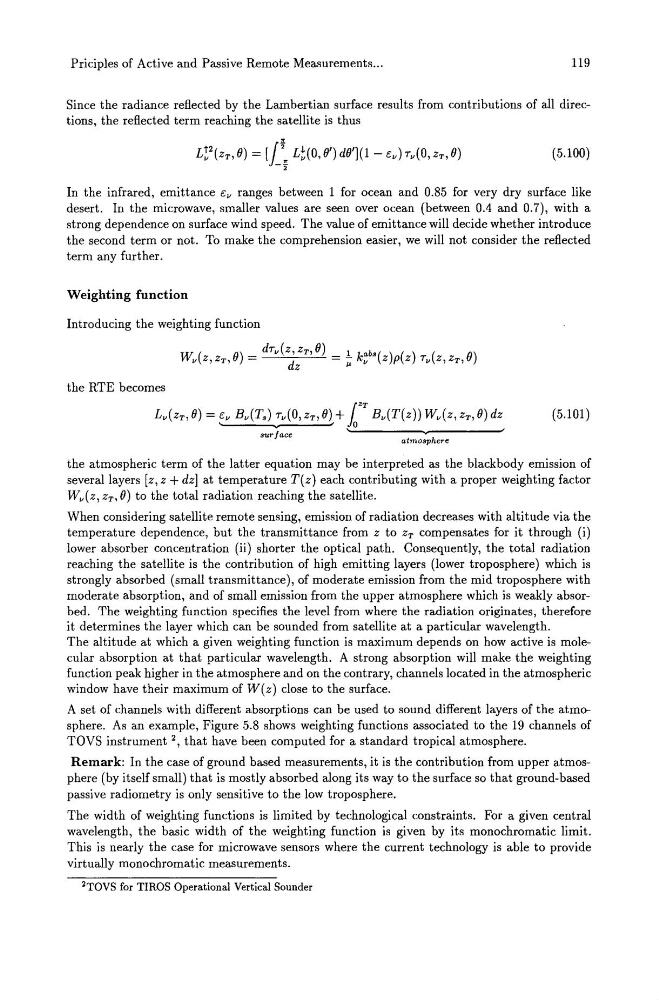
Since the radiance reflected by the Lambertian surface results from contributions of all directions, the reflected term reaching the satellite is thus
L~2(ZT,8) = [t!! Lt(0,8')d8'](1-Ev )Tv (0'ZT,8)
2
(5.100)
In the infrared, emittance Ev ranges between 1 for ocean and 0.S5 for very dry surface like
desert. In the microwave, smaller values are seen over ocean (between 0.4 and 0.7), with a
strong dependence on surface wind speed. The value of emittance will decide whether introduce
the second term or not. To make the comprehension easier, we will not consider the reflected
term any further.
Weighting function
Introducing the weighting function
the RTE becomes
LV(ZT' 8) = ~v Bv(Ts) Tv(O, ZT, 8), + fo ZT Bv(T(z)) Wv(z, ZT, 8) dz
surjace
"
..
'
atmosphere
(5.101)
the atmospheric term of the latter equation may be interpreted as the blackbody emission of
several layers [z, z + dz] at temperature T(z) each contributing with a proper weighting factor
Wv(z, ZT, 8) to the total radiation reaching the satellite.
When considering satellite remote sensing, emission of radiation decreases with altitude via the
temperature dependence, but the transmittance from z to ZT compensates for it through (i)
lower absorber concentration (ii) shorter the optical path. Consequently, the total radiation
reaching the satellite is the contribution of high emitting layers (lower troposphere) which is
strongly absorbed (small transmittance), of moderate emission from the mid troposphere with
moderate absorption, and of small emission from the upper atmosphere which is weakly absorbed. The weighting function specifies the level from where the radiation originates, therefore
it determines the layer which can be sounded from satellite at a particular wavelength.
The altitude at which a given weighting function is maximum depends on how active is molecular absorption at that particular wavelength. A strong absorption will make the weighting
function peak higher in the atmosphere and on the contrary, channels located in the atmospheric
window have their maximum of W(z) close to the surface.
A set of channels with different absorptions can be used to sound different layers of the atmosphere. As an example, Figure 5.S shows weighting functions associated to the 19 channels of
TOVS instrument 2, that have been computed for a standard tropical atmosphere.
Remark: In the case of ground based measurements, it is the contribution from upper atmosphere (by itself small) that is mostly absorbed along its way to the surface so that ground-based
passive radiometry is only sensitive to the low troposphere.
The width of weighting functions is limited by technological constraints. For a given central
wavelength, the basic width of the weighting function is given by its monochromatic limit.
This is nearly the case for microwave sensors where the current technology is able to provide
virtually monochromatic measurements.
2TOVS for TIROS Operational Vertical Sounder
119
Since the radiance reflected by the Lambertian surface results from contributions of all directions, the reflected term reaching the satellite is thus
L~2(ZT,8) = [t!! Lt(0,8')d8'](1-Ev )Tv (0'ZT,8)
2
(5.100)
In the infrared, emittance Ev ranges between 1 for ocean and 0.S5 for very dry surface like
desert. In the microwave, smaller values are seen over ocean (between 0.4 and 0.7), with a
strong dependence on surface wind speed. The value of emittance will decide whether introduce
the second term or not. To make the comprehension easier, we will not consider the reflected
term any further.
Weighting function
Introducing the weighting function
the RTE becomes
LV(ZT' 8) = ~v Bv(Ts) Tv(O, ZT, 8), + fo ZT Bv(T(z)) Wv(z, ZT, 8) dz
surjace
"
..
'
atmosphere
(5.101)
the atmospheric term of the latter equation may be interpreted as the blackbody emission of
several layers [z, z + dz] at temperature T(z) each contributing with a proper weighting factor
Wv(z, ZT, 8) to the total radiation reaching the satellite.
When considering satellite remote sensing, emission of radiation decreases with altitude via the
temperature dependence, but the transmittance from z to ZT compensates for it through (i)
lower absorber concentration (ii) shorter the optical path. Consequently, the total radiation
reaching the satellite is the contribution of high emitting layers (lower troposphere) which is
strongly absorbed (small transmittance), of moderate emission from the mid troposphere with
moderate absorption, and of small emission from the upper atmosphere which is weakly absorbed. The weighting function specifies the level from where the radiation originates, therefore
it determines the layer which can be sounded from satellite at a particular wavelength.
The altitude at which a given weighting function is maximum depends on how active is molecular absorption at that particular wavelength. A strong absorption will make the weighting
function peak higher in the atmosphere and on the contrary, channels located in the atmospheric
window have their maximum of W(z) close to the surface.
A set of channels with different absorptions can be used to sound different layers of the atmosphere. As an example, Figure 5.S shows weighting functions associated to the 19 channels of
TOVS instrument 2, that have been computed for a standard tropical atmosphere.
Remark: In the case of ground based measurements, it is the contribution from upper atmosphere (by itself small) that is mostly absorbed along its way to the surface so that ground-based
passive radiometry is only sensitive to the low troposphere.
The width of weighting functions is limited by technological constraints. For a given central
wavelength, the basic width of the weighting function is given by its monochromatic limit.
This is nearly the case for microwave sensors where the current technology is able to provide
virtually monochromatic measurements.
2TOVS for TIROS Operational Vertical Sounder