

ll8
Y. Fouquart and M. Vesperini
For a non scattering atmosphere, the RTE applies with (J'Zc = 0 and consequently (J'~xt = (J'~bs.
The radiance at a given position x is
(5.96)
10 being the position of the boundary.
Radiation at satellite level
Fot remote sensing applications, we are interested in the radiance reaching a satellite, located at
the top of the atmosphere (TOA), in a direction s defined by its angle () with respect to nadir.
Considering an atmosphere with horizontal homogeneity (plane parallel hypothesis), optical
depth can be expressed as a function of altitude z. The distance 1 to the satellite is related to
Z by Z = I cos (), so that dl = dz / cos () = dz / J1 (with the convention J1 > 0 for upwarding path
and J1 < 0 downwards).
The radiance reaching the satellite has two origins:
Upward radiation between the surface and the satellite
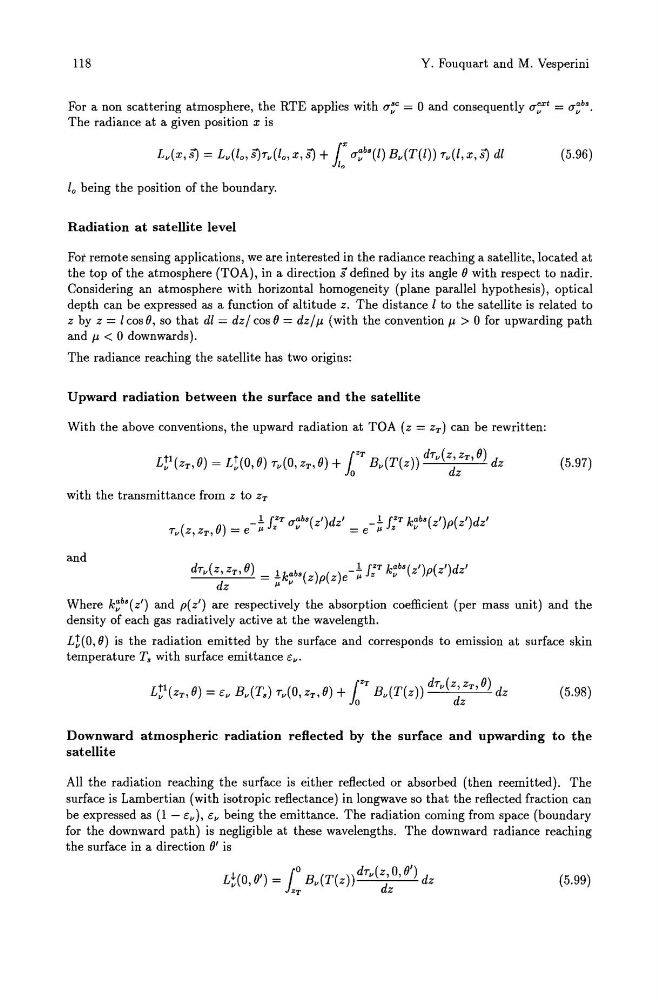
With the above conventions, the upward radiation at TOA (z = ZT) can be rewritten:
(5.97)
with the transmittance from z to ZT
_1 f ZT (J'abs(z')dz'
_1 f ZT kabs(z')p(z')dz'
Tv(Z, ZT, 0) = e J.I. Z v
= e I-' Z
v
and
dTv(z, ZT, (}) 1 k ab8 ( ) ( ) _1 J:T k~bs(z')p(z')dz'
dz
= -;; v Z P z e I'
Where k~bs(z') and p(z') are respectively the absorption coefficient (per mass unit) and the
density of each gas radiatively active at the wavelength.
LHo, (}) is the radiation emitted by the surface and corresponds to emission at surface skin
temperature Ts with surface emittance Cv'
(5.98)
Downward atmospheric radiation reflected by the surface and upwarding to the
satellite
All the radiation reaching the surface is either reflected or absorbed (then reemitted). The
surface is Lambertian (with isotropic reflectance) in longwave so that the reflected fraction can
be expressed as (1 - cv), Cv being the emittance. The radiation coming from space (boundary
for the downward path) is negligible at these wavelengths. The downward radiance reaching
the surface in a direction ()' is
(5.99)
Y. Fouquart and M. Vesperini
For a non scattering atmosphere, the RTE applies with (J'Zc = 0 and consequently (J'~xt = (J'~bs.
The radiance at a given position x is
(5.96)
10 being the position of the boundary.
Radiation at satellite level
Fot remote sensing applications, we are interested in the radiance reaching a satellite, located at
the top of the atmosphere (TOA), in a direction s defined by its angle () with respect to nadir.
Considering an atmosphere with horizontal homogeneity (plane parallel hypothesis), optical
depth can be expressed as a function of altitude z. The distance 1 to the satellite is related to
Z by Z = I cos (), so that dl = dz / cos () = dz / J1 (with the convention J1 > 0 for upwarding path
and J1 < 0 downwards).
The radiance reaching the satellite has two origins:
Upward radiation between the surface and the satellite
With the above conventions, the upward radiation at TOA (z = ZT) can be rewritten:
(5.97)
with the transmittance from z to ZT
_1 f ZT (J'abs(z')dz'
_1 f ZT kabs(z')p(z')dz'
Tv(Z, ZT, 0) = e J.I. Z v
= e I-' Z
v
and
dTv(z, ZT, (}) 1 k ab8 ( ) ( ) _1 J:T k~bs(z')p(z')dz'
dz
= -;; v Z P z e I'
Where k~bs(z') and p(z') are respectively the absorption coefficient (per mass unit) and the
density of each gas radiatively active at the wavelength.
LHo, (}) is the radiation emitted by the surface and corresponds to emission at surface skin
temperature Ts with surface emittance Cv'
(5.98)
Downward atmospheric radiation reflected by the surface and upwarding to the
satellite
All the radiation reaching the surface is either reflected or absorbed (then reemitted). The
surface is Lambertian (with isotropic reflectance) in longwave so that the reflected fraction can
be expressed as (1 - cv), Cv being the emittance. The radiation coming from space (boundary
for the downward path) is negligible at these wavelengths. The downward radiance reaching
the surface in a direction ()' is
(5.99)