

Priciples of Active and Passive Remote Measurements ...
99
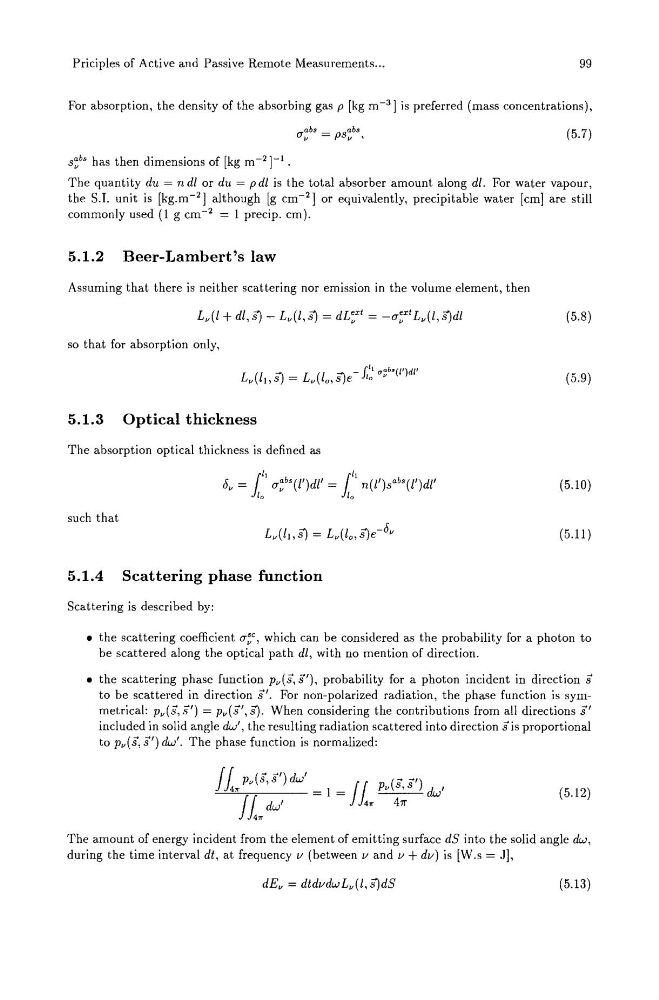
For absorption, the density of the absorbing gas p [kg m- 3 ] is preferred (mass concentrations),
(5.7)
S~bs has then dimensions of [kg m- 2 ]-I.
The quantity du = ndl or du = pdl is the total absorber amount along dl. For water vapour,
the S.l. unit is [kg.m- 2 ] although [g cm- 2 ] or equivalently, precipitable water [cm] are still
commonly used (1 g cm- 2 = 1 precip. cm).
5.1.2 Beer-Lambert's law
Assuming that there is neither scattering nor emission in the volume element, then
(5.8)
so that for absorption only,
(5.9)
5.1.3 Optical thickness
The absorption optical thickness is defined as
(5.10)
such that
(5.l1)
5.1.4 Scattering phase function
Scattering is described by:
• the scattering coefficient cr: c , which can be considered as the probability for a photon to
be scattered along the optical path dl, with no mention of direction .
• the scattering phase function Pv(.s, s'), probability for a photon incident in direction s
to be scattered in direction s'. For non-polarized radiation, the phase function is symmetrical: Pv(s, s') = Pv(s', 8). When considering the contributions from all directions s'
included in solid angle dw', the resulting radiation scattered into direction sis proportional
to Pv(s, s') dw'. The phase function is normalized:
f L Pv(s, s') dw' = 1 = J' ( Pv(s, s') dw'
fL dw'
J47r 411'
(5.12)
The amount of energy incident from the element of emitting surface dS into the solid angle dw,
during the time interval dt, at frequency v (between v and v + dv) is [W.s = J],
dEv = dtdvdwLv (l,8)dS
( 5.13)
99
For absorption, the density of the absorbing gas p [kg m- 3 ] is preferred (mass concentrations),
(5.7)
S~bs has then dimensions of [kg m- 2 ]-I.
The quantity du = ndl or du = pdl is the total absorber amount along dl. For water vapour,
the S.l. unit is [kg.m- 2 ] although [g cm- 2 ] or equivalently, precipitable water [cm] are still
commonly used (1 g cm- 2 = 1 precip. cm).
5.1.2 Beer-Lambert's law
Assuming that there is neither scattering nor emission in the volume element, then
(5.8)
so that for absorption only,
(5.9)
5.1.3 Optical thickness
The absorption optical thickness is defined as
(5.10)
such that
(5.l1)
5.1.4 Scattering phase function
Scattering is described by:
• the scattering coefficient cr: c , which can be considered as the probability for a photon to
be scattered along the optical path dl, with no mention of direction .
• the scattering phase function Pv(.s, s'), probability for a photon incident in direction s
to be scattered in direction s'. For non-polarized radiation, the phase function is symmetrical: Pv(s, s') = Pv(s', 8). When considering the contributions from all directions s'
included in solid angle dw', the resulting radiation scattered into direction sis proportional
to Pv(s, s') dw'. The phase function is normalized:
f L Pv(s, s') dw' = 1 = J' ( Pv(s, s') dw'
fL dw'
J47r 411'
(5.12)
The amount of energy incident from the element of emitting surface dS into the solid angle dw,
during the time interval dt, at frequency v (between v and v + dv) is [W.s = J],
dEv = dtdvdwLv (l,8)dS
( 5.13)