

98
Y. Fouquart and M. Vesperini
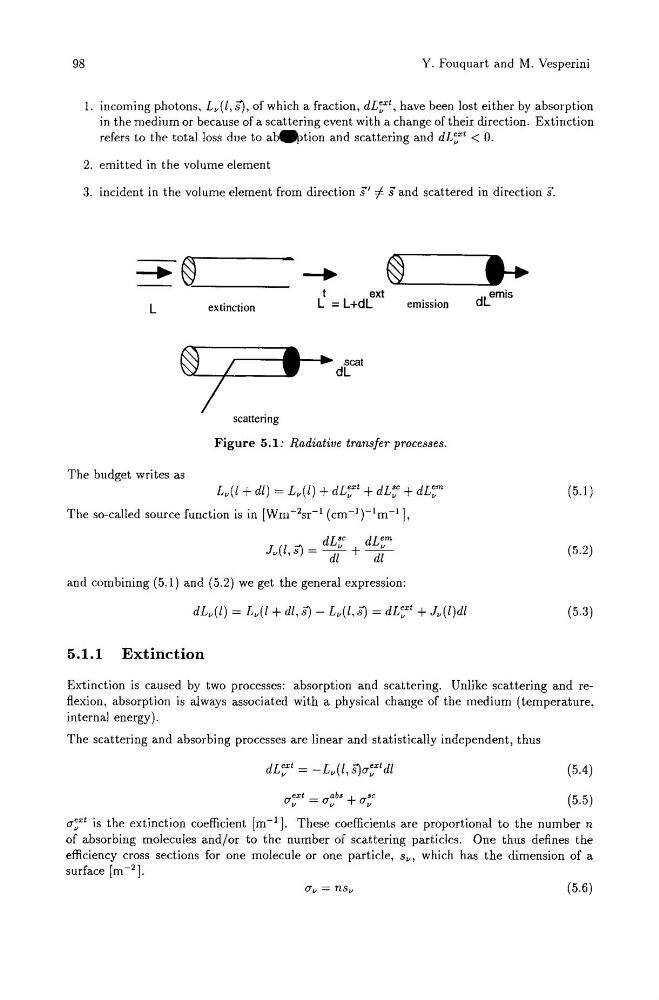
1. incoming photons, Lv(l, 5), of which a fraction, dL~xt, have been lost either by absorption
in the medium or because of a scattering event with a change of their direction. Extinction
refers to the total loss due to absorption and scattering and dL~xt < O.
2. emitted in the volume element
3. incident in the volume element from direction s' i=- s and scattered in direction s.
~ Q
,--+ ~U<.-____ I+
'--_ _ _ _ _ ...3'
t
ext
L
extinction
L = L+dL
® /,-----I.-...~ scat
-7 - dl
scattering
emission
Figure 5.1: Radiative transfer processes.
The budget writes as
Lv(l + dl) = Lv(l) + dL~xt + dL~c + dL~m
The so-called source function is in [Wm- 2 sr- 1 (cm-1)-lm- 1 J,
and combining (5.1) and (5.2) we get the general expression:
5.1.1 Extinction
(5.1 )
(5.2)
(5.3)
Extinction is caused by two processes: absorption and scattering. Unlike scattering and reflexion, absorption is always associated with a physical change of the medium (temperature,
internal energy).
The scattering and absorbing processes are linear and statistically independent, thus
(5.4)
(5.5)
(T~xt is the extinction coefficient [m- I ]. These coefficients are proportional to the number n
of absorbing molecules and/or to the number of scattering particles. One thus defines the
efficiency cross sections for one molecule or one particle, sv, which has the dimension of a
surface [m- 2 ].
(5.6)
Y. Fouquart and M. Vesperini
1. incoming photons, Lv(l, 5), of which a fraction, dL~xt, have been lost either by absorption
in the medium or because of a scattering event with a change of their direction. Extinction
refers to the total loss due to absorption and scattering and dL~xt < O.
2. emitted in the volume element
3. incident in the volume element from direction s' i=- s and scattered in direction s.
~ Q
,--+ ~U<.-____ I+
'--_ _ _ _ _ ...3'
t
ext
L
extinction
L = L+dL
® /,-----I.-...~ scat
-7 - dl
scattering
emission
Figure 5.1: Radiative transfer processes.
The budget writes as
Lv(l + dl) = Lv(l) + dL~xt + dL~c + dL~m
The so-called source function is in [Wm- 2 sr- 1 (cm-1)-lm- 1 J,
and combining (5.1) and (5.2) we get the general expression:
5.1.1 Extinction
(5.1 )
(5.2)
(5.3)
Extinction is caused by two processes: absorption and scattering. Unlike scattering and reflexion, absorption is always associated with a physical change of the medium (temperature,
internal energy).
The scattering and absorbing processes are linear and statistically independent, thus
(5.4)
(5.5)
(T~xt is the extinction coefficient [m- I ]. These coefficients are proportional to the number n
of absorbing molecules and/or to the number of scattering particles. One thus defines the
efficiency cross sections for one molecule or one particle, sv, which has the dimension of a
surface [m- 2 ].
(5.6)