

Introduction to Numerical Weather Prediction Data Assimilation
93
condensation is essential in order to get reasonable humidity fields in the upper troposphere.
More generally, it is expected that the important feedback loops present in the model M will
have to be described to a reasonable accuracy with n; this is expected to be of particular
importance in the tropics. Zou et al. (1993) and Zupanski (1993) have performed feasibility
studies using the adjoint of physical parametrizations. The automatic methods developed at
INRIA will assist us in formulating a series of tangent-linear models including progressively
more effects of the physics (Rostaing et aI., 1993).
In terms of cost this will eventually double the CPU cost of 4D- Var (as the cost of the physical
parametrizations is about 50% of the cost of the model) but it will immediately double the
storage required for the trajectory (and the related 10). Currently, only t values are stored
since the dynamics are nonlinear only with respect to these t values and not the t - l:;.t. Since
the physics are nonlinear with respect to t - l:;.t values, they too will have to be stored. It
should be pointed out, however, that a 2 time-level semi-Lagrangian scheme would not require
this extra storage.
The physics is far more nonlinear than the dynamics. As a consequence, the tangent-linear
approximation is likely to be less valid for the full model than for the adiabatic version. This
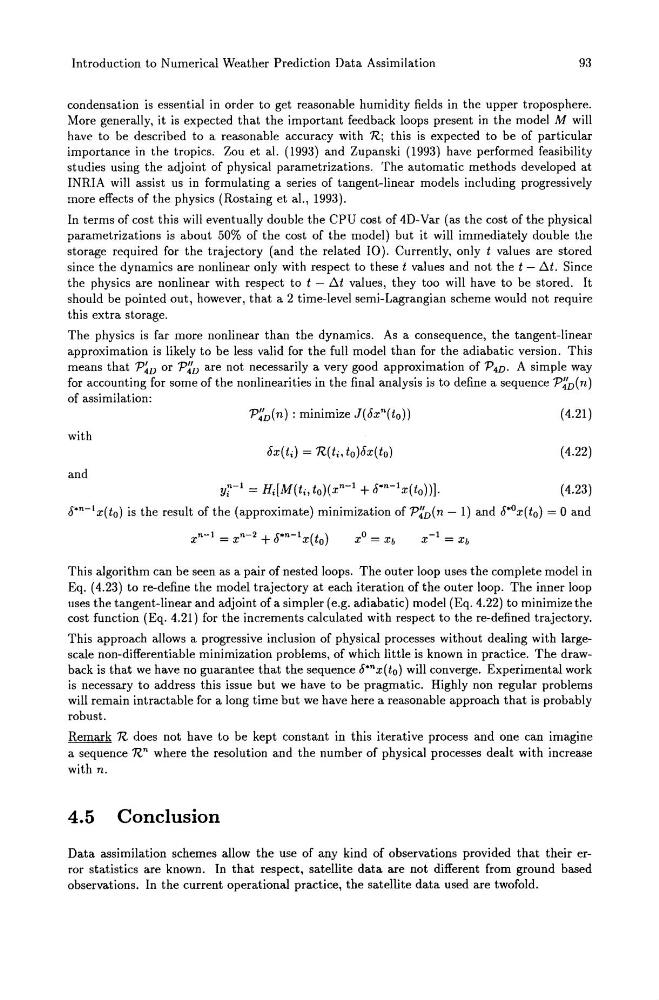
means that P~o or P%o are not necessarily a very good approximation of P4o. A simple way
for accounting for some of the nonlinearities in the final analysis is to define a sequence P%o(n)
of assimilation:
(4.21 )
with
b"x(t;) = n(t;, to)b"x(to)
(4.22)
and
(4.23)
b".n-l x( to) is the result of the (approximate) minimization of P%o( n - 1) and b"'ox( to) = 0 and
This algorithm can be seen as a pair of nested loops. The outer loop uses the complete model in
Eq. (4.23) to re-define the model trajectory at each iteration of the outer loop. The inner loop
uses the tangent-linear and adjoint of a simpler (e.g. adiabatic) model (Eq. 4.22) to minimize the
cost function (Eq. 4.21) for the increments calculated with respect to the re-defined trajectory.
This approach allows a progressive inclusion of physical processes without dealing with largescale non-differentiable minimization problems, of which little is known in practice. The drawback is that we have no guarantee that the sequence b".nx(to) will converge. Experimental work
is necessary to address this issue but we have to be pragmatic. Highly non regular problems
will remain intractable for a long time but we have here a reasonable approach that is probably
robust.
Remark n does not have to be kept constant in this iterative process and one can imagine
a sequence nn where the resolution and the number of physical processes dealt with increase
with n.
4.5 Conclusion
Data assimilation schemes allow the use of any kind of observations provided that their error statistics are known. In that respect, satellite data are not different from ground based
observations. In the current operational practice, the satellite data used are twofold.
93
condensation is essential in order to get reasonable humidity fields in the upper troposphere.
More generally, it is expected that the important feedback loops present in the model M will
have to be described to a reasonable accuracy with n; this is expected to be of particular
importance in the tropics. Zou et al. (1993) and Zupanski (1993) have performed feasibility
studies using the adjoint of physical parametrizations. The automatic methods developed at
INRIA will assist us in formulating a series of tangent-linear models including progressively
more effects of the physics (Rostaing et aI., 1993).
In terms of cost this will eventually double the CPU cost of 4D- Var (as the cost of the physical
parametrizations is about 50% of the cost of the model) but it will immediately double the
storage required for the trajectory (and the related 10). Currently, only t values are stored
since the dynamics are nonlinear only with respect to these t values and not the t - l:;.t. Since
the physics are nonlinear with respect to t - l:;.t values, they too will have to be stored. It
should be pointed out, however, that a 2 time-level semi-Lagrangian scheme would not require
this extra storage.
The physics is far more nonlinear than the dynamics. As a consequence, the tangent-linear
approximation is likely to be less valid for the full model than for the adiabatic version. This
means that P~o or P%o are not necessarily a very good approximation of P4o. A simple way
for accounting for some of the nonlinearities in the final analysis is to define a sequence P%o(n)
of assimilation:
(4.21 )
with
b"x(t;) = n(t;, to)b"x(to)
(4.22)
and
(4.23)
b".n-l x( to) is the result of the (approximate) minimization of P%o( n - 1) and b"'ox( to) = 0 and
This algorithm can be seen as a pair of nested loops. The outer loop uses the complete model in
Eq. (4.23) to re-define the model trajectory at each iteration of the outer loop. The inner loop
uses the tangent-linear and adjoint of a simpler (e.g. adiabatic) model (Eq. 4.22) to minimize the
cost function (Eq. 4.21) for the increments calculated with respect to the re-defined trajectory.
This approach allows a progressive inclusion of physical processes without dealing with largescale non-differentiable minimization problems, of which little is known in practice. The drawback is that we have no guarantee that the sequence b".nx(to) will converge. Experimental work
is necessary to address this issue but we have to be pragmatic. Highly non regular problems
will remain intractable for a long time but we have here a reasonable approach that is probably
robust.
Remark n does not have to be kept constant in this iterative process and one can imagine
a sequence nn where the resolution and the number of physical processes dealt with increase
with n.
4.5 Conclusion
Data assimilation schemes allow the use of any kind of observations provided that their error statistics are known. In that respect, satellite data are not different from ground based
observations. In the current operational practice, the satellite data used are twofold.