

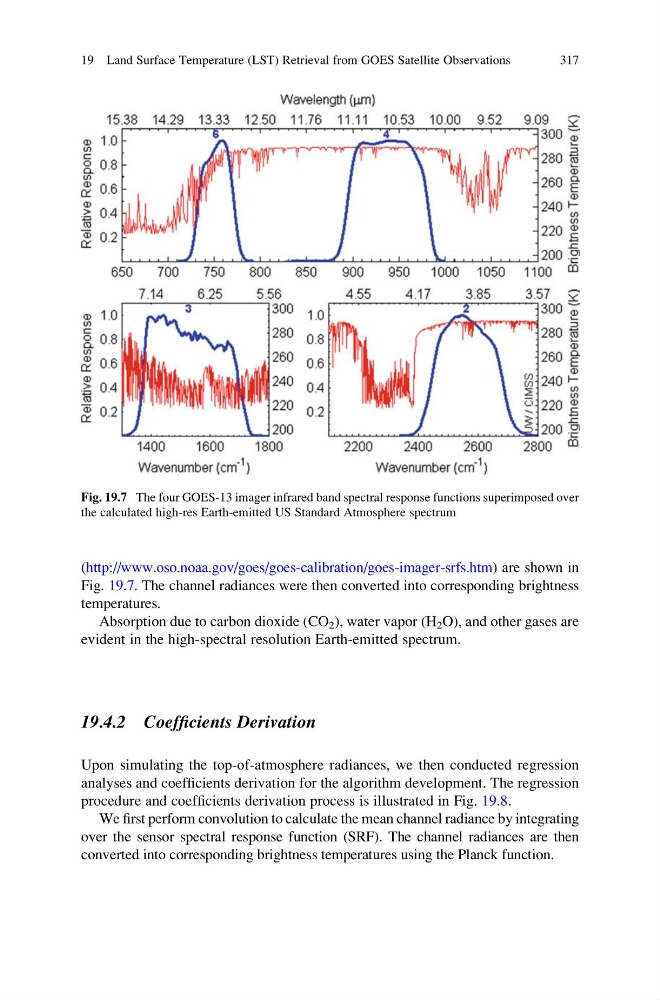
(http://www.oso.noaa.gov/goes/goes-calibration/goes-imager-srfs.htm) are shown in
Fig. 19.7. The channel radiances were then converted into corresponding brightness
temperatures.
Absorption due to carbon dioxide (CO 2 ), water vapor (H 2 O), and other gases are
evident in the high-spectral resolution Earth-emitted spectrum.
19.4.2 Coefficients Derivation
Upon simulating the top-of-atmosphere radiances, we then conducted regression
analyses and coefficients derivation for the algorithm development. The regression
procedure and coefficients derivation process is illustrated in Fig. 19.8.
We first perform convolution to calculate the mean channel radiance by integrating
over the sensor spectral response function (SRF). The channel radiances are then
converted into corresponding brightness temperatures using the Planck function.
Fig. 19.7 The four GOES-13 imager infrared band spectral response functions superimposed over
the calculated high-res Earth-emitted US Standard Atmosphere spectrum
19 Land Surface Temperature (LST) Retrieval from GOES Satellite Observations
317
Fig. 19.7. The channel radiances were then converted into corresponding brightness
temperatures.
Absorption due to carbon dioxide (CO 2 ), water vapor (H 2 O), and other gases are
evident in the high-spectral resolution Earth-emitted spectrum.
19.4.2 Coefficients Derivation
Upon simulating the top-of-atmosphere radiances, we then conducted regression
analyses and coefficients derivation for the algorithm development. The regression
procedure and coefficients derivation process is illustrated in Fig. 19.8.
We first perform convolution to calculate the mean channel radiance by integrating
over the sensor spectral response function (SRF). The channel radiances are then
converted into corresponding brightness temperatures using the Planck function.
Fig. 19.7 The four GOES-13 imager infrared band spectral response functions superimposed over
the calculated high-res Earth-emitted US Standard Atmosphere spectrum
19 Land Surface Temperature (LST) Retrieval from GOES Satellite Observations
317