

spectral IR emissivity with full spectra for IGBP types, including the 17 MODIS IGBP
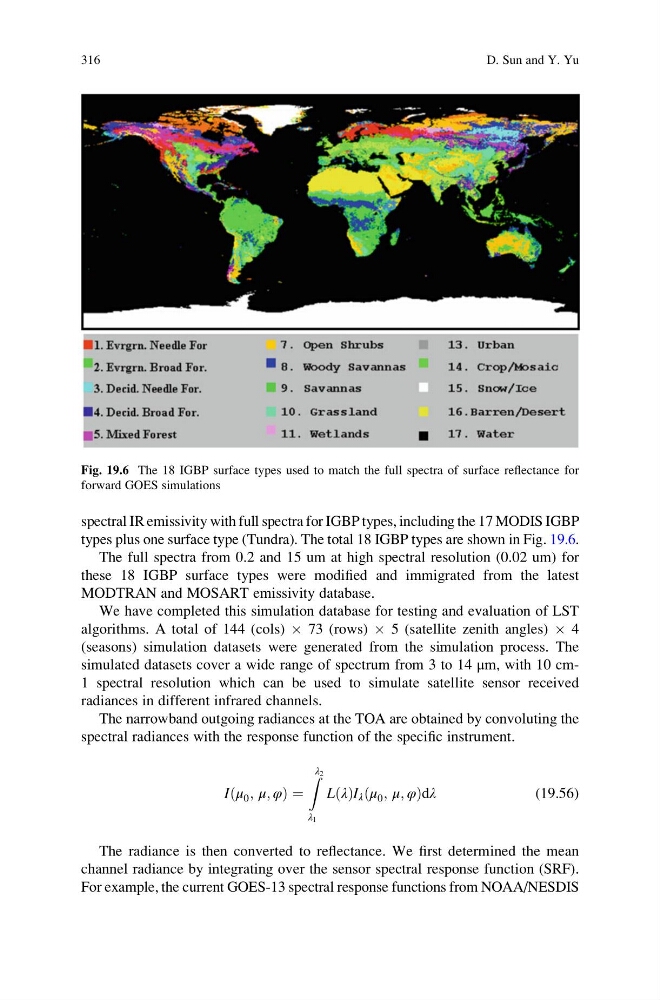
types plus one surface type (Tundra). The total 18 IGBP types are shown in Fig. 19.6.
The full spectra from 0.2 and 15 um at high spectral resolution (0.02 um) for
these 18 IGBP surface types were modified and immigrated from the latest
MODTRAN and MOSART emissivity database.
We have completed this simulation database for testing and evaluation of LST
algorithms. A total of 144 (cols) Â 73 (rows) Â 5 (satellite zenith angles) Â 4
(seasons) simulation datasets were generated from the simulation process. The
simulated datasets cover a wide range of spectrum from 3 to 14 μm, with 10 cm1 spectral resolution which can be used to simulate satellite sensor received
radiances in different infrared channels.
The narrowband outgoing radiances at the TOA are obtained by convoluting the
spectral radiances with the response function of the specific instrument.
I μ 0 ; μ; φ
ð
Þ¼
Z λ 2
λ 1
LðλÞI λ μ 0 ; μ; φ
ð
Þ dλ
(19.56)
The radiance is then converted to reflectance. We first determined the mean
channel radiance by integrating over the sensor spectral response function (SRF).
For example, the current GOES-13 spectral response functions from NOAA/NESDIS
Fig. 19.6 The 18 IGBP surface types used to match the full spectra of surface reflectance for
forward GOES simulations
316
D. Sun and Y. Yu
types plus one surface type (Tundra). The total 18 IGBP types are shown in Fig. 19.6.
The full spectra from 0.2 and 15 um at high spectral resolution (0.02 um) for
these 18 IGBP surface types were modified and immigrated from the latest
MODTRAN and MOSART emissivity database.
We have completed this simulation database for testing and evaluation of LST
algorithms. A total of 144 (cols) Â 73 (rows) Â 5 (satellite zenith angles) Â 4
(seasons) simulation datasets were generated from the simulation process. The
simulated datasets cover a wide range of spectrum from 3 to 14 μm, with 10 cm1 spectral resolution which can be used to simulate satellite sensor received
radiances in different infrared channels.
The narrowband outgoing radiances at the TOA are obtained by convoluting the
spectral radiances with the response function of the specific instrument.
I μ 0 ; μ; φ
ð
Þ¼
Z λ 2
λ 1
LðλÞI λ μ 0 ; μ; φ
ð
Þ dλ
(19.56)
The radiance is then converted to reflectance. We first determined the mean
channel radiance by integrating over the sensor spectral response function (SRF).
For example, the current GOES-13 spectral response functions from NOAA/NESDIS
Fig. 19.6 The 18 IGBP surface types used to match the full spectra of surface reflectance for
forward GOES simulations
316
D. Sun and Y. Yu