

19.3.2.3 Triple-Window LST Algorithm
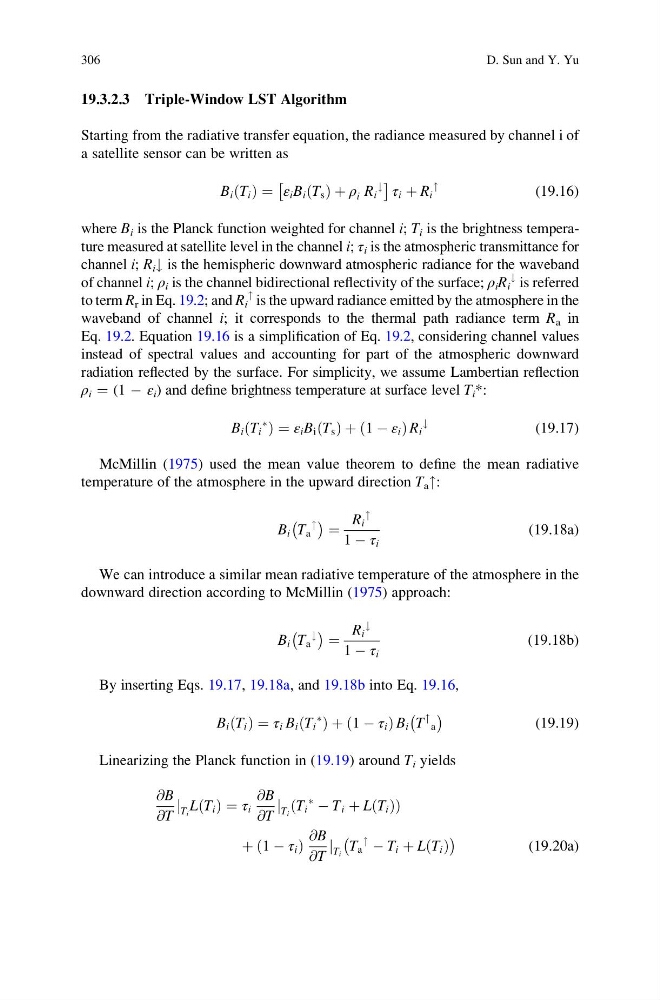
Starting from the radiative transfer equation, the radiance measured by channel i of
a satellite sensor can be written as
B i T i
ð Þ ¼ ε i B i T s
ð Þ þ ρ i R i
#
Â
à τ i þ R i
"
(19.16)
where B i is the Planck function weighted for channel i; T i is the brightness temperature measured at satellite level in the channel i; τ i is the atmospheric transmittance for
channel i; R i # is the hemispheric downward atmospheric radiance for the waveband
of channel i; ρ i is the channel bidirectional reflectivity of the surface; ρ i R i
# is referred
to term R r in Eq. 19.2; and R i
" is the upward radiance emitted by the atmosphere in the
waveband of channel i; it corresponds to the thermal path radiance term R a in
Eq. 19.2. Equation 19.16 is a simplification of Eq. 19.2, considering channel values
instead of spectral values and accounting for part of the atmospheric downward
radiation reflected by the surface. For simplicity, we assume Lambertian reflection
ρ i ¼ (1 À ε i ) and define brightness temperature at surface level T i *:
B i T i
Ã
ð Þ ¼ ε i B i T s
ð Þ þ 1 À ε i
ð
ÞR i
#
(19.17)
McMillin (1975) used the mean value theorem to define the mean radiative
temperature of the atmosphere in the upward direction T a ":
B i T a
"
À Á ¼
R i
"
1 À τ i
(19.18a)
We can introduce a similar mean radiative temperature of the atmosphere in the
downward direction according to McMillin (1975) approach:
B i T a
#
À Á ¼
R i
#
1 À τ i
(19.18b)
By inserting Eqs. 19.17, 19.18a, and 19.18b into Eq. 19.16,
B i T i
ð Þ ¼ τ i B i T i
Ã
ð Þ þ 1 À τ i
ð
ÞB i T
"
a
À Á
(19.19)
Linearizing the Planck function in (19.19) around T i yields
@B
@T
j T i L T i
ð Þ ¼ τ i
@B
@T
j T i T i
Ã
À T i þ L T i
ð Þ
ð
Þ
þ 1 À τ i
ð
Þ
@B
@T
j T i T a
"
À T i þ L T i
ð Þ
À
Á
(19.20a)
306
D. Sun and Y. Yu
Starting from the radiative transfer equation, the radiance measured by channel i of
a satellite sensor can be written as
B i T i
ð Þ ¼ ε i B i T s
ð Þ þ ρ i R i
#
Â
à τ i þ R i
"
(19.16)
where B i is the Planck function weighted for channel i; T i is the brightness temperature measured at satellite level in the channel i; τ i is the atmospheric transmittance for
channel i; R i # is the hemispheric downward atmospheric radiance for the waveband
of channel i; ρ i is the channel bidirectional reflectivity of the surface; ρ i R i
# is referred
to term R r in Eq. 19.2; and R i
" is the upward radiance emitted by the atmosphere in the
waveband of channel i; it corresponds to the thermal path radiance term R a in
Eq. 19.2. Equation 19.16 is a simplification of Eq. 19.2, considering channel values
instead of spectral values and accounting for part of the atmospheric downward
radiation reflected by the surface. For simplicity, we assume Lambertian reflection
ρ i ¼ (1 À ε i ) and define brightness temperature at surface level T i *:
B i T i
Ã
ð Þ ¼ ε i B i T s
ð Þ þ 1 À ε i
ð
ÞR i
#
(19.17)
McMillin (1975) used the mean value theorem to define the mean radiative
temperature of the atmosphere in the upward direction T a ":
B i T a
"
À Á ¼
R i
"
1 À τ i
(19.18a)
We can introduce a similar mean radiative temperature of the atmosphere in the
downward direction according to McMillin (1975) approach:
B i T a
#
À Á ¼
R i
#
1 À τ i
(19.18b)
By inserting Eqs. 19.17, 19.18a, and 19.18b into Eq. 19.16,
B i T i
ð Þ ¼ τ i B i T i
Ã
ð Þ þ 1 À τ i
ð
ÞB i T
"
a
À Á
(19.19)
Linearizing the Planck function in (19.19) around T i yields
@B
@T
j T i L T i
ð Þ ¼ τ i
@B
@T
j T i T i
Ã
À T i þ L T i
ð Þ
ð
Þ
þ 1 À τ i
ð
Þ
@B
@T
j T i T a
"
À T i þ L T i
ð Þ
À
Á
(19.20a)
306
D. Sun and Y. Yu