

19.3.1 Physical Description
Under clear sky conditions, the outgoing spectral radiance at the top of the atmosphere can be represented as
Rðλ; μÞ ¼ ε 0 ðλ; μÞB λ; T s
ð
Þτ 0 ðλ; μÞ þ R a ðλ; μÞ þ R s λ; μ; μ 0 ; φ 0
ð
Þ
þ R d λ; μ; μ 0 ; φ 0
ð
ÞþR r ðλ; μÞ
ð 19:2Þ
where ε 0 is the surface spectral emissivity, B is the Planck function, τ 0 is the
transmittance from the Earth’s surface to the top of atmosphere, R a is the thermal
path radiance, R s is the path radiance resulting from scattering of solar radiation, R d
is the solar diffuse radiance, and R r is the atmospheric thermal radiation reflected by
the surface. T s is the skin temperature, λ is the wavelength, μ ¼ cos(θ), and μ 0 ¼
cos (ψ), where θ is the satellite zenith angle, ψ is the solar zenith angle, and φ 0 is the
azimuth angle.
The wavelength λ is actually the wavelength center of a narrow interval because
there is no way to measure the exact monochromatic signal as a continuous function
of wavelength by satellite sensors. For the far-IR bands, solar contributions can be
negligible, so the outgoing infrared spectral radiance at the top of atmosphere can
be represented by
Rðλ; μÞ ¼ ε 0 ðλ; μÞB λ; T s
ð
Þτ 0 ðλ; μÞ þ R a ðλ; μÞ
(19.3)
The purpose of the LST algorithm is to retrieve the land surface skin temperature
T s from the satellite sensor measured radiance R(λ, μ). Physically, in this problem,
the surface temperature is basically coupled with two other factors: surface emissivity and the atmospheric absorptions. Developing an LST algorithm means to find
a solution of decoupling the emissivity and the atmospheric absorption effects from
satellite received radiance.
As shown from Fig. 19.3, in order to retrieve surface information from satellite
observations, we need to select window channels with no or less atmospheric
absorption. Some bands, such as 3–4, 8–9, and 10–12 μm, are some typical
atmospheric windows.
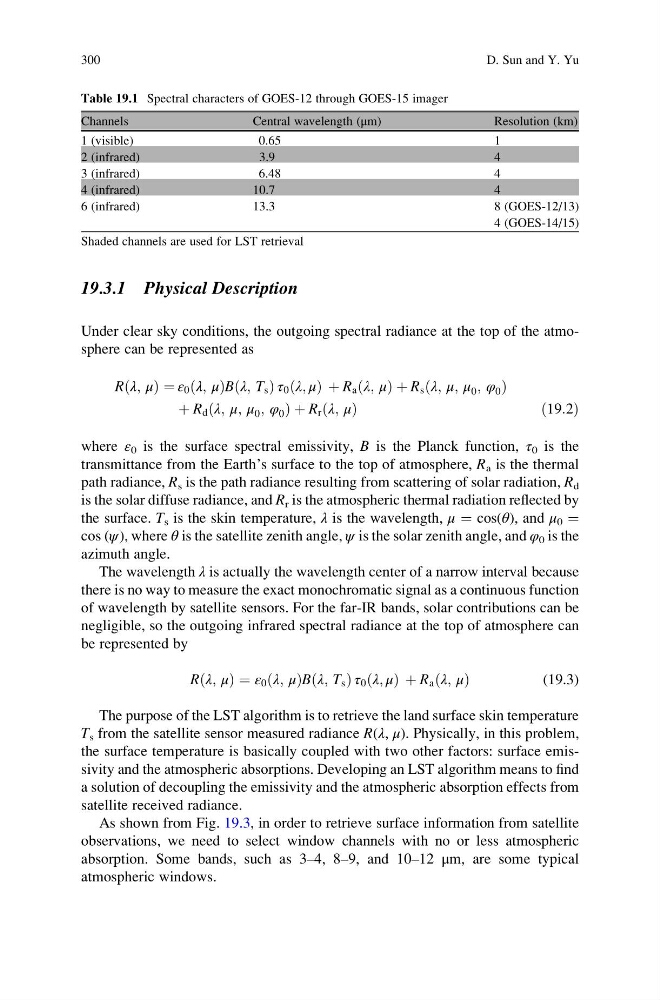
Table 19.1 Spectral characters of GOES-12 through GOES-15 imager
Channels
Central wavelength (μm)
Resolution (km)
1 (visible)
0.65
1
2 (infrared)
3.9
4
3 (infrared)
6.48
4
4 (infrared)
10.7
4
6 (infrared)
13.3
8 (GOES-12/13)
4 (GOES-14/15)
Shaded channels are used for LST retrieval
300
D. Sun and Y. Yu
Under clear sky conditions, the outgoing spectral radiance at the top of the atmosphere can be represented as
Rðλ; μÞ ¼ ε 0 ðλ; μÞB λ; T s
ð
Þτ 0 ðλ; μÞ þ R a ðλ; μÞ þ R s λ; μ; μ 0 ; φ 0
ð
Þ
þ R d λ; μ; μ 0 ; φ 0
ð
ÞþR r ðλ; μÞ
ð 19:2Þ
where ε 0 is the surface spectral emissivity, B is the Planck function, τ 0 is the
transmittance from the Earth’s surface to the top of atmosphere, R a is the thermal
path radiance, R s is the path radiance resulting from scattering of solar radiation, R d
is the solar diffuse radiance, and R r is the atmospheric thermal radiation reflected by
the surface. T s is the skin temperature, λ is the wavelength, μ ¼ cos(θ), and μ 0 ¼
cos (ψ), where θ is the satellite zenith angle, ψ is the solar zenith angle, and φ 0 is the
azimuth angle.
The wavelength λ is actually the wavelength center of a narrow interval because
there is no way to measure the exact monochromatic signal as a continuous function
of wavelength by satellite sensors. For the far-IR bands, solar contributions can be
negligible, so the outgoing infrared spectral radiance at the top of atmosphere can
be represented by
Rðλ; μÞ ¼ ε 0 ðλ; μÞB λ; T s
ð
Þτ 0 ðλ; μÞ þ R a ðλ; μÞ
(19.3)
The purpose of the LST algorithm is to retrieve the land surface skin temperature
T s from the satellite sensor measured radiance R(λ, μ). Physically, in this problem,
the surface temperature is basically coupled with two other factors: surface emissivity and the atmospheric absorptions. Developing an LST algorithm means to find
a solution of decoupling the emissivity and the atmospheric absorption effects from
satellite received radiance.
As shown from Fig. 19.3, in order to retrieve surface information from satellite
observations, we need to select window channels with no or less atmospheric
absorption. Some bands, such as 3–4, 8–9, and 10–12 μm, are some typical
atmospheric windows.
Table 19.1 Spectral characters of GOES-12 through GOES-15 imager
Channels
Central wavelength (μm)
Resolution (km)
1 (visible)
0.65
1
2 (infrared)
3.9
4
3 (infrared)
6.48
4
4 (infrared)
10.7
4
6 (infrared)
13.3
8 (GOES-12/13)
4 (GOES-14/15)
Shaded channels are used for LST retrieval
300
D. Sun and Y. Yu