

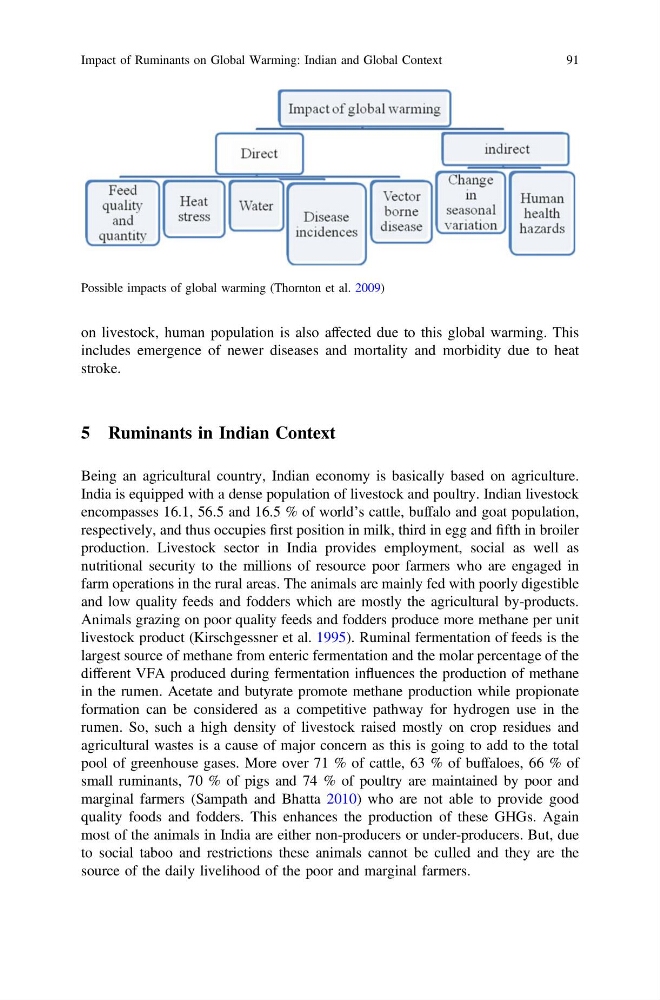
on livestock, human population is also affected due to this global warming. This
includes emergence of newer diseases and mortality and morbidity due to heat
stroke.
5 Ruminants in Indian Context
Being an agricultural country, Indian economy is basically based on agriculture.
India is equipped with a dense population of livestock and poultry. Indian livestock
encompasses 16.1, 56.5 and 16.5 % of world’s cattle, buffalo and goat population,
respectively, and thus occupies first position in milk, third in egg and fifth in broiler
production. Livestock sector in India provides employment, social as well as
nutritional security to the millions of resource poor farmers who are engaged in
farm operations in the rural areas. The animals are mainly fed with poorly digestible
and low quality feeds and fodders which are mostly the agricultural by-products.
Animals grazing on poor quality feeds and fodders produce more methane per unit
livestock product (Kirschgessner et al. 1995). Ruminal fermentation of feeds is the
largest source of methane from enteric fermentation and the molar percentage of the
different VFA produced during fermentation influences the production of methane
in the rumen. Acetate and butyrate promote methane production while propionate
formation can be considered as a competitive pathway for hydrogen use in the
rumen. So, such a high density of livestock raised mostly on crop residues and
agricultural wastes is a cause of major concern as this is going to add to the total
pool of greenhouse gases. More over 71 % of cattle, 63 % of buffaloes, 66 % of
small ruminants, 70 % of pigs and 74 % of poultry are maintained by poor and
marginal farmers (Sampath and Bhatta 2010) who are not able to provide good
quality foods and fodders. This enhances the production of these GHGs. Again
most of the animals in India are either non-producers or under-producers. But, due
to social taboo and restrictions these animals cannot be culled and they are the
source of the daily livelihood of the poor and marginal farmers.
Possible impacts of global warming (Thornton et al. 2009)
Impact of Ruminants on Global Warming: Indian and Global Context
91
includes emergence of newer diseases and mortality and morbidity due to heat
stroke.
5 Ruminants in Indian Context
Being an agricultural country, Indian economy is basically based on agriculture.
India is equipped with a dense population of livestock and poultry. Indian livestock
encompasses 16.1, 56.5 and 16.5 % of world’s cattle, buffalo and goat population,
respectively, and thus occupies first position in milk, third in egg and fifth in broiler
production. Livestock sector in India provides employment, social as well as
nutritional security to the millions of resource poor farmers who are engaged in
farm operations in the rural areas. The animals are mainly fed with poorly digestible
and low quality feeds and fodders which are mostly the agricultural by-products.
Animals grazing on poor quality feeds and fodders produce more methane per unit
livestock product (Kirschgessner et al. 1995). Ruminal fermentation of feeds is the
largest source of methane from enteric fermentation and the molar percentage of the
different VFA produced during fermentation influences the production of methane
in the rumen. Acetate and butyrate promote methane production while propionate
formation can be considered as a competitive pathway for hydrogen use in the
rumen. So, such a high density of livestock raised mostly on crop residues and
agricultural wastes is a cause of major concern as this is going to add to the total
pool of greenhouse gases. More over 71 % of cattle, 63 % of buffaloes, 66 % of
small ruminants, 70 % of pigs and 74 % of poultry are maintained by poor and
marginal farmers (Sampath and Bhatta 2010) who are not able to provide good
quality foods and fodders. This enhances the production of these GHGs. Again
most of the animals in India are either non-producers or under-producers. But, due
to social taboo and restrictions these animals cannot be culled and they are the
source of the daily livelihood of the poor and marginal farmers.
Possible impacts of global warming (Thornton et al. 2009)
Impact of Ruminants on Global Warming: Indian and Global Context
91