

Of the four compartments the rumen is the largest compartment and the main
digestive centre. The rumen is unique in its flora and fauna which is the fermentation vat. Rumen microbes ferment the fibrous food taken by the animals and
produce volatile fatty acids (VFA) which serve as energy source. Methane is
produced as a by-product of rumen microbial fermentation. Energy lost as methane
from cattle ranges from 2 to approx. 12 % of GE intake (Johnson and Johnson
1995). Compared to ruminants, non-ruminants (pigs and poultry) have a
single-chambered stomach which has negligible methane emission.
There are 1.4 billon cattle, 1.1 billion sheep, 0.9 billion goats and 0.2 billon
buffalo which sums up to 3.6 billion domestic ruminants on Earth in 2011
(FAOSTAT 2013). On an average, 25 million domestic ruminants are added to this
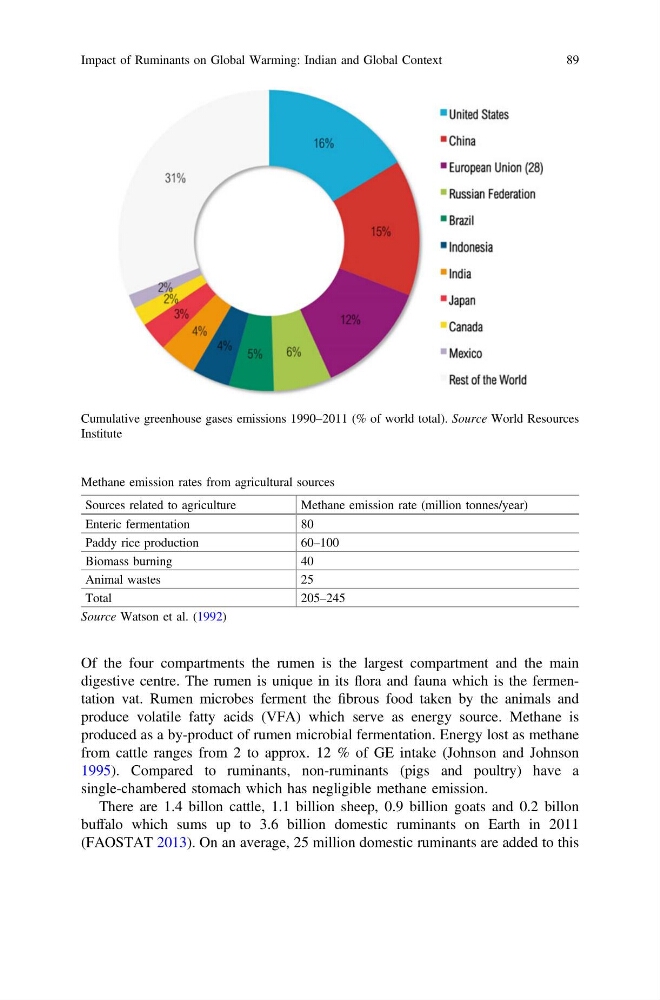
Cumulative greenhouse gases emissions 1990–2011 (% of world total). Source World Resources
Institute
Methane emission rates from agricultural sources
Sources related to agriculture
Methane emission rate (million tonnes/year)
Enteric fermentation
80
Paddy rice production
60–100
Biomass burning
40
Animal wastes
25
Total
205–245
Source Watson et al. (1992)
Impact of Ruminants on Global Warming: Indian and Global Context
89
digestive centre. The rumen is unique in its flora and fauna which is the fermentation vat. Rumen microbes ferment the fibrous food taken by the animals and
produce volatile fatty acids (VFA) which serve as energy source. Methane is
produced as a by-product of rumen microbial fermentation. Energy lost as methane
from cattle ranges from 2 to approx. 12 % of GE intake (Johnson and Johnson
1995). Compared to ruminants, non-ruminants (pigs and poultry) have a
single-chambered stomach which has negligible methane emission.
There are 1.4 billon cattle, 1.1 billion sheep, 0.9 billion goats and 0.2 billon
buffalo which sums up to 3.6 billion domestic ruminants on Earth in 2011
(FAOSTAT 2013). On an average, 25 million domestic ruminants are added to this
Cumulative greenhouse gases emissions 1990–2011 (% of world total). Source World Resources
Institute
Methane emission rates from agricultural sources
Sources related to agriculture
Methane emission rate (million tonnes/year)
Enteric fermentation
80
Paddy rice production
60–100
Biomass burning
40
Animal wastes
25
Total
205–245
Source Watson et al. (1992)
Impact of Ruminants on Global Warming: Indian and Global Context
89