

long term? The demographic examination at the very beginning of the study was
helpful to design the work plan for further activities. The working population for an
agriculture sector is increasing, while people are also looking for other occupations
besides agriculture. This is because every household has agricultural land and
women, in particular, contribute to this sector throughout the year although the land
use has drastically changed in the last three decades. We noticed that farmers are
trying to explore different sources of income to sustain their life in these fragile
environmental conditions. For the current analysis, the period of 1970–80 was the
starting period to study agent behavior and ecosystem functioning of the region.
Therefore, in the context of time (t1), it is important to analyze the system’s
functioning and consequently the behavior of the farmers of the area. Meanwhile,
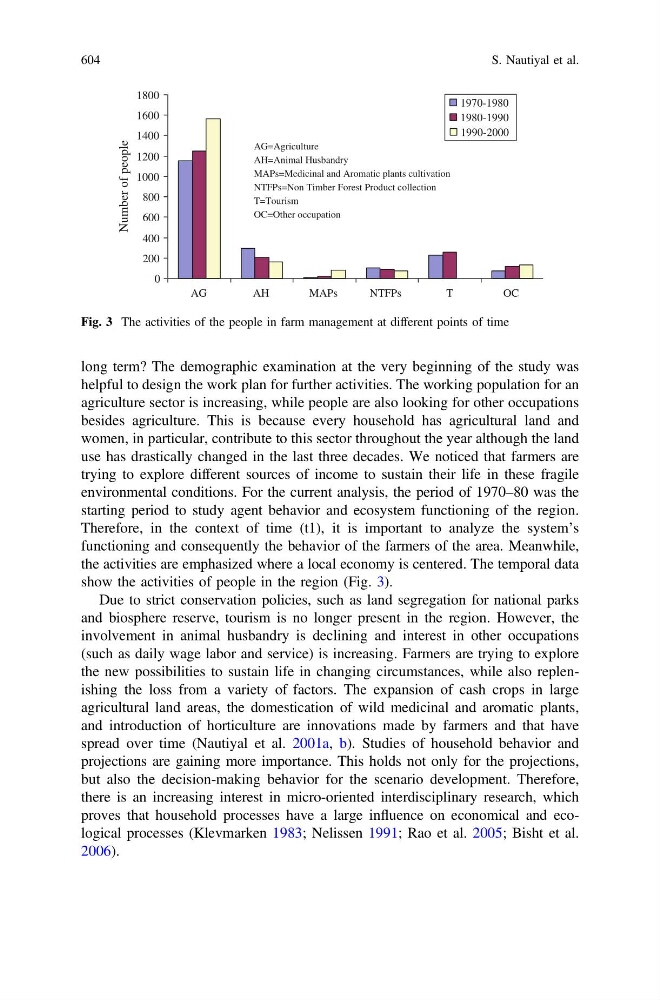
the activities are emphasized where a local economy is centered. The temporal data
show the activities of people in the region (Fig. 3).
Due to strict conservation policies, such as land segregation for national parks
and biosphere reserve, tourism is no longer present in the region. However, the
involvement in animal husbandry is declining and interest in other occupations
(such as daily wage labor and service) is increasing. Farmers are trying to explore
the new possibilities to sustain life in changing circumstances, while also replenishing the loss from a variety of factors. The expansion of cash crops in large
agricultural land areas, the domestication of wild medicinal and aromatic plants,
and introduction of horticulture are innovations made by farmers and that have
spread over time (Nautiyal et al. 2001a, b). Studies of household behavior and
projections are gaining more importance. This holds not only for the projections,
but also the decision-making behavior for the scenario development. Therefore,
there is an increasing interest in micro-oriented interdisciplinary research, which
proves that household processes have a large influence on economical and ecological processes (Klevmarken 1983; Nelissen 1991; Rao et al. 2005; Bisht et al.
2006).
0
200
400
600
800
1000
1200
1400
1600
1800
AG
AH
MAPs
NTFPs
T
OC
Number of people
1970-1980
1980-1990
1990-2000
AG=Agriculture
AH=Animal Husbandry
MAPs=Medicinal and Aromatic plants cultivation
NTFPs=Non Timber Forest Product collection
T=Tourism
OC=Other occupation
Fig. 3 The activities of the people in farm management at different points of time
604
S. Nautiyal et al.