

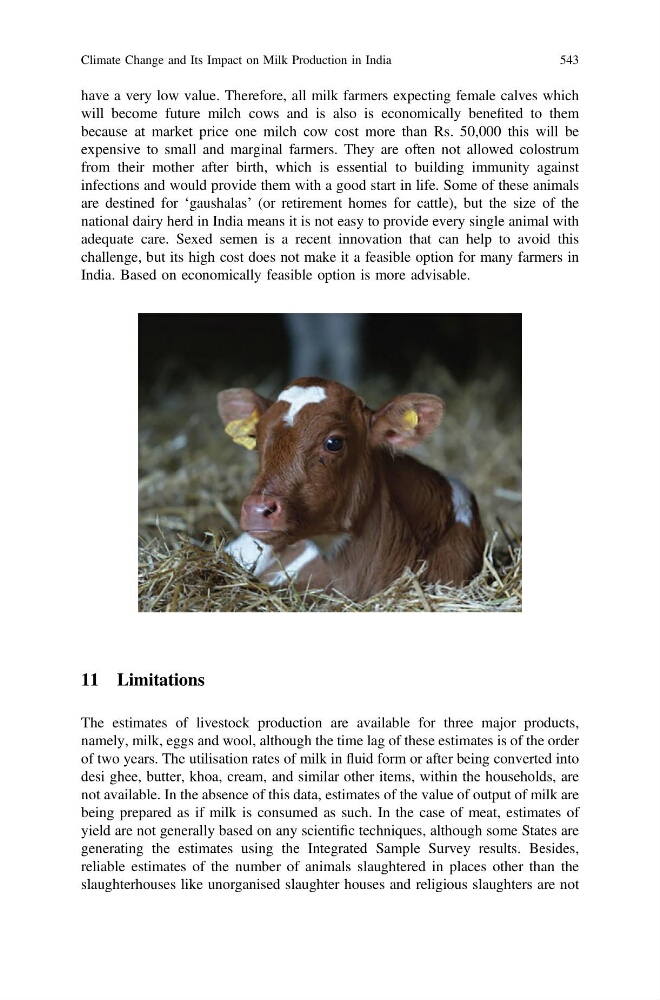
have a very low value. Therefore, all milk farmers expecting female calves which
will become future milch cows and is also is economically benefited to them
because at market price one milch cow cost more than Rs. 50,000 this will be
expensive to small and marginal farmers. They are often not allowed colostrum
from their mother after birth, which is essential to building immunity against
infections and would provide them with a good start in life. Some of these animals
are destined for ‘gaushalas’ (or retirement homes for cattle), but the size of the
national dairy herd in India means it is not easy to provide every single animal with
adequate care. Sexed semen is a recent innovation that can help to avoid this
challenge, but its high cost does not make it a feasible option for many farmers in
India. Based on economically feasible option is more advisable.
11 Limitations
The estimates of livestock production are available for three major products,
namely, milk, eggs and wool, although the time lag of these estimates is of the order
of two years. The utilisation rates of milk in fluid form or after being converted into
desi ghee, butter, khoa, cream, and similar other items, within the households, are
not available. In the absence of this data, estimates of the value of output of milk are
being prepared as if milk is consumed as such. In the case of meat, estimates of
yield are not generally based on any scientific techniques, although some States are
generating the estimates using the Integrated Sample Survey results. Besides,
reliable estimates of the number of animals slaughtered in places other than the
slaughterhouses like unorganised slaughter houses and religious slaughters are not
Climate Change and Its Impact on Milk Production in India
543
will become future milch cows and is also is economically benefited to them
because at market price one milch cow cost more than Rs. 50,000 this will be
expensive to small and marginal farmers. They are often not allowed colostrum
from their mother after birth, which is essential to building immunity against
infections and would provide them with a good start in life. Some of these animals
are destined for ‘gaushalas’ (or retirement homes for cattle), but the size of the
national dairy herd in India means it is not easy to provide every single animal with
adequate care. Sexed semen is a recent innovation that can help to avoid this
challenge, but its high cost does not make it a feasible option for many farmers in
India. Based on economically feasible option is more advisable.
11 Limitations
The estimates of livestock production are available for three major products,
namely, milk, eggs and wool, although the time lag of these estimates is of the order
of two years. The utilisation rates of milk in fluid form or after being converted into
desi ghee, butter, khoa, cream, and similar other items, within the households, are
not available. In the absence of this data, estimates of the value of output of milk are
being prepared as if milk is consumed as such. In the case of meat, estimates of
yield are not generally based on any scientific techniques, although some States are
generating the estimates using the Integrated Sample Survey results. Besides,
reliable estimates of the number of animals slaughtered in places other than the
slaughterhouses like unorganised slaughter houses and religious slaughters are not
Climate Change and Its Impact on Milk Production in India
543