

2.2 Variables and Data
The district-level time series data for the period of 1984–2013 on yield, area under
cultivation and production of wheat were collected from Federal Bureau of
Statistics, Pakistan. District-level share of fertilizer (NPK nutrients) for wheat crop
was obtained from National Fertilizer Development Centre (NFDC) Islamabad for
the same time period, whereas the monthly data of metrological variables of
wheat-growing season (November to April) is collected from the Pakistan
Meteorological Department (PMD) Islamabad for the period of 1964–2013. The
collected monthly data was categorized according to growth stages of wheat crop as
suggested by Ahmad et al. (2014) to avoid the problem of autocorrelation and
endogenity. Defined growth stages of wheat crop are presented in Table 1. Yield of
wheat crop was taken as a dependent variable in the model, while stage-wise
climatic variables, area under cultivation and amount of fertilizer were used as
explanatory variables as shown in Table 2. Moreover “Time trend” a dummy
variable was used to capture technology improvement and to avoid trend in
explanatory variables as suggested by Poudel and Kotani (2013).
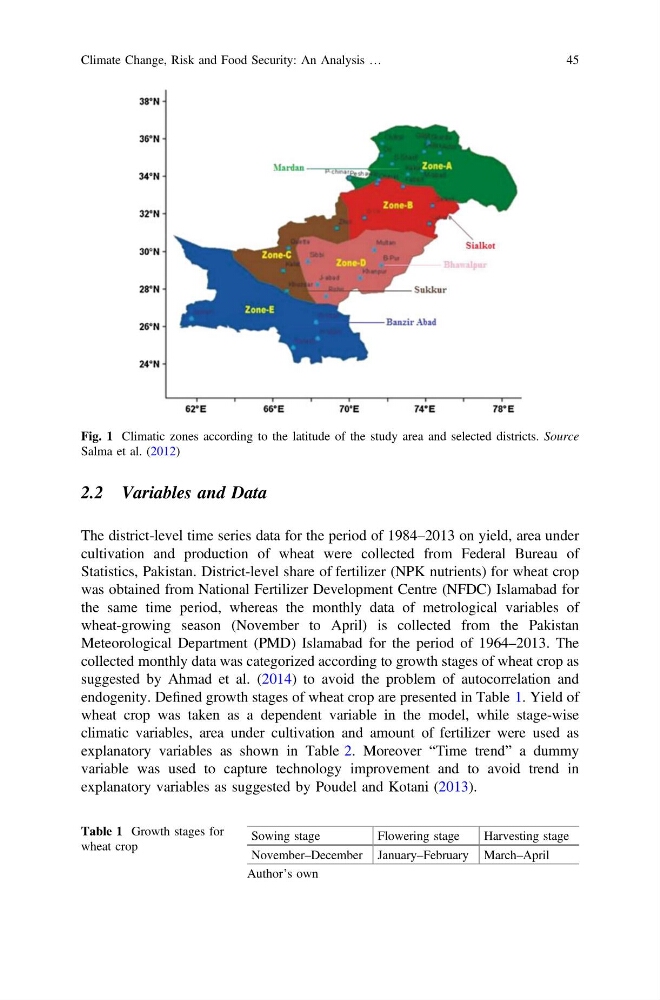
Fig. 1 Climatic zones according to the latitude of the study area and selected districts. Source
Salma et al. (2012)
Table 1 Growth stages for
wheat crop
Sowing stage
Flowering stage
Harvesting stage
November–December January–February March–April
Author’s own
Climate Change, Risk and Food Security: An Analysis …
45
The district-level time series data for the period of 1984–2013 on yield, area under
cultivation and production of wheat were collected from Federal Bureau of
Statistics, Pakistan. District-level share of fertilizer (NPK nutrients) for wheat crop
was obtained from National Fertilizer Development Centre (NFDC) Islamabad for
the same time period, whereas the monthly data of metrological variables of
wheat-growing season (November to April) is collected from the Pakistan
Meteorological Department (PMD) Islamabad for the period of 1964–2013. The
collected monthly data was categorized according to growth stages of wheat crop as
suggested by Ahmad et al. (2014) to avoid the problem of autocorrelation and
endogenity. Defined growth stages of wheat crop are presented in Table 1. Yield of
wheat crop was taken as a dependent variable in the model, while stage-wise
climatic variables, area under cultivation and amount of fertilizer were used as
explanatory variables as shown in Table 2. Moreover “Time trend” a dummy
variable was used to capture technology improvement and to avoid trend in
explanatory variables as suggested by Poudel and Kotani (2013).
Fig. 1 Climatic zones according to the latitude of the study area and selected districts. Source
Salma et al. (2012)
Table 1 Growth stages for
wheat crop
Sowing stage
Flowering stage
Harvesting stage
November–December January–February March–April
Author’s own
Climate Change, Risk and Food Security: An Analysis …
45