

conservative. If you have a herd of high-producing Holstein-Friesian, it is better
to overestimate the risks of heat stress using a lower THI than get caught out. It
is strongly being realized that gradual stress induced by global warming and
climate change is also influencing fertility and productivity of livestock directly,
and, through reduction in fodder production indirectly. Milk production of high
producing European, crossbreds and buffaloes is reduced when the THI of the
region exceeds 75. On an average THI exceeds 75 at 75–80 % places in India
throughout the year. The Majority of places in India observes THI > 75 and
more than 85 % places in India experience moderate to high heat stress during
April, May and June and THI range of 75–85 at 2.00 p.m. This situation is
likely to worsen in the years to come. All THI maps for baseline and 2030
indicates a temperature rise and change in THI in Uttar Pradesh, Madhya
Pradesh, Gujarat, Rajasthan and other states of India based on the regional
climate model PRECIS A1B scenario (source NDDB).
5.2 Effects of Heat Stress on Fertility Among the Cows
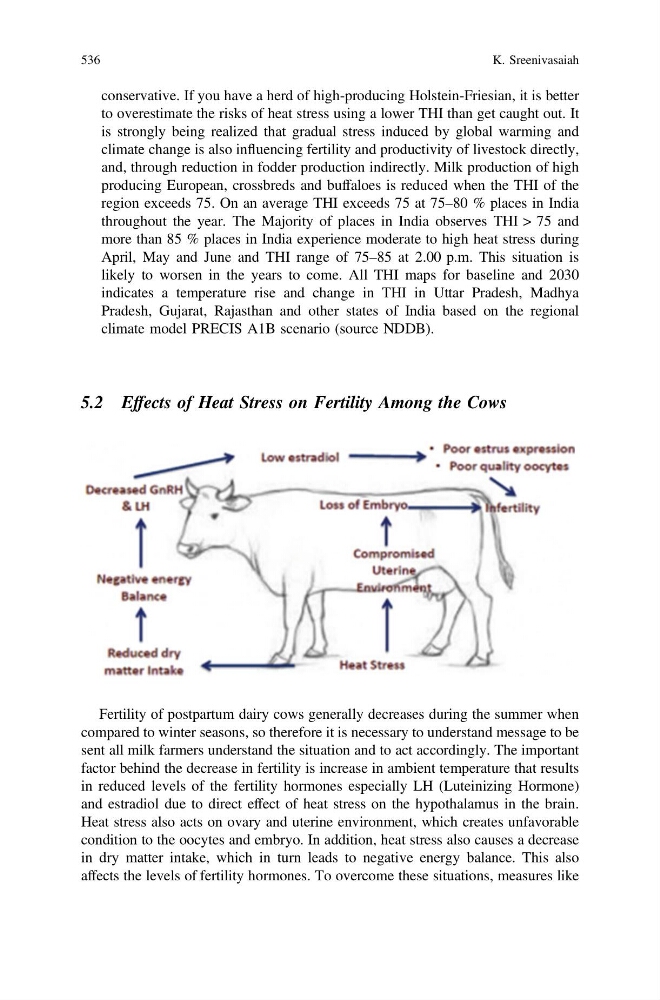
Fertility of postpartum dairy cows generally decreases during the summer when
compared to winter seasons, so therefore it is necessary to understand message to be
sent all milk farmers understand the situation and to act accordingly. The important
factor behind the decrease in fertility is increase in ambient temperature that results
in reduced levels of the fertility hormones especially LH (Luteinizing Hormone)
and estradiol due to direct effect of heat stress on the hypothalamus in the brain.
Heat stress also acts on ovary and uterine environment, which creates unfavorable
condition to the oocytes and embryo. In addition, heat stress also causes a decrease
in dry matter intake, which in turn leads to negative energy balance. This also
affects the levels of fertility hormones. To overcome these situations, measures like
536
K. Sreenivasaiah
to overestimate the risks of heat stress using a lower THI than get caught out. It
is strongly being realized that gradual stress induced by global warming and
climate change is also influencing fertility and productivity of livestock directly,
and, through reduction in fodder production indirectly. Milk production of high
producing European, crossbreds and buffaloes is reduced when the THI of the
region exceeds 75. On an average THI exceeds 75 at 75–80 % places in India
throughout the year. The Majority of places in India observes THI > 75 and
more than 85 % places in India experience moderate to high heat stress during
April, May and June and THI range of 75–85 at 2.00 p.m. This situation is
likely to worsen in the years to come. All THI maps for baseline and 2030
indicates a temperature rise and change in THI in Uttar Pradesh, Madhya
Pradesh, Gujarat, Rajasthan and other states of India based on the regional
climate model PRECIS A1B scenario (source NDDB).
5.2 Effects of Heat Stress on Fertility Among the Cows
Fertility of postpartum dairy cows generally decreases during the summer when
compared to winter seasons, so therefore it is necessary to understand message to be
sent all milk farmers understand the situation and to act accordingly. The important
factor behind the decrease in fertility is increase in ambient temperature that results
in reduced levels of the fertility hormones especially LH (Luteinizing Hormone)
and estradiol due to direct effect of heat stress on the hypothalamus in the brain.
Heat stress also acts on ovary and uterine environment, which creates unfavorable
condition to the oocytes and embryo. In addition, heat stress also causes a decrease
in dry matter intake, which in turn leads to negative energy balance. This also
affects the levels of fertility hormones. To overcome these situations, measures like
536
K. Sreenivasaiah