

The livestock industry is likely to be impacted greatly by the effects of climate
change. Some climate forecasters predict that will experience increasing average
temperatures and humidity in the future, and more hot spells. A ‘hot spell’ means
seven days or more consecutive days where temperatures are above 40 °C that will
impact on the negative on milk production.
Scientists use a kind of scale, called the temperature-humidity index (THI), to
measure heat stress on cattle, and this can also measure how productive the cattle
are. When cattle are under heat stress, farmers can expect their stock to have:
• Reduced grazing time (because the animals might be seeking shade).
• Reduced feed intake.
• Increase in body temperature.
• Increased sweating and panting.
• Weight loss.
5.1 Temperature Humidity Index (THI)
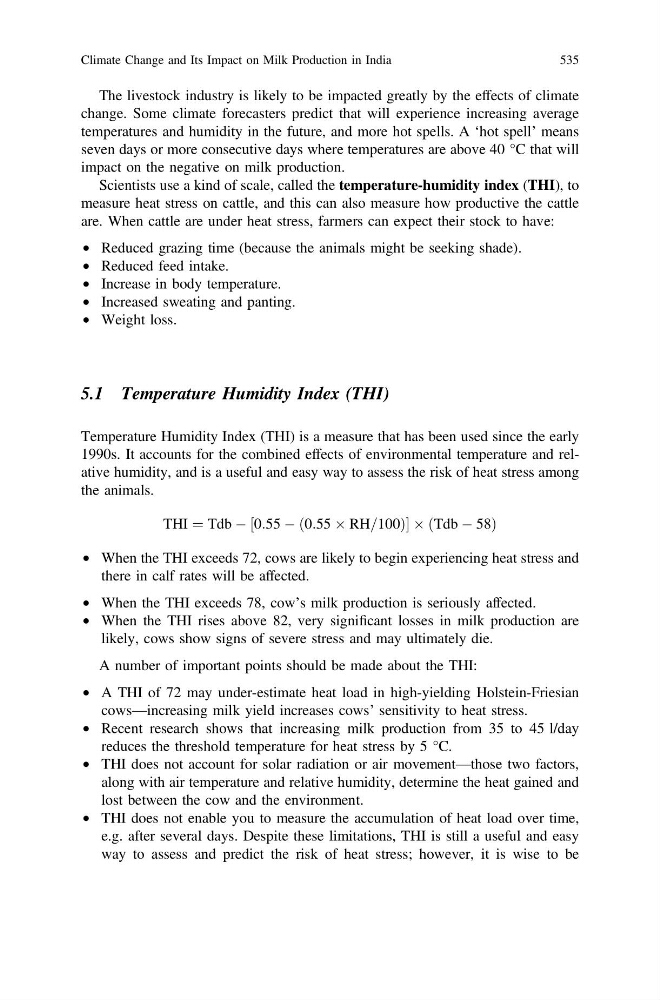
Temperature Humidity Index (THI) is a measure that has been used since the early
1990s. It accounts for the combined effects of environmental temperature and relative humidity, and is a useful and easy way to assess the risk of heat stress among
the animals.
THI ¼ Tdb À 0:55 À 0:55 Â RH=100
ð
Þ
½
 Tdb À 58
ð
Þ
• When the THI exceeds 72, cows are likely to begin experiencing heat stress and
there in calf rates will be affected.
• When the THI exceeds 78, cow’s milk production is seriously affected.
• When the THI rises above 82, very significant losses in milk production are
likely, cows show signs of severe stress and may ultimately die.
A number of important points should be made about the THI:
• A THI of 72 may under-estimate heat load in high-yielding Holstein-Friesian
cows—increasing milk yield increases cows’ sensitivity to heat stress.
• Recent research shows that increasing milk production from 35 to 45 l/day
reduces the threshold temperature for heat stress by 5 °C.
• THI does not account for solar radiation or air movement—those two factors,
along with air temperature and relative humidity, determine the heat gained and
lost between the cow and the environment.
• THI does not enable you to measure the accumulation of heat load over time,
e.g. after several days. Despite these limitations, THI is still a useful and easy
way to assess and predict the risk of heat stress; however, it is wise to be
Climate Change and Its Impact on Milk Production in India
535
change. Some climate forecasters predict that will experience increasing average
temperatures and humidity in the future, and more hot spells. A ‘hot spell’ means
seven days or more consecutive days where temperatures are above 40 °C that will
impact on the negative on milk production.
Scientists use a kind of scale, called the temperature-humidity index (THI), to
measure heat stress on cattle, and this can also measure how productive the cattle
are. When cattle are under heat stress, farmers can expect their stock to have:
• Reduced grazing time (because the animals might be seeking shade).
• Reduced feed intake.
• Increase in body temperature.
• Increased sweating and panting.
• Weight loss.
5.1 Temperature Humidity Index (THI)
Temperature Humidity Index (THI) is a measure that has been used since the early
1990s. It accounts for the combined effects of environmental temperature and relative humidity, and is a useful and easy way to assess the risk of heat stress among
the animals.
THI ¼ Tdb À 0:55 À 0:55 Â RH=100
ð
Þ
½
 Tdb À 58
ð
Þ
• When the THI exceeds 72, cows are likely to begin experiencing heat stress and
there in calf rates will be affected.
• When the THI exceeds 78, cow’s milk production is seriously affected.
• When the THI rises above 82, very significant losses in milk production are
likely, cows show signs of severe stress and may ultimately die.
A number of important points should be made about the THI:
• A THI of 72 may under-estimate heat load in high-yielding Holstein-Friesian
cows—increasing milk yield increases cows’ sensitivity to heat stress.
• Recent research shows that increasing milk production from 35 to 45 l/day
reduces the threshold temperature for heat stress by 5 °C.
• THI does not account for solar radiation or air movement—those two factors,
along with air temperature and relative humidity, determine the heat gained and
lost between the cow and the environment.
• THI does not enable you to measure the accumulation of heat load over time,
e.g. after several days. Despite these limitations, THI is still a useful and easy
way to assess and predict the risk of heat stress; however, it is wise to be
Climate Change and Its Impact on Milk Production in India
535