

radiation, air movement, and precipitation) cause the effective temperature of the
environment to be higher than the animal’s thermo-neutral zone (TNZ). Several
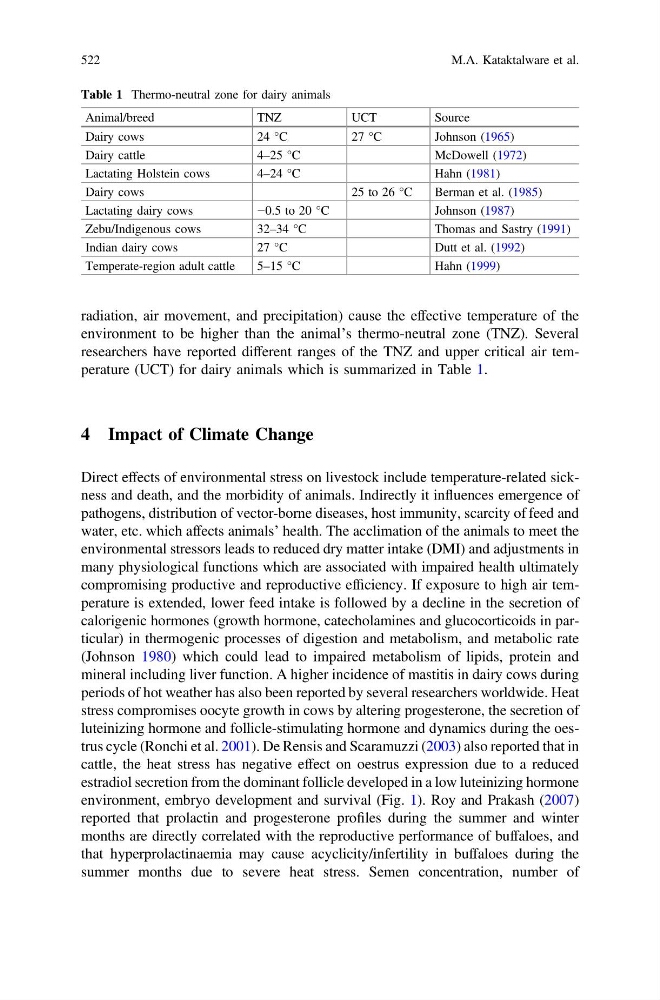
researchers have reported different ranges of the TNZ and upper critical air temperature (UCT) for dairy animals which is summarized in Table 1.
4 Impact of Climate Change
Direct effects of environmental stress on livestock include temperature-related sickness and death, and the morbidity of animals. Indirectly it influences emergence of
pathogens, distribution of vector-borne diseases, host immunity, scarcity of feed and
water, etc. which affects animals’ health. The acclimation of the animals to meet the
environmental stressors leads to reduced dry matter intake (DMI) and adjustments in
many physiological functions which are associated with impaired health ultimately
compromising productive and reproductive efficiency. If exposure to high air temperature is extended, lower feed intake is followed by a decline in the secretion of
calorigenic hormones (growth hormone, catecholamines and glucocorticoids in particular) in thermogenic processes of digestion and metabolism, and metabolic rate
(Johnson 1980) which could lead to impaired metabolism of lipids, protein and
mineral including liver function. A higher incidence of mastitis in dairy cows during
periods of hot weather has also been reported by several researchers worldwide. Heat
stress compromises oocyte growth in cows by altering progesterone, the secretion of
luteinizing hormone and follicle-stimulating hormone and dynamics during the oestrus cycle (Ronchi et al. 2001). De Rensis and Scaramuzzi (2003) also reported that in
cattle, the heat stress has negative effect on oestrus expression due to a reduced
estradiol secretion from the dominant follicle developed in a low luteinizing hormone
environment, embryo development and survival (Fig. 1). Roy and Prakash (2007)
reported that prolactin and progesterone profiles during the summer and winter
months are directly correlated with the reproductive performance of buffaloes, and
that hyperprolactinaemia may cause acyclicity/infertility in buffaloes during the
summer months due to severe heat stress. Semen concentration, number of
Table 1 Thermo-neutral zone for dairy animals
Animal/breed
TNZ
UCT
Source
Dairy cows
24 °C
27 °C
Johnson (1965)
Dairy cattle
4–25 °C
McDowell (1972)
Lactating Holstein cows
4–24 °C
Hahn (1981)
Dairy cows
25 to 26 °C
Berman et al. (1985)
Lactating dairy cows
−0.5 to 20 °C
Johnson (1987)
Zebu/Indigenous cows
32–34 °C
Thomas and Sastry (1991)
Indian dairy cows
27 °C
Dutt et al. (1992)
Temperate-region adult cattle
5–15 °C
Hahn (1999)
522
M.A. Kataktalware et al.
environment to be higher than the animal’s thermo-neutral zone (TNZ). Several
researchers have reported different ranges of the TNZ and upper critical air temperature (UCT) for dairy animals which is summarized in Table 1.
4 Impact of Climate Change
Direct effects of environmental stress on livestock include temperature-related sickness and death, and the morbidity of animals. Indirectly it influences emergence of
pathogens, distribution of vector-borne diseases, host immunity, scarcity of feed and
water, etc. which affects animals’ health. The acclimation of the animals to meet the
environmental stressors leads to reduced dry matter intake (DMI) and adjustments in
many physiological functions which are associated with impaired health ultimately
compromising productive and reproductive efficiency. If exposure to high air temperature is extended, lower feed intake is followed by a decline in the secretion of
calorigenic hormones (growth hormone, catecholamines and glucocorticoids in particular) in thermogenic processes of digestion and metabolism, and metabolic rate
(Johnson 1980) which could lead to impaired metabolism of lipids, protein and
mineral including liver function. A higher incidence of mastitis in dairy cows during
periods of hot weather has also been reported by several researchers worldwide. Heat
stress compromises oocyte growth in cows by altering progesterone, the secretion of
luteinizing hormone and follicle-stimulating hormone and dynamics during the oestrus cycle (Ronchi et al. 2001). De Rensis and Scaramuzzi (2003) also reported that in
cattle, the heat stress has negative effect on oestrus expression due to a reduced
estradiol secretion from the dominant follicle developed in a low luteinizing hormone
environment, embryo development and survival (Fig. 1). Roy and Prakash (2007)
reported that prolactin and progesterone profiles during the summer and winter
months are directly correlated with the reproductive performance of buffaloes, and
that hyperprolactinaemia may cause acyclicity/infertility in buffaloes during the
summer months due to severe heat stress. Semen concentration, number of
Table 1 Thermo-neutral zone for dairy animals
Animal/breed
TNZ
UCT
Source
Dairy cows
24 °C
27 °C
Johnson (1965)
Dairy cattle
4–25 °C
McDowell (1972)
Lactating Holstein cows
4–24 °C
Hahn (1981)
Dairy cows
25 to 26 °C
Berman et al. (1985)
Lactating dairy cows
−0.5 to 20 °C
Johnson (1987)
Zebu/Indigenous cows
32–34 °C
Thomas and Sastry (1991)
Indian dairy cows
27 °C
Dutt et al. (1992)
Temperate-region adult cattle
5–15 °C
Hahn (1999)
522
M.A. Kataktalware et al.