

Rice residue burning results in extensive impacts both on farms, e.g., losses in
soil nutrients, soil organic matter, production and productivity, air quality, biodiversity, and water and energy efficiency, and on human and animal health. In India,
air pollution from residue burning can be severe, with impacts on human health by
directly causing or exacerbating a range of health hazards and contributing to the
incidence of traumatic road accidents through significantly reduced visibility. One
of the recognized threats to the rice–wheat cropping system sustainability is the loss
of soil organic matter as a result of burning. The straw collected from the fields is of
great economic value as livestock feed, fuel, and industrial raw material. In
Northern India, wheat straw is preferred while in Southern India paddy straw is fed
to livestock (Hegde 2010). The residue generated from the rice–wheat cropping
system can be put to many uses, but this is possible if the residue is separated from
the grain and carried out of the field. Burning reduces the availability of straw to
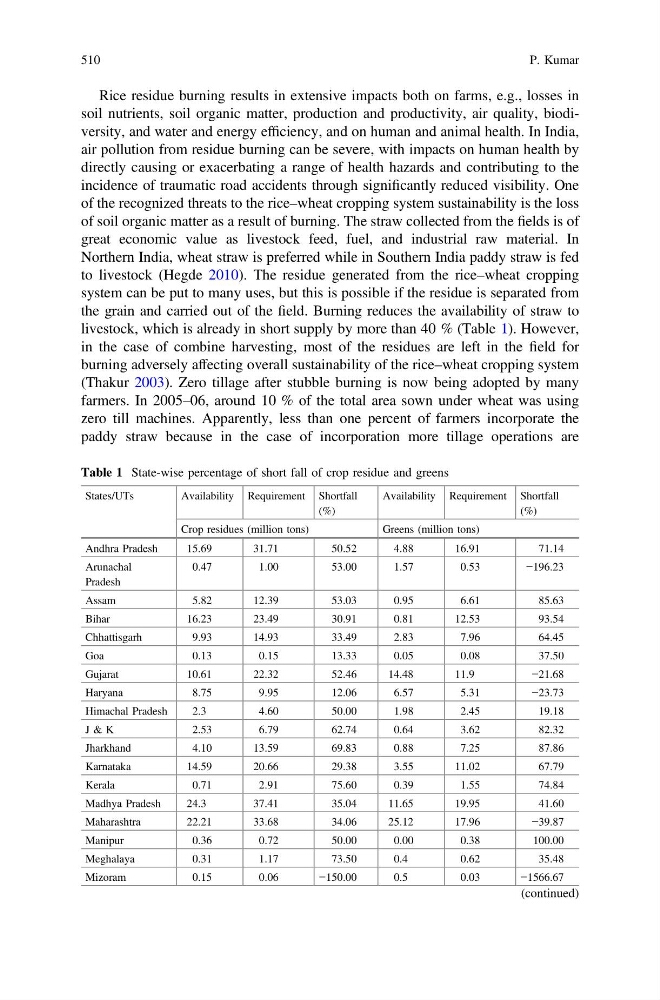
livestock, which is already in short supply by more than 40 % (Table 1). However,
in the case of combine harvesting, most of the residues are left in the field for
burning adversely affecting overall sustainability of the rice–wheat cropping system
(Thakur 2003). Zero tillage after stubble burning is now being adopted by many
farmers. In 2005–06, around 10 % of the total area sown under wheat was using
zero till machines. Apparently, less than one percent of farmers incorporate the
paddy straw because in the case of incorporation more tillage operations are
Table 1 State-wise percentage of short fall of crop residue and greens
States/UTs
Availability Requirement Shortfall
(%)
Availability Requirement Shortfall
(%)
Crop residues (million tons)
Greens (million tons)
Andhra Pradesh
15.69
31.71
50.52
4.88
16.91
71.14
Arunachal
Pradesh
0.47
1.00
53.00
1.57
0.53
−196.23
Assam
5.82
12.39
53.03
0.95
6.61
85.63
Bihar
16.23
23.49
30.91
0.81
12.53
93.54
Chhattisgarh
9.93
14.93
33.49
2.83
7.96
64.45
Goa
0.13
0.15
13.33
0.05
0.08
37.50
Gujarat
10.61
22.32
52.46
14.48
11.9
−21.68
Haryana
8.75
9.95
12.06
6.57
5.31
−23.73
Himachal Pradesh
2.3
4.60
50.00
1.98
2.45
19.18
J & K
2.53
6.79
62.74
0.64
3.62
82.32
Jharkhand
4.10
13.59
69.83
0.88
7.25
87.86
Karnataka
14.59
20.66
29.38
3.55
11.02
67.79
Kerala
0.71
2.91
75.60
0.39
1.55
74.84
Madhya Pradesh
24.3
37.41
35.04
11.65
19.95
41.60
Maharashtra
22.21
33.68
34.06
25.12
17.96
−39.87
Manipur
0.36
0.72
50.00
0.00
0.38
100.00
Meghalaya
0.31
1.17
73.50
0.4
0.62
35.48
Mizoram
0.15
0.06
−150.00
0.5
0.03
−1566.67
(continued)
510
P. Kumar
soil nutrients, soil organic matter, production and productivity, air quality, biodiversity, and water and energy efficiency, and on human and animal health. In India,
air pollution from residue burning can be severe, with impacts on human health by
directly causing or exacerbating a range of health hazards and contributing to the
incidence of traumatic road accidents through significantly reduced visibility. One
of the recognized threats to the rice–wheat cropping system sustainability is the loss
of soil organic matter as a result of burning. The straw collected from the fields is of
great economic value as livestock feed, fuel, and industrial raw material. In
Northern India, wheat straw is preferred while in Southern India paddy straw is fed
to livestock (Hegde 2010). The residue generated from the rice–wheat cropping
system can be put to many uses, but this is possible if the residue is separated from
the grain and carried out of the field. Burning reduces the availability of straw to
livestock, which is already in short supply by more than 40 % (Table 1). However,
in the case of combine harvesting, most of the residues are left in the field for
burning adversely affecting overall sustainability of the rice–wheat cropping system
(Thakur 2003). Zero tillage after stubble burning is now being adopted by many
farmers. In 2005–06, around 10 % of the total area sown under wheat was using
zero till machines. Apparently, less than one percent of farmers incorporate the
paddy straw because in the case of incorporation more tillage operations are
Table 1 State-wise percentage of short fall of crop residue and greens
States/UTs
Availability Requirement Shortfall
(%)
Availability Requirement Shortfall
(%)
Crop residues (million tons)
Greens (million tons)
Andhra Pradesh
15.69
31.71
50.52
4.88
16.91
71.14
Arunachal
Pradesh
0.47
1.00
53.00
1.57
0.53
−196.23
Assam
5.82
12.39
53.03
0.95
6.61
85.63
Bihar
16.23
23.49
30.91
0.81
12.53
93.54
Chhattisgarh
9.93
14.93
33.49
2.83
7.96
64.45
Goa
0.13
0.15
13.33
0.05
0.08
37.50
Gujarat
10.61
22.32
52.46
14.48
11.9
−21.68
Haryana
8.75
9.95
12.06
6.57
5.31
−23.73
Himachal Pradesh
2.3
4.60
50.00
1.98
2.45
19.18
J & K
2.53
6.79
62.74
0.64
3.62
82.32
Jharkhand
4.10
13.59
69.83
0.88
7.25
87.86
Karnataka
14.59
20.66
29.38
3.55
11.02
67.79
Kerala
0.71
2.91
75.60
0.39
1.55
74.84
Madhya Pradesh
24.3
37.41
35.04
11.65
19.95
41.60
Maharashtra
22.21
33.68
34.06
25.12
17.96
−39.87
Manipur
0.36
0.72
50.00
0.00
0.38
100.00
Meghalaya
0.31
1.17
73.50
0.4
0.62
35.48
Mizoram
0.15
0.06
−150.00
0.5
0.03
−1566.67
(continued)
510
P. Kumar