

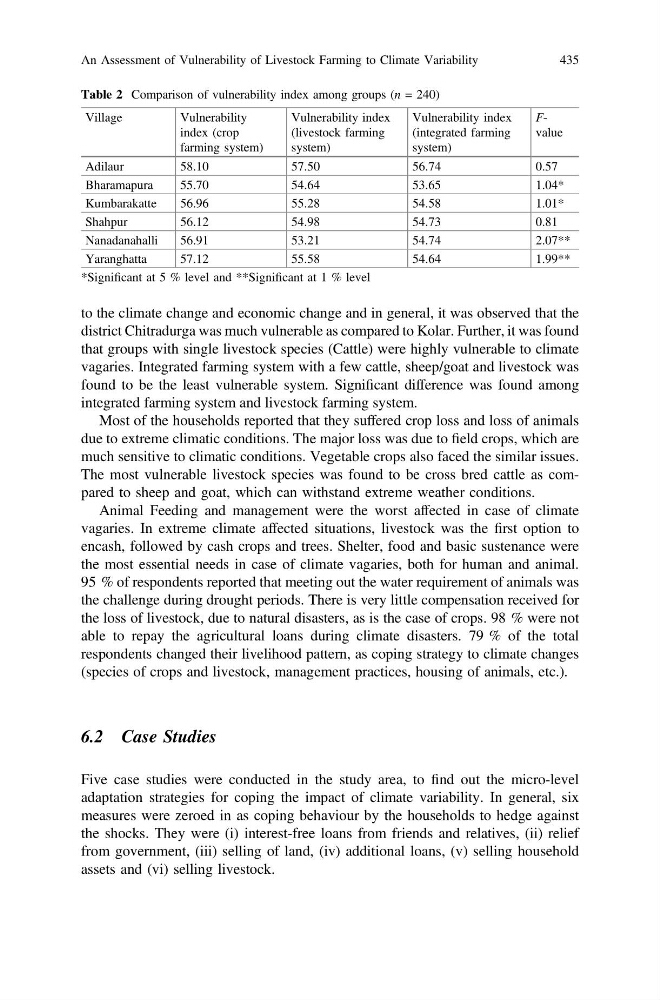
to the climate change and economic change and in general, it was observed that the
district Chitradurga was much vulnerable as compared to Kolar. Further, it was found
that groups with single livestock species (Cattle) were highly vulnerable to climate
vagaries. Integrated farming system with a few cattle, sheep/goat and livestock was
found to be the least vulnerable system. Significant difference was found among
integrated farming system and livestock farming system.
Most of the households reported that they suffered crop loss and loss of animals
due to extreme climatic conditions. The major loss was due to field crops, which are
much sensitive to climatic conditions. Vegetable crops also faced the similar issues.
The most vulnerable livestock species was found to be cross bred cattle as compared to sheep and goat, which can withstand extreme weather conditions.
Animal Feeding and management were the worst affected in case of climate
vagaries. In extreme climate affected situations, livestock was the first option to
encash, followed by cash crops and trees. Shelter, food and basic sustenance were
the most essential needs in case of climate vagaries, both for human and animal.
95 % of respondents reported that meeting out the water requirement of animals was
the challenge during drought periods. There is very little compensation received for
the loss of livestock, due to natural disasters, as is the case of crops. 98 % were not
able to repay the agricultural loans during climate disasters. 79 % of the total
respondents changed their livelihood pattern, as coping strategy to climate changes
(species of crops and livestock, management practices, housing of animals, etc.).
6.2 Case Studies
Five case studies were conducted in the study area, to find out the micro-level
adaptation strategies for coping the impact of climate variability. In general, six
measures were zeroed in as coping behaviour by the households to hedge against
the shocks. They were (i) interest-free loans from friends and relatives, (ii) relief
from government, (iii) selling of land, (iv) additional loans, (v) selling household
assets and (vi) selling livestock.
Table 2 Comparison of vulnerability index among groups (n = 240)
Village
Vulnerability
index (crop
farming system)
Vulnerability index
(livestock farming
system)
Vulnerability index
(integrated farming
system)
Fvalue
Adilaur
58.10
57.50
56.74
0.57
Bharamapura
55.70
54.64
53.65
1.04*
Kumbarakatte
56.96
55.28
54.58
1.01*
Shahpur
56.12
54.98
54.73
0.81
Nanadanahalli
56.91
53.21
54.74
2.07**
Yaranghatta
57.12
55.58
54.64
1.99**
*Significant at 5 % level and **Significant at 1 % level
An Assessment of Vulnerability of Livestock Farming to Climate Variability
435
district Chitradurga was much vulnerable as compared to Kolar. Further, it was found
that groups with single livestock species (Cattle) were highly vulnerable to climate
vagaries. Integrated farming system with a few cattle, sheep/goat and livestock was
found to be the least vulnerable system. Significant difference was found among
integrated farming system and livestock farming system.
Most of the households reported that they suffered crop loss and loss of animals
due to extreme climatic conditions. The major loss was due to field crops, which are
much sensitive to climatic conditions. Vegetable crops also faced the similar issues.
The most vulnerable livestock species was found to be cross bred cattle as compared to sheep and goat, which can withstand extreme weather conditions.
Animal Feeding and management were the worst affected in case of climate
vagaries. In extreme climate affected situations, livestock was the first option to
encash, followed by cash crops and trees. Shelter, food and basic sustenance were
the most essential needs in case of climate vagaries, both for human and animal.
95 % of respondents reported that meeting out the water requirement of animals was
the challenge during drought periods. There is very little compensation received for
the loss of livestock, due to natural disasters, as is the case of crops. 98 % were not
able to repay the agricultural loans during climate disasters. 79 % of the total
respondents changed their livelihood pattern, as coping strategy to climate changes
(species of crops and livestock, management practices, housing of animals, etc.).
6.2 Case Studies
Five case studies were conducted in the study area, to find out the micro-level
adaptation strategies for coping the impact of climate variability. In general, six
measures were zeroed in as coping behaviour by the households to hedge against
the shocks. They were (i) interest-free loans from friends and relatives, (ii) relief
from government, (iii) selling of land, (iv) additional loans, (v) selling household
assets and (vi) selling livestock.
Table 2 Comparison of vulnerability index among groups (n = 240)
Village
Vulnerability
index (crop
farming system)
Vulnerability index
(livestock farming
system)
Vulnerability index
(integrated farming
system)
Fvalue
Adilaur
58.10
57.50
56.74
0.57
Bharamapura
55.70
54.64
53.65
1.04*
Kumbarakatte
56.96
55.28
54.58
1.01*
Shahpur
56.12
54.98
54.73
0.81
Nanadanahalli
56.91
53.21
54.74
2.07**
Yaranghatta
57.12
55.58
54.64
1.99**
*Significant at 5 % level and **Significant at 1 % level
An Assessment of Vulnerability of Livestock Farming to Climate Variability
435