

5 Vulnerability Index
The unit scores of each respondent were multiplied by respective component scale
values and summed up. The scores thus obtained were divided by the total scale
value and multiplied by 100 to get the vulnerability index for each respondent.
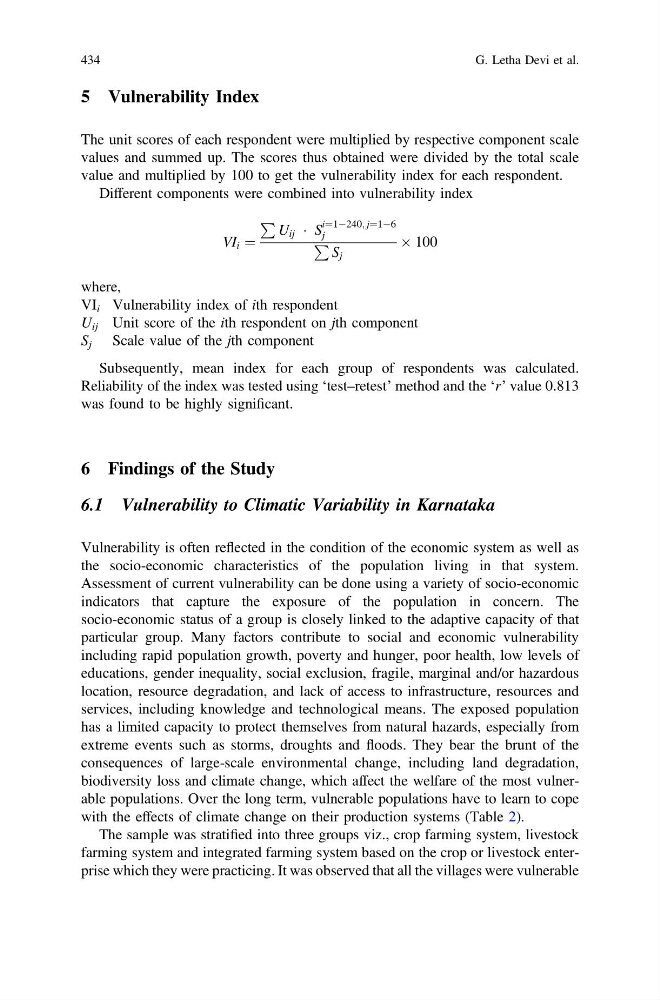
Different components were combined into vulnerability index
VI i ¼
P
U ij Á S
i¼1À240; j¼1À6
j
P
S j
 100
where,
VI i Vulnerability index of ith respondent
U ij Unit score of the ith respondent on jth component
S j Scale value of the jth component
Subsequently, mean index for each group of respondents was calculated.
Reliability of the index was tested using ‘test–retest’ method and the ‘r’ value 0.813
was found to be highly significant.
6 Findings of the Study
6.1 Vulnerability to Climatic Variability in Karnataka
Vulnerability is often reflected in the condition of the economic system as well as
the socio-economic characteristics of the population living in that system.
Assessment of current vulnerability can be done using a variety of socio-economic
indicators that capture the exposure of the population in concern. The
socio-economic status of a group is closely linked to the adaptive capacity of that
particular group. Many factors contribute to social and economic vulnerability
including rapid population growth, poverty and hunger, poor health, low levels of
educations, gender inequality, social exclusion, fragile, marginal and/or hazardous
location, resource degradation, and lack of access to infrastructure, resources and
services, including knowledge and technological means. The exposed population
has a limited capacity to protect themselves from natural hazards, especially from
extreme events such as storms, droughts and floods. They bear the brunt of the
consequences of large-scale environmental change, including land degradation,
biodiversity loss and climate change, which affect the welfare of the most vulnerable populations. Over the long term, vulnerable populations have to learn to cope
with the effects of climate change on their production systems (Table 2).
The sample was stratified into three groups viz., crop farming system, livestock
farming system and integrated farming system based on the crop or livestock enterprise which they were practicing. It was observed that all the villages were vulnerable
434
G. Letha Devi et al.
The unit scores of each respondent were multiplied by respective component scale
values and summed up. The scores thus obtained were divided by the total scale
value and multiplied by 100 to get the vulnerability index for each respondent.
Different components were combined into vulnerability index
VI i ¼
P
U ij Á S
i¼1À240; j¼1À6
j
P
S j
 100
where,
VI i Vulnerability index of ith respondent
U ij Unit score of the ith respondent on jth component
S j Scale value of the jth component
Subsequently, mean index for each group of respondents was calculated.
Reliability of the index was tested using ‘test–retest’ method and the ‘r’ value 0.813
was found to be highly significant.
6 Findings of the Study
6.1 Vulnerability to Climatic Variability in Karnataka
Vulnerability is often reflected in the condition of the economic system as well as
the socio-economic characteristics of the population living in that system.
Assessment of current vulnerability can be done using a variety of socio-economic
indicators that capture the exposure of the population in concern. The
socio-economic status of a group is closely linked to the adaptive capacity of that
particular group. Many factors contribute to social and economic vulnerability
including rapid population growth, poverty and hunger, poor health, low levels of
educations, gender inequality, social exclusion, fragile, marginal and/or hazardous
location, resource degradation, and lack of access to infrastructure, resources and
services, including knowledge and technological means. The exposed population
has a limited capacity to protect themselves from natural hazards, especially from
extreme events such as storms, droughts and floods. They bear the brunt of the
consequences of large-scale environmental change, including land degradation,
biodiversity loss and climate change, which affect the welfare of the most vulnerable populations. Over the long term, vulnerable populations have to learn to cope
with the effects of climate change on their production systems (Table 2).
The sample was stratified into three groups viz., crop farming system, livestock
farming system and integrated farming system based on the crop or livestock enterprise which they were practicing. It was observed that all the villages were vulnerable
434
G. Letha Devi et al.